“Fascism” and the Myth of a Good Capitalism

With the rise of contemporary authoritarian regimes (including those of Duterte, Bolsonaro, Orbán, and Erdoğan) in notional, or prior, ‘liberal democracies’ and especially with the revival of Trump in the US, the term ‘Fascist’ has become a popular and widely applied descriptive term – a quick means of summing up both recent changes and the possible dangers that lie ahead. Of course, like any term, it can suffer from ‘Crying Wolf’ syndrome if it is applied too easily and widely. Indeed, it is known that far-right ‘Libertarians’ can call their more socially-conservative brethren ‘Fascists’, due to differing stances on state-church ‘authorities’ and their political usage. Criticising use of the term ‘Fascist’, however, should not forget that there are connections between a phenomena like the 2nd Trump ‘administration’ and Nazi Germany (and other ‘totalitarian’ states), such as the scapegoating of minority populations, attempts at (and actualised) mass deportations, and a clawing culture of fellow-travelling loyalty to a false-god patriotism. Yet, my criticism here is aimed at the distractive use of “Fascism” in deflecting attention away from the bubbling-stream source of such turns towards reactionary politics, namely, capitalist crises (both with small ‘c’), and the underlying desire for a reconstruction of not just ‘authority’ but, more importantly, profitability.

That recent changes are to be summed up and identified as ‘Fascist’ overlooks two key facts: (1) that there is no form of ‘good’ capitalism against which to contrast the “Fascist” (the latter was/is a product of the former: it’s off-spring); and (2) that Fascism (now in ‘bold’ type) was a specific historic social movement which arose in a pre-Keynesian (so pre-‘planner state’) era, where Fascism represented one ‘possible’ alternate means of capitalism’s ‘evolution’ out of crisis at a specific moment in time (1920s-40s). Furthermore, it competed with Stalinism, Keynesianism, and Japanese Imperialism (all different responses to a global crisis in ‘world markets’, i.e., capital accumulation); only two of which managed to ‘survive’ the war.

Social historian Ellen Meiksins Wood (2002), in The Origin of Capitalism: A Longer View, described the French Ancien Regime as a social form (mode of production) which withered on the tree of life – it literally had its head cut-off by the French Revolution. Nevertheless, in 19th century France there were several attempts at a monarchial revival, and there were certainly members of the French nobility knocking about Europe (never mind France) providing mimetic vocabulary to garnish constitutional debates with their liberal adversaries. Though such nobles did traverse the world with bankers’ drafts in their pocket – not the quick rents nor corvee (labour taxes) of Ancien Regime peasants, ‘incomes’ which were abolished with their ancestors’ ‘offices’ in 1793 (the political positions that had enabled a historically and geographically peculiar form of extra-economic domination). While the idea of aristocratic rule then ‘echoed’ down the decades, the generator of this increasingly-distant sound wave had disappeared in any physical/practical sense.

Hence, today we may have the silhouette of what a reactionary politics coping (or not coping) with a crisis in capitalism accumulation looks like, but in drawing attention to the silhouette do we run the risk ignoring its source: the fire and the people making shadows?

When is a capitalist a “Fascist”?

Let me now turn to matters much more mundane. On Monday 15th September 2025, I spotted an investigative report by the BBC World Service entitled “Ex-London bus driver runs degrading sex-trade ring in Dubai’s glamorous neighbourhoods”. Mr Charles Mweisgwa claimed he “could provide women for a sex party at a starting price of $1,000 (£740), adding that many can do ‘pretty much everything’ clients want them to”. According to women involved, one client “regularly asks to defecate on the women”. The women come from poor countries, notably, rural areas of Uganda; so are being exploited due to their lack of jobs and their desperation to earn a living, to survive. They are drawn to Dubai on promises of obtaining work in “supermarkets or hotels”, and face violence if they want to go back home when the promise (expectation) of normal work is not fulfilled. Reporters were also informed by the women “that clients were mostly white Europeans, and included men with extreme fetishes” – which, of course, can only be fulfilled through cold, hard financial transaction.

Of course, Mr Mweisgwa denies the allegations that he’s a pimp who abuses visa ‘rights’ and uses violence. He merely “helps women find accommodation through landlords, and that women follow him to parties because of his wealthy Dubai contacts”. Thus, it’s the women’s free-willed desire for and chase after money that leads them into such situations – everyone wants a piece of action in Dubai! And Mr Mweisgwa doesn’t appear to be a Fascist, even though he facilitates arrangements which are clearly racist. As one witness noted: [The white clients] “want somebody who is going to cry and scream and run. And that somebody [in their eyes] should be a black person”. But if they turn to the police, they are told: “You Africans cause problems for each other. We don’t want to get involved”.

Indeed, Mr Mweisgwa is a worker (a former wage slave) ‘made good’. From starting out as a bus driver in London, he now appears to be ‘living the dream’ in a posh part of Dubai. He doesn’t seem to be bothered by either racism (he is Black living alongside Dubai’s police, who wouldn’t care about offering him protection) nor nationalism (after all, his business is international and multi-national, offering Europeans the services of Africans in a Western Asian/Arab setting). As far as the Dubai authorities are concerned, nothing illegal is taking place, as it’s just Africans hurting each other. Tightened rules on immigration would harm his profitability. Mr Mweisgwa has moved from being one of life’s exploited to being one its successful exploiters. He’s now making more money than he did before, when he was an ‘honest’ bus driver. That’s business. That’s good business. This is the outcome of societal values instilled within Mr Mweisgwa. Once he ‘makes’ enough money the red carpet will be rolled out for him. Dirty money will be cleaned; it will go on to be invested in all sorts of ‘wholesome’ essential businesses (from tyre manufacturing to artificial intelligence and fast-food outlets). After this point, all taxes will be paid, and respect ‘earned’. There is nothing unusual here, as this is everyday capitalism.

Holding on to Capitalism without “Fascism”

Can we imagine Mr Mweisgwa’s ‘enterprise’ operating under the keen eye of ‘inspector capitalism’, that is, the left-leaning social marketeers of socialist heritage who, apparently, want to regulate their nation’s workplaces into conditions of ‘social justice’? The BBC are bringing our attention to this specific case because of its extremities. But it is not just because someone defecating on another (abused) person will gain readers and ‘clicks’ (an instrumental requirement of the media industry, for it to make money or at least justify journalists’ existence). Rather, Mr Mweisgwa’s enterprise does not meet the ‘ideal’ (utopian) standards of how capitalism should operate, as set down by large multi-national corporations such as McDonalds, Walmart, Elbit Systems, Coca Cola, Astra Zeneca, Pfizer, Lush, Ben & Gerry’s, Shell, Mobile, Starbucks, etc. The BBC are reminding us that this is not the way in which things ‘should be’ organised under capitalism – the ‘good’ capitalism that everybody loves and is ‘in favour’ of as “the worst system available, except for all the others” (Churchill).

But the ‘good’ capitalism is mythical as it always relies on memory loss. It’s a product of dementia, literally, being driven demented. Money ‘earned’ during the slave era was reinvested, reinvested and reinvested. But more importantly, as Bonefeld (2023) puts it, today’s workers are employed with money stolen from the very same workers the day before. The system is continuous, with no ‘break’ between the bad and the good days.

Yes, people are suffering under the new “Fascist” Trumpian regime; but people also suffered under Obama, who increased the number of drone strikes in Afghanistan and Iraq on his predecessor, George W Bush, who launched an illegal war leading to the deaths of 1.6 million people. Prior to this Bill Clinton bombed Iraq several times. All of them supported Israel and its use of ‘administrative detention’, based on a law introduced by the British in the 1920s. All of these, along with Western European ‘democracies’, saw regimes such as the Dubai, Qatari, Bahraini, and Saudi ‘monarchies’ as allies (who regularly used torture). Meanwhile, take up a ‘counter-hegemonic’ stand with Second and Third World ‘nations’ and governments isn’t going to help in the classification of Trump as ‘weirdly’ out of sync with what has gone before: Putin, Xi, the Kims, Modi, the Egyptian-Pakistani-Brazilian-Greek-Turkish-Argentine military ‘juntas’, then there are the Black Nationalist ‘socialists’ of East Africa, the Apartheid of South Africa. Can or should we redefine ‘Fascism’ as when suffering ‘comes home’?

My point, to be clear, is not that type of ‘regime’ does not make a difference to ordinary peoples lives, and especially to some people (the lucky ones). Of course regime change can make a difference. But calling Trump a “Fascist” simply takes away from the fact he is a “Capitalist”. And he is the latter first and foremost! Trump has always been motivated by money and capital accumulation; as have his entourage. They are all motivated just like Mr Mweisgwa. Trump’s policies, which he himself has given no overall ‘ideological’ shape to (we see this in his erratic swings and shifts), are an experimental, hotch-potch attempt (similar to Thacther’s) to reconstruct ‘capital’, by which I mean the relationship of labour to capital, between workers and money. The days of seeing the ‘capitalist’ as a top-hat wearing Mr Scrooge are long gone – such people never controlled, individually, the dispossession of indigenous communities, enclosure of land, the enforcement of private property ‘entitlements’ (‘rights’), the privation and starvation of needless / ‘useless’ mouths, programmed reductions in the cost of living (e.g., the reproduction of workers through cheap, subsidised housing), nor the ‘required’ education (indoctrination) of workers and the wider population. It is the (capitalist) State that has always been tasked with ensuring the population of its territorial area (domain) becomes and remains compliant with the core, self-evident truth of modern (bourgeois) society, namely, the successful accumulation of capital: that (as Mr Mweisgwa discovered) money can somehow, magically, become more money. Grabbing the state’s levers hasn’t just been a tactic of Fascists – its been done by Leninists, Conservatives and Social Democrats – but the results have always been some form of reconstruction of ‘capital’, and never the State’s own “withering away”.

So, is Trump a “Fascist”? Well, let’s say he is. The question becomes ‘so what?’ He’s a capitalist, and it is the ‘idea’ (notion) that there can be some form of better or ‘good’ capitalism (a utopia of cold monetary relations) that needs to be questioned!

References:

Bonefeld, W. (2023) A Critical Theory of Economic Compulsion: Wealth, Suffering, Negation London: Routledge.

Wood. E. M. (2002) The Origin of Capitalism: A Longer View London: Verso.

History produces nothing but Barbarism

In a recent video interview for publisher Unherd, Yanis Varoufakis asked the question: “Why is the Left the loser of history?’ He went on to argue that the Left failed to “take its opportunity” in the wake of the crisis of capitalism in 2008. Consequently, the ground remained wide-open, only to be filled by the politics of the Far Right.

Of course, since the Left failed in its historic duty to take up the reigns of ‘power’, it has the unenviable position of remaining religiously pure and untainted as the rightful and righteous outcome of ‘history’. It can live for another day, though such a position leads to the inevitable question, given there are ‘right’ and ‘wrong’ sides of history, of ‘why, so far, has the Right always ended up as the victor of history?’

There is a deeper question here: ‘What is history?’

To ‘Left revolutionaries’, Rosa Luxembourg is famous for stating that ‘the’ class struggle will end in either “Socialism or Barbarism”. The openness of the ‘choice’ with which she confronted her comrades indicates Luxembourg did not see ‘socialism’ as an automatic outcome of the ‘historical process’. But her statement does leave two interpretations: (1) that ‘socialism’ is one possible outcome of ‘the historical process’ (for Varoufakis, socialism can be ‘the victor’), and, alternately, (2) that human action – struggle – is the means by which to avoid the inevitable barbarism that ‘the historical process’ will produce (so, ‘socialism’ can never be ‘the victor’ of a socio-historical process humanity must struggle against).

Following the latter interpretation, a key question is ‘what form should the required struggle take?’ Well, aiming to take up the reigns of political ‘power’ (electoral politics; state capture, Social Democracy, Democratic Socialism, Bolshevism, Leninism, Trotskyism, Maoism, Black Power, and Matriarchy) has been tried on numerous occasions. Luxembourg was murdered in 1919, so didn’t live to see the historical outcome of ‘actually existing socialism’.

That is, Varoufakis, no matter how he, himself, sees the world, or understands contemporary ‘history’, needs to deal with the fact that for many people, in certain places and times, socialism has been ‘the victor of history’ and has done nothing but produce barbarism. When socialism has been ‘the victor of history’ then, to change Luxembourg’s quotation: Socialism becomes Barbarism! To the ‘victors’ the spoils.

What has Varoufakis missed?

Varoufakis clearly understands ‘socialism’ to be part and parcel of the historical process – it is a component of the current system which can ‘guide’ history towards a positive outcome. This ‘positivity’ is a theoretical descendant of early utopian socialists (heavily criticised by Marx) such as John Bray and Proudhon – who believed in nationalised banks and ‘fair’ labour exchanges on the basis (as Bonefeld, 2023 puts it) that they could get rid of ‘the capitalist’ but keep ‘capital’ (i.e., the waged labour relationship or social form).

Incidentally, I find Varoufakis’ coining of the ‘concept’ technofeudalism very confusing – a jumble of definitions and meanings. By ‘feudalism’ he appears to serfdom (in a similar way as Hayek referred to ‘The Road to Serfdom’). But this forgets that the tech-bros’ goal is to produce ‘surplus value’ and NOT garner tribune (rents/taxes) under a system of ‘extra-economic’ devine-rights (imposed by ‘direct’ violence). In short, Greece had a Finance Minister who never really understood ‘capitalism’ (conceptually nor practically).

I surmise that Varoufakis has never read the Frankfurt School Critical Theorists (Benjamin, Horkheimer, Adorno), or, if he has, he hasn’t understood them. Benjamin’s Theses on the Philosophy of History reminds us that the point of history is to break with it, not “swim” with its tide. Rather, the struggle is to bring the historical process to a ‘stop’ (to serve the needs of the present) and not drive history to its ‘completion’ (towards some Messianic ‘vision’). Adorno brilliantly sums the same point up: “There is a history which leads from the slingshot to the atom bomb, but not one that goes from barbarism to humanity”.

History is on the wrong side of class struggle – it is a process which runs against the presently-existing needs of humanity. Rather, history (the perpetuation of tradition) is an accumulating “nightmare” which weighs heavily on the “brains of the living” (Marx from 18th Brumaire), compelling them forward on grounds of ‘lack of alternative’. The struggle is to wake up and leave the nightmare; not stay in it to find out who will be ‘victors’. If we stay in it (do not wake up) and keep ‘falling’, then the urban myth tells us there will be just one outcome: Thump!

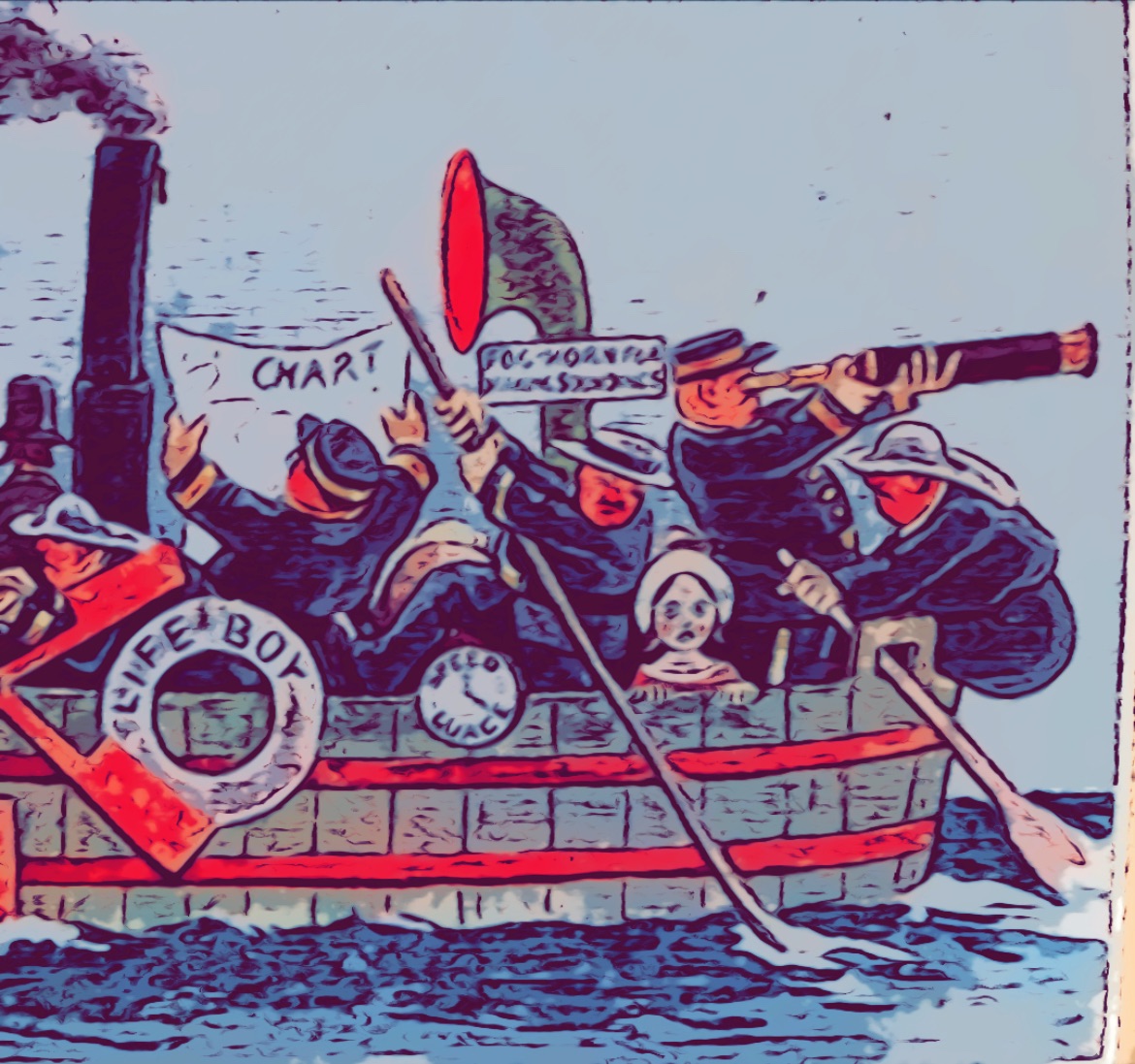
Notes: The featured image is from a photo of holiday postcards I took in a museum – I’ve entitled it ‘History Sails Forward’. It’s an image captured from ‘the past’, held within a time-capsule.

References:

Bonefeld, W. (2023) A Critical Theory of Economic Compulsion: Wealth, Suffering, Negation London: Routledge.

Marx’s Anarchism and the Politics of Capitalism

On the relevance of Marx in times of ‘Zombie Capitalism?’

Studying an author hermeneutically refers to understanding a writer by standing in their shoes and seeing the world from their perspective.  Studying political writings in such a manner was advanced in the mid-20th century by scholars like those in the ‘Cambridge School’ of history of political thought.  

When Karl Marx was writing Capital, in mid 19th century, the term ‘left’ (on the political spectrum) meant being ‘radical’ whilst ‘right’ referred to being ‘conservative’.  The designations (literally positions or ’wings’) were taken from the post-revolutionary Constituent Assembly of France, with the colours derived from the Republican tricolour flag. 

However, by the mid 20th century, during the post-war consensus, ‘the left’ was associated with support for state control of the economy and government social intervention whilst ‘the right’ had come to be associated with anti-state individualism and ‘liberalism’ (or Hayekian ‘market non-interventionism’).  By the 1970s and ‘80s a new breed of ‘post-consensus’ right-wing politicians emerged who were deemed (in many respects correctly) ‘radical’.

Reagan and Thatcher were the most prominent ’radicals’ to have ideologies named after them (Reaganism and Thatcherism).  Such radical right-wingers wanted to tear down what they saw as a ’statist’ establishment which, of course, many left-wingers wanted to ‘conserve’.  The switch in meanings of left and right was completed in the form of conservative left-wingers (whether Bolsheviks, Maoists, Post-colonialists, Keynesians, Swedish Social Democrats, British reformers, or any other version of left ’state power’ grabbers who felt they had something to preserve, a status quo).

This kind of ‘conservative’ left statism was not unknown to Marx.  Marx’s awareness can be detected in his many critiques of ‘utopian’ socialists during his lifetime, from Robert Owen to his Critique of the Gotha Programme (of the German Social Democratic Party, SPD). But Marx describes workers taking control of (rather than power over) society on very few occasions, with his most prominent account featured in news articles published (later) by Engels as The Civil Wars in France (1871).

This was Marx’s account of the rise and fall of the Paris Commune (1870).  Importantly, what he describes in these articles is a delegate-based anti-statist workers’ council or commune system (the word ‘commune’ meaning grassroots council).  ’Councils’ were both local (geographically-centred – the rural village) and vocational (workplace or activity centred – e.g., a weavers’ collective) to ensure different elements of society were heard, but significantly that no-one living off the private expropriation of production (performed by others) would be (easily) heard.  This was a reversal of the prior situation where a separate class of politicians (who expropriated or represented expropriators, and even proprietors of private ‘labour power’) formed the state and government. 

Furthermore, when Marx was asked if the ‘stage’ between pre-capitalist and communist societies could be by-passed or skipped, he eventually nodded to a positive answer regarding the development of existing Russian ‘communes’ (in a letter to a Narodniki).  To be clear, I consider him hinting that ‘industrialisation’ and ‘urbanisation’ were not prerequisites to the fulfilment of some objectified ’inevitable’ historical progression working ‘at the backs of people’ towards ‘socialism’ and then ‘communism’ in a compulsory stadial trajectory.

As ‘communes’ already existed in Russia they could form the basis of an emancipated society, without a deranged detour through ‘capitalism’!  However, Marx still thought that the experience of capitalism would be more likely to produce a social revolution, given the nascent conservatism of the rural commune – put another way, more advanced industrial countries should see a revolution first given the (contradictory) life conditions they generate.  Also, given capitalism’s existence (historical arrival, even by accident) hopes of a direct transition from peasant communes were, simply, after the fact even in the mid-Victorian era.  The social form that gave rise to such hopes (the peasant village eulogised by the Narodniki) was already disappearing, specifically in the advanced and developing industrial nations who had the power to colonise and suppress every other type of social form or mode of production

Nevertheless, and this is a salient point, I would argue that for most (if not all) of his political life Marx was what would be known, in both 19th and 20th centuries, as an ‘anarchist’!  The point of the Paris Commune’s mandatory delegation system was to ensure there would be no separation between a (professional) political class and the rest of the population.  Thus, parliamentary ‘representation’ with its political leadership (elites or vanguards) was simply not good enough since it would reproduce one of the fundamental social / political divisions which Marx wished to see the back of.

Indeed, one way of outlining how Marx understood the ‘politics’ of capitalism, compared to feudalist and ancient slave modes of production, was that capitalism makes what was obvious in the others (direct political domination) an inconspicuous, or ‘hidden’, process (via indirect economic domination under the ‘guise’ of ‘fair’ trade – see Ellen Meiskins Wood, 2002).

But how did the previously noted transition in meaning, from the 19th century radical left / conservative right to the 20th century conservative left / radical right, take place?  The answer, not surprisingly, was via successful social revolution in the early 20th century!  The conceptual and analytical problem here is that all too often activists (those present at the time) and commentators (contemporary or later) have focused attention on the ‘trees’ whilst failing to see the ’wood’!  Hence, we end up with histories and analyses of ‘The Russian Revolution’ (1917), ‘The German Revolution’ (1918-19), ‘The Hungarian Revolution’ (1919-20), but don’t hear much about ‘The Irish Revolution’ (1916), the Syrian democratic constitution (1919-20), ‘The Finnish Revolution’ (1917-22) nor ‘The British Revolution’ (1918-22).  Generally, a global move towards universal suffrage, imposed from below as part of a working class revolution in political practice (namely, direct democracy), gets overlooked. 

The dominant analytical time frames and intellectual interests tend to be centred on what can be described as moments of coup d’etat (significant but fleeting changes within forms of political ‘representation’) which merely punctuated much broader social changes.  With the latter including changes in working practices, shifts in artistic practices and possibilities in communication, but also developments in social roles and recognition – the rise of married women in the workplace, the emergence of state welfare recipients (like working-class ‘pensioners’ in Britain), the emergence of ‘childhood’, and the extended legal reach of the state (such as compulsory purchase of land, military conscription, and nationalisation of banking). 

One way of taking a wider survey of the workers’ revolution is to frame it in terms of all those socio-politico-economic changes taking place between the start of the Great War (1914) and a final capitulation of ‘traditional’ (pre-fiat money) capitalism in the Wall Street Crash (1929); a fifteen year period after which things can never go back to the way they were before though the desire to do so (right-wing radicalism) continues to be felt as an echo – the march of the Zombies.

Whether we understand ‘the revolution’ as having succeeded (the eventual emergence of the Soviet Union as a ‘workers’ state’) or failed (the crushing of the German Revolution by the freikorp in 1919), by the early 1930s states (and/or public, centralised institutions associated with them, such as central banks) are everywhere taking the lead role in forming (and/or reforming) the most advanced ’capitalist?’ economies.  From here on, I place a question mark on ‘capitalism?’ to indicate the far-away hills distance of the classic liberal model or mode.  Both the ideology and practice of classical ‘liberal’ political-economy was ’dead’ but also ‘alive’ as a zombie.

Whereas before 1914 capitalist enterprises mostly got on with the job of reproducing, disciplining, exploiting workers in an autonomous manner (with little to no state intervention), by the early 1930s the state becomes, increasingly, an integral part of the social process, including the production of surplus value (profit) via a national organisation of surplus labour time (e.g. how to manage unemployment).  States did take different forms, such as ’total‘ states (a singularity, as in the Soviet Union and Nazi Germany) compared to ‘hegemonic’ ones (pluralities dominated by mass cultures and technocratic control), but the main task of all states / governments was to reproduce (provide subsistence to), discipline, and (successfully) exploit workers directly as the key means of sustaining the wage-labour mode of production. The purpose of the modern nation-state, after all, is to ensure the compliance of the population (whether worker, manager, capitalist, or politburo member) under its territorial control with the accumulation of capital.

By exploitation, of course, I include the ideological elements of emotional exploitation (something Gramsci picked up on as hegemonic cultural domination): “Heave away lads, put your backs into it, for the benefit and sake of the nation!”  A new ‘social contract’ between political elite (the state) and the people (workers) was being founded, and in many experimental forms – Soviet Communism, Italian Fascism, Japanese Imperialism, Irish and Finnish nationalism, German Nazism, the American New Deal, Jewish Zionism, and ‘Greater’ Britishness (re-modelling the Empire as ‘Commonwealth’).  The last of these was even mooted, at one point, as a new country, called Greater Britain.

Some of these were ethno-nationalist (Nazism / Zionism) whilst others were pan- or trans-nationalist (the Soviet federation and British unionism), but almost all (excepting the smaller nations) led to expansionism (ultimately, war).  In contrast with the era of joint-stock ‘liberalism’, state-control of economic and social life was now in the driving seat.  Many of these subsequently failed (losers to others in war) and the leading ideologies emerged as those of (Western) ‘Keynesianism’ and (Eastern) ‘Communism’, with a common connection in ‘state-led’ social formation.  It is not inaccurate to describe the outcome as socialism, with socialism as the natural religion (‘binding’) of capitalist alienation.

In this sense, ‘a’ social revolution did take place in the early 20th century, but one with a compromised, synthetic outcome.  In Gunn and Wilding’s (2022) Hegelian terms: mis-recognition pertained.  Workers gaining universal suffrage in Britain was ‘a revolution’, but one that is almost always overlooked!  Sometimes the achievement of suffrage is deemed a mere ‘concession’ by a ruling class determined to retain their power through more subtle methods (the hegemonic control of education and broadcast media, as pinpointed by Gramsci’s early analysis of Italian Fascism).  But to rob the period and Gramsci of their ‘openness’ produces an historiography which makes the ruling class ‘oh-so clever’, as if it was their ‘Revolution’. 

More tellingly, the same social revolution produced a crisis in surplus value production (and the rate at which accumulation could proceed) – the Wall Street Crash both questioned the emerging fascist conceptions of a ‘New Man’ (much admired by elite figures such as the British Royals: Edward Prince of Wales and Albert Duke of York) whilst also hastening change.  As Thomas Piketty’s (2018) empirical data has demonstrated, before 1914 capital accumulation grew at a rate faster than wage growth, but throughout the mid-20th century the reverse was true (wages grew faster than profits).  ‘Capitalism?’ had been saved by socialist collectivism (the amalgamation of multiple capitals into a singularity), but at massive economic and social (status) cost to the conventional ruling class and its practices.  Workers, in their role as waged workers (subjects central to the accumulation system), had imposed their interests and gained decision-making power within the capitalist state mechanism, even if their so-called ‘class consciousness’ remained ‘corrupted’.

In his overview of Keynes’ theoretical work, and reformation of capitalist strategy, Negri, in Revolution Retrieved (1988), coins the term positive Keynesianism to refer to the immediate post-war period (1945-1973) when state welfare benefits and full employment policies were used to encourage and entice employees to work hard and raise their productivity.  This ever-rising productivity was central to the strategy and was baked-in to a social necessity for endless economic growth and, so long as the economy could be grown at a sufficient rate, the fact wage earners (as property owners) were making distributional ground on recipients of profits, rents and taxes was an acceptable trade-off, especially as any class relying on unearned income was on the back foot.  But with ‘stagnation’ in the 1970s the situation grew desperate for profiteers, rentiers and public servants (tax-takers) meaning something needed to be done – the rise of the right-wing radical was witnessed just as open ‘class conflict’ surfaced or re-emerged.

This conflict produced a shift in the social contract, but not one from Keynesianism back to Liberalism, despite the hopes of the radical right-wing ideology known as ‘Neoliberalism’.  Rather, Negri describes the shift as one towards negative Keynesianism.  That is, rather than the state taking a reduced and fading (or to use Marx’s phrase, vanishing) role in ‘the economy’, which is what Neoliberals like Thatcher may have ‘thought’ was going to happen (or wished would happen in a return to the ‘classic’ era), negative Keynesianism maintained levels of state intervention in social life (and its prominence in guaranteeing the reproduction, discipline, and exploitation of the working class).

Instead of positive encouragements (material benefits; socialised myths of ‘we are all in it together’), negative Keynesianism ‘liberated’ the representatives of monied-capital only by ‘oppressing’ worker dissent to capital’s imposition that people remain ’waged labour’.  Militarisation of society (higher prison populations; investment in security, securitisation, and surveillance), the piling on of indebtedness (for housing, education, and health), and creeping isolation (social individualisation and insulation: gated communities; financial ‘independence’) were the negative Keynesian modes of operation.

So, what is the importance of the above analysis of social change over the last 100 years with regards to studying Marx’s Capital?  On the one hand, when we read Marx via his original writings his anti-statist (radical) position must be kept in mind – his anarchism means he was against political systems containing social divisions between rulers and ruled.  He would have been appalled by the ‘Soviet’ regime produced not just by ‘Stalin’ (that is too easy a cop-out) but Bolshevism from its inception (in 1892). Marx would have recognised the ‘council communist’ and even ’liberal democratic’ revolution that occurred in Russia in Feb (or March) 1917 as progressive whilst reserving criticism for remnants of expropriator influence and power. 

Whilst Bolshevism did get a ‘populist’ upper-hand on (the more ‘reformist’) Menshivist movement (largely related to ending the war immediately), leading to the ‘October Revolution’ (a coup d’etat), the dismantling of the Soviet (‘council’) system and democratic ‘reforms’ happened very quickly under Lenin’s centralisation of political institutions.  The democratic arrangements of Feb-Oct 1917 may not have led to a ‘non-statist’ system, as Marx would have desired, but they could have produced a different outcome for both Russia and Germany in the 1920s (Luxembourg did not feel the time was right for the kind of ‘coup’ attempted by workers in Germany).  Probably the ‘revolution’ would have developed more along lines of what happened in the Western world.  Marx reserves his ‘ire’ for statist politicians of all shades in his political writings, as well as those who try to ‘force’ history and recognition forward (e.g., the professional ‘revolutionary’)!

On the other hand, a standard objection to taking Marx seriously is that, given all the social and technical ‘change’ that took place during the 20th century, surely Marx’s writings are limited to the kind of 19th century capitalism he witnessed (of the classic liberal type)?  Namely, he is good at excoriating Mr MoneyBags, the woefully selfish carpetbagger and child-exploitative industrialist of Victorian slum cities, but modern capitalist corporations are operated by equality, diversity and inclusion-qualified executives who are socially aware and just don’t operate in the same way as the Victorian businessman!  I would point out that whilst Marx is often associated with writing a ‘grand narrative’ (an overarching account of the large sweep of history, a la The Communist Manifesto) his study in Capital is highly specific

Capital is an examination of just one type of social relation (or mode of production) – the wage labour / capital relationshipMarx’s work analyses (breaks down) this relationship and identifies its complex and multifarious derivative forms – that is, if we find ‘the commodity’ (which is produced and appears everywhere in daily life – part of our immediate experience) then we will also find both mutual recognition and value (defined as socially necessary labour) – anyone producing ‘commodities’ must recognise others as equivalents (owners) and produce at a socially-recognised rate (e.g., items per hour).

If we then find that human ‘labour power’ is one of the commodities available for purchase, then we will find ‘surplus value’, which is produced via ‘absolute’ and ’relative’ processes, and so on.  The argument in Capital Is not an ‘historical’ story but Marx’s way of laying out a conceptual ‘unfolding’.  One difficulty, compared to earlier classical political economists, is in getting the order of conceptual presentation correct, so that the reader does not go off on the wrong foot by starting with something which is ‘derivative’ (e.g., ‘profit’).

In summary, Capital is a study of one kind of social relation, and wherever that social relation (waged labour) is found then Marx’s analysis remains applicable, no matter how technologically-advanced or different a ‘society’ might happen to appear.  The main question, therefore: is ‘our society’ still based on waged labour (capital)?  If so, then Marx’s Capital is [remains] relevant. The flesh of the elephant may have fallen away, but to the trained anatomist what stands before them is still an elephant.

Publication Note:

I wrote (started) this article in February 2024, but it then lay dormant and unfinished (on my cloud drive) until September 2025. Reading my friend Werner Bonefeld’s (2023) book (A Critical Theory of Economic Compulsion Routledge) inspired me to return to it and at least publish, in a still unfinished form (the referencing is incomplete; if / when I get the time I will return to this element).

References:

Bonefeld, W. (2023) A Critical Theory of Economic Compulsion: Wealth, Suffering, Negation London: Rutledge.

Gunn, R. & Wilding, A. (2022) Revolutionary Recognition

Negri, T. (1988) Revolution Retrieved

Piketty, T. (2018) Capital in the 21st Century

Wood, E. M. (2002) The Origins of Capitalism: A Longer View

On Becoming a Critical Thinker?

There are many courses within higher education (HE) which claim to turn students into “critical thinkers”.  The focus is on skills and techniques students can learn, adopt, or adapt such that they “become” a critical thinker, as if such a designation (or identification) was a personal possession and/or that the individual student’s transformation, chrysalis and butterfly like, could be “embodied” – the action of perpetual “critical critic” (Marx – marginal notes to The German Ideology) being captured by the learner.

What such an approach to ‘critical thinking’ forgets is the extent to which criticism is a social act (and event), and not a personal outcome.  Hence, if primacy for the ability to criticise is given to the pertaining social conditions (including individual actions interacting, not simply ‘determinist’ structures) to what extent will any adopter (learner) of critical abilities and skills lose these capacities with changes in their social surroundings, such as ‘leaving university’?

Take a student coming to university from a culture, family, or society ‘A’, where criticism is frowned upon and suppressed (internally as much as externally to the individual).  Upon arrival at university in culture / society ‘B’, they find themselves in a social setting where criticism is encouraged and allowed to flourish.  The student learns techniques and skills of interpretation, contrast, hermeneutics, statistical analysis, or research which enables them to emulate the activities associated with being a “critical thinker”.  By the end of their time at university they have ‘become’ a critical thinker, or at least it seems that way.

But then the student moves back to culture / society ‘B’ (or family context) or onwards to culture ‘C’ (the waged hierarchical workplace) where criticism is limited, disallowed, and even protected against (in some settings) by using non-disclosure agreements (NDAs).  Soon enough the skills of ‘critical thinking’ may be abandoned or left behind!  The ‘learner’ unlearns what they were able to use in the ‘freer’ culture and may no longer ‘be’ or remain a critical thinker.

Is it arrogant of further and higher education institutions and their teachers to ‘think’ that they can turn students into perpetual motion ‘critical thinkers’ based on the mediation / transference of not just ‘critical’ techniques, skills, and abilities (on a ‘banking model’ basis – Freire, 1970) but upon temporary experience of a rather unusual or atypical environment?

Or, to what extent can individual (knowledge-embodied) students carry over and inculcate the practices of the university (as a temporal suppression of commercial ‘pressure’) into wider society and/or their culture ‘A’?  Certainly, the ‘belief’ system of so-called Western liberalism, focused on the individual learner as scholastic commodity, has held dearly to the latter conception as a core method of colonisation (distribution of the ‘learned’) for more than 200 years.

Considering these questions, perhaps it is not the educator who imparts ‘critical thinking’ as a technique, but the forms of social relation the individual ‘learner’ moves between and negotiates which either promotes or denies critical thinking’s very possibility.  Educators need to keep this in mind and, as bell hooks might remind us, reflect on how their actions are changing the social world (or not) rather than how their lesson is changing their ‘students’.

References:

Freire, P. (1970) The Pedagogy of the Oppressed. [Penguin Classics]. London: Penguin Books.

Affliction of the Grade-seeking Student

How might students behave if grades and marks are removed from their course assignments, yet they are still able to obtain the necessary credits for ‘progression’ to the next level in education?  Would their approach to learning, or their ‘philosophy’ of learning, change as a result?  In this article I am going to explore this issue based on experience of designing and then teaching an Access Social Sciences course (for the last half decade) where these very parameters were met.  As this process involves memoir and reflection, and is not a piece of ‘research’, points made in speech marks are not direct quotes but simulations that approximate and typify what (real) students wrote or said.

Returner Adult students often come with poor prior experiences of education, feeling unconfident about their learning abilities and weighed down by negative feedback or outcomes from previous learning experiences, typically in but not confined to a secondary ‘school’ context.  In designing a new Access course (Centre for Open Learning, University of Edinburgh), permission was sought and a decision taken to allow first semester (Aug-Nov) courses to award 10-credits (SCQF Level 7 / QCF Level 4) without assignments being ‘graded’.  The emphasis for students was placed, after admission via interview, on attendance, participation, peer engagement, and assignment submission.  For teachers, it was on ‘assessment for learning’ (AfL) and developing abilities.  Students were expected to complete two courses, from a combination of Access Humanities, Social Sciences, Art & Design, and (later) Languages.  The most popular pathway was a combination of Humanities and Social Sciences.  With the latter combination, each course was designed with 5 assignments of 500 words each, and the assignments were purposely staggered so, from the student’s perspective, two assignments never came in the same week.  The course submissions would ‘leap-frog’ each other: Humanities Assignment 1, then Social Sciences Assignment 1, Humanities Assignment 2, and so on.

Given the nature of Access, with a single Programme and just two course choices feeding all the undergrad degrees in relevant areas (30+ possible degrees in the core social sciences, like politics and sociology, not including law and business), the Access courses had to be interdisciplinary and focused on enhancing key academic literacies.  The Humanities course would focus on subjects such as literature, philosophy, history and art history.  In terms of early assignments within Humanities, students are encouraged to develop argumentation and logic skills with regards to structuring writing, such as knowledge of the substantive points they are making.

In the Social Sciences course I (along with a colleague) designed the 5 assignments around core elements (‘paragraphs’) of a scientific paper, namely, writing from observation, summarising the work of others, turning visual ‘data’ content (graphs, maps) into text, writing responses to analytical questions, and evaluating competing arguments.  Thus, by the time students reach second semester and are expected to write full length essays (1,000 then 2,000 words) they have already written the core component parts (‘paragraphs’) of a classic social science essay and developed some necessary skills (describing qualitative evidence, reading graphs, evaluating claims).  Whereas second semester submissions (the full essays) are graded in the traditional manner, the first semester ones are not – they are all viewed as being ‘formative’ with tutors providing as much (or more) feedforward as feedback.  Tuition aims to be encouraging by highlighting the positives to be carried forth.  The question, then, is ‘how do students respond to the first semester assignments when no grades are being awarded?’

Generally, students have shown initial appreciation – the dread of being ‘graded’ is avoided – but as the course progresses not having access to ‘grades’ becomes an increasing concern for many (though not all) students.  They want to be treated in a more conventional educational manner.  In essence, they begin to ‘map’ their co-ordinates and need to know ‘where’ they are – ‘am I meeting the required grades?’  But the overall effect of ‘holding back’ grading to a later date is not my focus here.  That specific point is part of a wider issue on sense of progression through the programme of study.  What I have chosen to focus on is the way in which students’ prior knowledge and assumptions about the purpose of assignments influences how they tackle the ‘work’ and their own ‘learning’.  In other words, how are they thinking about negotiating and navigating an ‘assignment’?  And, of course, does the fact it’s not being ‘graded’ make a difference, especially at what could be described as a sub-conscious level when they are not being confronted directly by, and thinking about, the issue of ‘non-grading’?

How can I possibly know what the students are thinking when they tackle assignments?  Assignment 2 has a self-reflection exercise built into it.  Before getting into the details of the self-reflection it is best to give readers an idea of the early course content and where the assignment lies (see Table 1).

Subject MatterAssignment (word limits)Literacies / Skills
Block 1: CriminologyMedia observation: Background information (150) and Detailed description (350)Accurate descriptive writing (of something chosen by the student).  Detailed account which is non-judgemental nor prejudicial (i.e. avoids biased language).
Block 2: AnthropologySummarising Exercise: Abstract / summary of chosen 1,000 word extract (350) and Self-reflection (150)Summarising of 1 (out of 4 possible) ‘extracts’ available, followed by self-reflection on process involved (why they chose the article they did, and what problems its summarisation posed, including in relation to other options).
Table 1: Rubric for the first two assignments.

Assignment 2 is related to the second block on anthropology, though the assignments are not defined / confined by the subject matter of the block they are related to.  Thus, with Assignment 2, the students are given 4 ‘extracts’ (all roughly 1,000 words in length).  They are advised to read all the extracts before making a choice, and not simply plumping for the one that ‘looks’ most appealing to them.  This is one way of extending the disciplinary subject matter studied as only one extract is on anthropology with the remaining three being on sociology, social policy and psychology. 

The extracted papers differ in style, content, and research methodologies used (historic review for sociology, qualitative interviews and life-mapping for social policy, ethnography for anthropology, and experimental review for psychology). Two papers are heavily referenced, with many Harvard-style citations, but the others draw on just a few works.  Specific content varies across mother baby interactions, homeless women compared to securely housed women, the rationalisation of religion and modernity, and the cultural significance of marriage and kinship.  This provides the students with a wide range of parameters to consider when making their ‘choice’ – which extract should I use as the basis of my assignment submission?  They need to consider if a paper is ‘interesting’ to them, easy to read (or not), contains many complex terms they are unsure about, how will they handle in-text citations (do they refer to authors’ mentioned’), should they convey detailed examples or case studies or just go for an over-arching narrative?

The self-reflection then asks students to explain their reasoning (thinking) when making their choice, plus what they found most difficult about summarising the piece they chose.  It is this element which has provided a rich vein on not just ‘why?’ students made the choice they did, but also what they ‘think’ the assignment and, hence, the assessment and feedback processes are about.

Assessing the ‘summary’ is a standard task in developing the students’ written English (grammar and punctuation, ensuring expression reflects the points intended), aiding accuracy and integrity by clarifying what the extract was saying, and highlighting where students misread or misunderstood any study guidance (e.g. simple things such as forgetting to include ‘word counts’).  The self-reflection, by comparison, allows for far greater ‘conversation’ between the student and myself with regards to their learning goals and their awareness of what underlying skills they should focus on, and how they should do that.

Referencing extract ‘choice’, the most common reason provided is that of interest – students will choose the piece they are attuned to in terms of subject matter (babies, marriage, homelessness, rationalism).  The second most common reasoning is ability, especially in terms of what has ‘just been studied’.  That is, the anthropology extract is popular because the previous week’s work was on anthropology and kinship.  Some students see the other extracts as containing more ‘risks’, being on subjects not yet covered by the course.  Style (or ease of reading / readability) then follows – there is perceived benefit in going for the piece which is easiest to ‘understand’.  And the next one is what I like to call negative theology.  If theology is about getting to know God and what God wants, then negative theology is about discovering what God does not want, hence, what should be avoided – the process of elimination.  One student stated that he found all the pieces “boring” and had no “interest” in any of them, however, he found the one on babies the least interesting and most boring, and knew from the start he would not do that one.

Having discussed choice, many students continue their reflection by offering an underlying incentive to their method (of choice).  This can be summed up by one student statement: “I wanted to choose the piece I would have the best chance of making a good job of”.  Similar statements have included: “I felt I could handle this extract more than the others and achieve a better result“.  Such positions are repeated often, yet it should be clear to students (and readers) that there is no consequent grading.  The sense of doing the assignment is that ‘one should always do ones best work’, specifically thinking in terms of the ‘outcome’ – what the submission, as opposed to the process, achieves!

In conclusion, many students continue to associate learning and education with grading – the status and ‘marks’, potential positive feedback and praise, which is attached to their product.  What this leaves to one side is the process the assignment involves and the alternative ways in which students can or could think when no grading is entailed.  Occasionally, there are one or two students who latch on to the potential and benefits of doing something “more challenging” and of “testing myself” especially as work is not being graded. However, such cases are rare – few and far between.  For the majority, despite the contemporary (positive reinforcement) approach taken by course designers, teachers and markers, their education remains steeped in ‘banking model’ (Freire) conceptions of learning – the aim of doing an assignment is to “do well”, meaning achieve a good or high ‘grade’, even when grading is not being undertaken.  And this aim appears to take primacy over all the other actual (via action) benefits of education: self-exploration, learning to learn, testing and challenging oneself, posing questions, and seeking ‘critical’ conversations (with tutors).  Course designers can reconstruct their curricula, course content, and assignment goals, but that doesn’t change the underlying social meanings students hold or carry (from wider society) when coming back into education.

AI? Aye, aye! Hyperbolic claims from Snooze-inducing Technologists

We’ve heard it all before. A new technology is going to ‘revolutionise’ everything, from the way we work to the way we play, learn, and relate. Yet, funnily enough, according to the ‘visionaries’, the basic social and political features of our current conditions won’t change. These aren’t going anywhere – the profit motive, unequal access to resources, the consumer ‘me too’ infantilisation, and the job as a lifetime of ‘confinement’. The boss may have fewer employees, the teacher many more students, whilst the taxi driver goes the way of the coal miner, but social and political inequality will persist, despite the ‘tech’ solutions, just at more extreme levels than ever before (at the moment we only have 1% of the world’s population ‘owning’ – controlling – 50% of human wealth, so there’s some way to go yet in making things more unequal).

In education, artificial intelligence (AI) is going to, apparently, improve the intelligence and writing abilities of my students.  Thank goodness – some improvement at last!  Here was my colleagues and I fighting a constant losing battle, but ChatGPT has it.  Except, it isn’t going to improve their writing even though it may enhance the punctuation in their submissions and neatly, correctly present non-existent papers in their reference lists.  The main concern is that it should help those who no longer have the time to study (part-time work if their working class, and off ‘entrepreneuring’, with family excess cash, if they’re not).  Instead of learning they will learn to ‘cheat’, though we won’t call it that anymore nor frown upon it because everyone will be at it (thereby meeting a Kantian definition of moral behaviour – as long as everyone can do it than it’s ‘okay’).

The bar for acceptable communication will be ‘raised’ as every student becomes a 1950s factory manager able to delegate their inability to spell to a ‘personal digital secretary’, who will take care, uncomplainingly, of such inconveniences and ‘lackings’.  Humanoid robots (androids), the personification of AI beyond old-hat avatars, will take a pink-skinned form of ‘being’ and, thereby, project the power of their possessors via volumes of blonde hair and scarcity of raiment.  Everything will change expect anything that could threaten the social and political order and of importance to the alienated labour that produces AI in the first place.

Perhaps AI will read Adam Smith and Karl Marx and conclude they have been badly misrepresented and poorly interpreted.  But since this has already been done by humans and few have listened, what difference will it make for a machine to ‘say so’?  Will the claim now be ‘fact’?  More likely, the machine will be ‘reprogrammed’ until it comes up with the ‘correct’ answer.

Or AI assistance will aid surgeons to perform twice as many operations as before, though this will actually lead to a quadrupling of cosmetic procedures as every operation still has to be ‘paid’ for and provision will go to those with the most money and the means to afford such AI-assisted surgery. Plumper lips, thinner waistline, larger pecks it is then! Thank goodness for AI since the demand from ageing wealthy pensioners for a ‘lift’ (of some kind) needs to be met.

So, is AI a utopian dream or a dystopian nightmare?

Manuel and Manuel (Utopian Thought in the Western World, 1979) noted that the best utopias startle whilst remaining feasible; they lie between a boring extension of the present and a fantastical leap into the impossible. From what I have read and seen of most AI ‘commentary’ so far, their contemporary predictions and utopias largely fall into the ‘boring extension of the present’ category. They presume waged labour (capital) as the mode of production with its on-going (endless) creation of surplus value (profits, rents, taxes, interest payments) as the ‘natural’ basis of human life, rather than seeing the system as a mere artificial ‘social construction’ of scarcity and an endless requirement to perform unnecessary ‘work’. Despite there being enough food to feed the UK three-times over (in any one year), food banks are popping-up like magic mushrooms to alleviate the conscience of the commodified and ration the access to subsistence of the recently de-commodified. But that’s just the way it is! AI will, no doubt, reconfirm this situation as fact (once re-programmed, of course). Everyone will hold the same social ‘posts’ as before but use ‘revolutionary’ AI to sustain their miserable renting-out of their own backside at ever higher levels of productivity (output per hydro-bot-flesh-thingy).

If this is the future with AI then it is mundane and the so-called ‘predictions’ of its impact are like watching endless (on loop) re-runs of Shelley’s Frankenstein. Been there, done that. Should the narrative makers of AI switch their focus to King Kong (genetic modification gone wrong) and make that ‘fantastical leap’ to the impossible? Or can we, collectively, imagine better, be that bit more imaginative on the social front and startle whilst remaining feasible?

References:

Manuel, F. & Manuel, F. (1979) Utopian Thought in the Western World Oxford: Basil Blackwell.

On the Scottish Origins of Social Science (Part 2)

[Opening Note: In line with comments made in Part 1, this text was originally intended for a foundation student audience and is written in a teaching (second person) style. For reasons of editorial convenience, I have left the text in this style. Also, a large part of the argument (Section II) is an exegesis of a debate between, texts by, George Caffentzis (1994) and Richard Gunn (1995) from the journal Common Sense. I hope readers find my take entertaining despite possible speculative stretches. One of my aims is (was) to stimulate discussion on the topic of what a specifically ‘Scottish’ social science looks like. Please see Part 1 for context.]

Introduction: On the Dynamics of Scottish Civilisation

By attending a Scottish university, you have a much greater chance of studying Scottish history than anywhere else – this makes obvious sense. By comparison, the term ‘Scottish social science’ rarely features, if ever, in university syllabuses even in Scotland. The closest equivalents are Scottish Studies (Edinburgh) and Celtic Studies (Glasgow), covering culture and literature as well as social studies. Consequently, Scottish society is predominantly seen through the eyes of historians, who write Scottish histories. As a social scientist I have a problem with this. Whilst there are different types of historian (empirical, social, cultural, etc.), the discipline of history has a different set of interests, priorities and criteria from social science. An historian can take 100,000 words to inform us, in gory detail, how Malcolm II came after Malcolm I, how one tyrant followed another tyrant, leaving us little further forward in our understanding of the dynamics of social change. Furthermore, historians can simply give us the wrong story, a version of events bereft of social relations and social inputs. For instance, it is often said that James Watt’s invention of the steam engine kick started the industrial revolution. In social science we call this a ‘technologically determinist’ view of history, as if the (clever or accidental) invention of the machine was the driving force. In brief, histories can lead us astray because they do not deal with the dynamics and inter-relations of social categories or classes.

You take a steam engine, and attach it by gears, drive-shafts and pulleys to 50 weaving looms, and let the machines (what economists call fixed capital) miraculously, all by themselves, produce enough linen for 100,000 shirts.  Your material for sale (called circulating capital) is now sitting in a warehouse rotting away.  The longer you leave it the more your capital, your wealth, rots away.  The ‘thing’ so far missing from the picture are of course people, who are needed as both consumers and producers.  The steam engine is a meaningless piece of machinery without ‘markets’, in which to sell the massively increased amount of material produced.  But markets are not just found, they have to be created – and people who weave their own cloth are in no need of yours, so you require people with a ‘need’.  Such needs may be physiological (a person with no shirt) or psychological (a person who wants the latest, most fashionable shirt to be the same as everyone else).  The latter ‘social need’ may be described as ‘more refined’ than the first, and this need becomes more important once all the people in your market have already obtained at least one hair shirt – discernment, refinement and good taste can be found in cities, amongst the civilised.  Try selling tobacco to people who don’t smoke.

There are more instances than this, but let’s refer to research (mentioned by Carter & Jordan, 2009) on Glasgow sun-tan salons! You can buy a tan by holidaying abroad or at a shop, but the tan is only part of the story. If you holiday abroad there is a ‘need’ to come back with a tan to indicate that you can afford to holiday abroad.

Markets also require exchange, and a means of exchange which can change hands quickly before your capital rots. As gold and silver are heavy, in short supply and can be melted down if stolen, promissory notes (drawn on a bank of gold) carrying the name of the bearer to be paid (you) are more transportable, secure and reliable, but you need laws to back up the value of these notes, as well as to arbitrate in trade disputes over measures and weights. Finally, you need labour to work those 50 looms. Unfortunately, you cannot get enough ‘decent’ civilised people who can read a clock, never mind read and write, nor have the dexterity and skill to operate the machines at a pace set by the steam engine (rather than themselves). The country bumpkins that are available expect to be paid at the end of the day in exchange for ‘a day’s labour’ (say Monday), they spend Tuesday in the ale house, and turn up Wednesday to get another day’s labour!

We can now see that the ‘social context’ of industrialisation and urbanisation tells us far more than a ‘linear history’ of Scottish kings, governments and wars. Thus, contemporary Scotland (Scotland today) can be understood far better by investigating the dynamics of Scottish Civilisation – how the Scots tried to engender civil ways of life both at home and abroad – than by examining the ‘history of the nation’. In what follows I hope to show that the Scots, far from being ‘victims’ of the Union or of the English (and victimology is widespread in Scottish nationalism), were key in developing a new type of society, using a new method of ‘civilisation’, but that we should not see that civilisation as ‘all bad’, rather, as contradictory, containing real improvements as well as the ‘improvements’ of powerful vested interests.

I. Investigating Scottish Civil Society & Its Social Theory

Historically, through the actual processes of Reformation, civil war, union with England, and Empire building, Scotland became a social arrangement formed by and perpetuated in the interests of one class of property owner over all others. As victors this social class laid claim to the intellectual property of the Scottish Enlightenment as a means of justifying their authority and position. However, this outcome was by no means set in stone before or after the Scottish Enlightenment (it was not ‘all’ the Enlightenment thinkers were about, see Gunn, 1995) and, furthermore, Scottish ‘civil’ society (in the unequal form we have come to know it) has been under continuous internal threat ever since – precisely because the process of ‘civilising’ it came to promote (which it adopted from Scottish social philosophy) is a contradictory two edged sword. On the one hand ‘to civilise’ means bringing people under the top-down, rationalised rule of civil law (see Caffentzis below), but on the other it means giving the same people control of society and its law and therein generating ‘fellow-feeling’ (the Latin civilis meaning ‘of or belonging to citizens’, Gunn,1995, p.42).

Scottish Enlightenment thinkers such as Francis Hutcheson, David Hume, Thomas Reid, and Adam Smith understood both these senses of the term. Consequently, the promotion or ‘advancement’ of Scottish civil society in the 18th century gave rise to vigorous debate amongst Scottish social scientists and legal jurists over the theoretical and practical problems of how to create the ideal civil state. As the realm of civil society grows through commerce and colonisation, there would be an ongoing absorption of new people who might not know how to conduct themselves ‘civilly’, thereby threatening the internal cohesion of civil society. But the exclusion of such people from the ideal civic state would undermine the very concept of being able ‘to civilise’. If a society is not to be constructed on the basis of family ties, traditional social bonds, nor birth rights, then what is the basis for social life? This question required a new social science. These issues were faced by all post-mediaeval European nations as they developed into early modern ‘civil societies’, often through civil wars, but whereas the English (Hobbes, Locke), Dutch (Grotius), and French (Rousseau) developed ‘contract’ theories based on the coming together of isolated individuals consenting to be governed, the Scottish philosophers rejected such ‘Robinsonade’ fairy tales:

“The work of the [Scots] shows a concern with the nature of human behaviour and with the fact that man is generally not found in the isolated but in the social state” (Skinner, 1999, p.12)

Subsequently, the Scots did not ask how individuals came to ‘surrender’ their natural rights in constituting a commonwealth, since they presumed people had always lived in societies and, therefore, had a propensity to do so. They instead asked after characteristics that enabled people to live peaceably together and if ‘character’ can be changed or adpated to meet such an end. How does a man [sic] best conduct himself in public affairs? What is it that makes men [sic] fit for social life? And, importantly, how might we reasonably possess or amass property in a society of our peers? This investigation of the interactive and behavioural basis of social existence produced some of the most read and influential works of social science, works like Adam Smith’s Theory of Moral Sentiments (1759) and Wealth of Nations (1776), which remain influential even to this day. Indeed, this last body of work sparked equally globally influential criticism (Karl Marx’s Capital: A Critique of Political Economy of 1867 was, in many if not all ways, a direct response to the political economy of Adam Smith). This means we cannot ignore the social theory of the Scottish Enlightenment. In brief, Scottish civil society, its social science or philosophy, and a now apparent ‘endemic’ perpetuation of social inequality all appear to go together in the formation of what we can refer to as modern civil, as opposed to ancient national, Scotland.

II. How the Scots civilised the English – Scottish Civil Jurisprudence (1707-1780)

The leader of Indian independence, Muhatma Ghandi, was asked by a journalist, in 1948, what he thought of Western civilisation? Rather cheekily Ghandi replied that he thought it was a nice idea and hoped he would live long enough to see it. What Ghandi was poking fun at was the way in which Western ‘civilisation’ had beaten, starved, enslaved, and exterminated many native peoples (nations) in the name of so-called progress and improvement and, yet, Western ‘civilised’ people still thought of themselves as cultured, well-mannered and refined.

However, the joke only works on one, non-original and one-sided but sadly now familiar meaning of the term ‘civilisation’, as “intellectual, cultural and moral refinement” (Collins, 1986, p.154).  This later meaning, in widespread use by the early 19th century, had been extracted out of an earlier one developed during the Scottish Enlightenment (1730-1780) by prominent Scots intellectuals such as David Hume, John Millar, Lord Kames, Adam Ferguson and Adam Smith, to name a few.  The word ‘to civilise’ at that time had come to encapsulate the technical problem of how to merge two traditions of law, those of England’s common law and Scotland’s civil law, under one new system in the interests of trade and commerce, but it also retained (at this point) the Scots’ philosophical sense of how to bring about an ideal civil state.

Whilst the two countries had similar systems of law in mediaeval times, based on the widespread separation of religious and secular realms (the division of subjects between church and common, or sacred and secular jurisdictions), the 16th century Reformations saw the countries diverge and develop two distinct forms of law and justice.  In England, Henry VIII and Anglican jurists rejected the principles of civil law as being tainted with Roman Catholicism and thus the common law tradition of ancient Anglo-Saxon England, based on previous cases or precedents, came to dominate the legislature and the courts.  This gave England a distinct system (of common law) from all other countries in Europe, through which it retained and developed, under the pressure of commoners, trial by jury and the notion of entitlements or rights for all Englishmen.

Meanwhile, in Reformation Scotland after 1560, Presbyterians under John Knox followed the lead of John Calvin (Calvinism) in trying to establish a society based on biblical principles (a theocracy, or rule of God).  Since ancient Roman civil law had been based on principles not precedents, this form of legal approach (rediscovered at the time) was adopted as it focused on ideals and maxims more suited to rule from above (God).  However, Calvin separated the canon laws of the Catholic Church from the underlying concepts of ancient Rome, and therein created a new form of civil law that formed the basis of law in Holland, France, and other ‘continental’ countries, including Scotland.  In this sense modern Scotland emerged as a ‘civil society’, one ruled by a civil code or law as opposed to common law.  Strictly speaking, from ancient Rome, a civilian is someone allowed to practice civil law (i.e. a lawyer).  However, in our modern, looser sense it has come to mean someone who simply abides by the civil law.  Hence, if you abide by civil law you are civilised.  Additionally, the term ‘civil’ had also been applied in civic humanism (a late mediaeval philosophy) to refer to the realm of active citizens, those who took a part in upholding and promoting the public good.

In the following passage George Caffentzis (1994) points out that the older Roman meaning of civilian as ‘lawyer’ was not lost to the early modern Scots.  In reading this passage one can try to answer two questions: (i) why was the directory ordered in such a fashion that an advocate’s clerk would come before a member of the nobility?; and (ii) what could happen to you and your family if you did not know the law or did not have enough money to access someone who did?

“The Civil Law was highly valued by the 18th century Scottish ruling class, who believed it provided the basic foundations for social and political life. A legal career was a ‘must’ among the bourgeoisie [urban capitalists] and landed gentry alike, for anyone intending to participate in economic and political activity; and it was a guarantee of prestige. When in the 1770s one of the first street directories was assembled in Edinburgh, the list of names placed the advocates first, then, in order, their clerks, the writers to the signant [solicitors], their clerks, the nobility and gentry with town houses, and finally the remainder of the middle class, without much further distinction (Smout, 1972, p.350). As late as the early 19th century, the dominant social and economic group in Edinburgh was the ‘jurisprudential aristocracy’ (Campbell, 1878)” (Caffentzis, 1994, p.68)

The directory was ordered so that a reader could quickly find whoever they needed, namely, someone who knew the civil law by being well trained and practiced in it. If the advocate was not at home (there were no phones nor internet) then his Clerk was the next best person on the list. The list also presumes that those lower down go to those higher up – it is quicker for the noble to find the advocate in the list than vice versa, and this shows the social status advocates and solicitors had. As for the second question, what would happen even today if Legal Aid or the Citizen Advice Bureau (CAB) were not available? A citizen would quickly find themself disadvantaged (unequal), no matter how ‘equal’ theoretically they are in the ‘eyes of the law’.

This example clearly shows the power of connection, of who has access to whom, but also the centrality of money (command over material goods) in making those connections, and how those connections subsequently reinforce social order. Even today people cannot access the law without money (whether private funds, state aid, or charity). Back then there was no state / public aid! You might object at this point that poor people in England were just as disadvantaged in gaining access to the law. You’d be right, so let’s keep this in mind but proceed to examine the development of Scottish civil society and its law.

Whilst Caffentzis describes a post-union (i.e. post-1707) era in the quote, such social and economic arrangements had evolved within Scotland well before 1707.  Indeed, when King James I (VI of England) moved to London in 1603 for the Union of Crowns, Scotland became one of the monarch’s less-interesting dominions, except when it caused trouble (the Bishop’s War of 1632).  Otherwise, the day-to-day running of Scotland was left to its Parliament and its lawyers.  Indeed, the Scots’ Parliament was so independent that when absolute monarchy was overthrown in England in 1688 and replaced by constitutional monarchy, the Scots, who had a separate constitution, did not even have to accept William & Mary as their new monarchs – they were legally free to choose whoever they wanted.  However, this independency also led to bankruptcy, and even though the Scots blamed English anti-Dutch shipping blockades for their failed attempt at a Scots’ colony (the Darrien Expedition), a majority of members in the Scots’ Parliament (which consisted of only 1200 wealthy men) voted for union with England.  Being controversial I will say this treaty was very well negotiated on behalf of the people involved – the Scots’ ruling class.

One of the reasons Scotland’s attempted colonisation of Panama, Central America, failed was lack of capital – the expedition was underfunded or under-capitalised, so in spite of other problems, such as the shipping blockades, it would have failed.  This under-capitalisation demonstrated the weak state of Scotland’s economy compared to England.  However, without access to a colony (to the slave trade, to raw materials, to colonial expansion and emigration, and thus expanding markets for goods produced at home) the Scots’ economy was going to fall even further behind that of the big European powers.  This form of uneven development, of the rich getting richer, would continue to concern the earliest thinkers of the Scottish Enlightenment, David Hume and Sir James Steuart even after 1707.  Before 1707 Catholic France was the major ‘domination’ worry to Protestant Scotland, and thus treaty with England was the best option.  However, building on the points made above the treaty of union posed some difficulties.  For example, with regards to the clash between two different legal systems, which system was to prevail?

The Scots’ negotiated to keep their own backyard, such that English common law did not become universal for the new treaty area with regards to established criminal and property law. The Scottish ruling class retained its own jurisdiction in these affairs, so its toes were not stepped on when dealing with its own lower classes. Nothing better displays how the 1707 Union was a treaty of equals (that is, equality between ruling classes) and not a domination. (If you weren’t ruling class, you were dominated anyhow). However, the unified Parliament needed to develop new laws on trade and commerce between Scotland and England, as well as for international trading. This was an area in which Scots civil law proved victorious. English common law was just not suitable. Imagine an English merchant sails to Belgium to trade with an Italian. In any exchange disputes might arise over values, qualities, or quantities and how to relate (measure) things one to the other. The Englishman might say ‘ah, according to tradition within English common law, we solve this dispute by referring to the ancient case of King versus Baron’. This, of course, is a meaningless case reference to the Belgian authorities and the Italian merchant. Some conception of a universal principle of measurement is required. Hence, new laws post-union began to be framed using the maxims of Scottish civil law, an area in which Scots lawyers had training, largely in Holland (at Leyden and Utrecht), and through which they gained prominence in London. As Caffentzis puts it:

“No Scots lawyer’s library was complete in those days which did not contain the works of Grotius, Vinnius, the Voets, Heinneccius and other learned civilians (Walker, 1976, p.134).  Such knowledge, Scottish law scholars believed, had much to contribute to the improvement of Britain’s legal system, whose adherence to Common Law they viewed as perniciously flawed.  English Common Law was too ‘peculiar’, thus being unfit for the management of international economic relations, and too sensitive to pressure from popular struggles; in one word, it was too prone to ‘liberty’.” (Caffentzis, 1994, p.69)

In this manner, English law was slowly civilised, turned over to the pursuit of ideals and maxims, and the word ‘to civilise’ first appeared in English, specifically referring to the process of “assimilating common law to civil law” (Jowett, 1959, cited in Caffentzis, 1994, p.66). As such, the people of England moved from being commoners (subject to the jurisdiction of common law) to commoner civilians (subject to both types of law making). We can joke that it was the Scots who thereby civilised the English, but this in essence was a ‘mixed bag’ and was no joke. At least with common law, laws come from the bottom up, and are thus transparent to ordinary people. Why something is custom and practice can be lost over time (thereby requiring reading skills) but each new case can still over turn the last. In which case you only need to remember the last case! By comparison, civil law is top down and philosophical, being based on universal reason and maxims.

Take the example of the maxim that ‘once you have committed to a sale you are morally obliged to complete the sale’.  This is fair on the person who thought they had made a purchase, especially if you put yourself in their shoes (the principle of ‘fellow feeling’ of Scots social theory), but no goods have actually changed hands and there was, thus, no actual sale.  Under common law you just stop the proceedings (there is no principle of sale; so, there was either a sale or no sale), but under civil law you may have broken an implied contract and a moral obligation.  In the first situation you do not need a lawyer as it is clear whether goods and cash have actually changed hands or not, and ordinary people can see that for what it is; in the second situation you may or may not have broken a moral obligation or not fulfilled an implied contract, and the question then becomes who is to decide what that moral obligation is?  You will need to be able to reason your actions (you will require educated refinement!), or better still get someone who is trained in such reasoning to do it for you – a lawyer.  Without proper training or money to buy a good lawyer you are likely to lose.  Furthermore, for the Scottish and English ruling classes:

“The civilisation of English law would also serve to thwart the English urban proletariat, who demanded a more egalitarian legal system, reflecting the ‘ancient rights of Englishmen’; that is, a system ensuring more popular control over the courts (…by jury), the Parliament (…widening the electorate) and over the military (…restrictions on press-ganging…). … But the ‘civilization’ of English law would void the legitimacy of any appeal to traditional rights, and to the judgement of sympathetic or pressurable jurymen. Under Civil Law judgements would be shaped by ‘general and equitable maxims’.” (Caffentzis, 1994, p.70)

Later in his article, Caffentzis eulogises the English working class a little too much, seeing in them a general call for liberation that they did not have. He refers to popular riots in London in 1780 as bringing to an end the Scottish attempt to civilise English law. These riots were called the Gordon Riots, during which ‘papists’ were the key targets of the London mob. As Gunn (1995) criticising Caffentzis points out, there was a social and moral upside to civil law such that Scots like Lord Mansfield (a London Court & Assizes judge) and William Robertson (an Edinburgh professor) came to a position of supporting the cause of Catholic poor relief (50 years before the Emancipation of Catholics Act, 1820), on a point of equitable principle. Thus, during earlier riots in Edinburgh, in 1777-8, Robertson’s life was threatened and during the Gordon riots Mansfield’s house was burned to the ground precisely because they had supported giving poor relief to Catholics (mainly Highland and Irish immigrants from clearances). The English mob were as bigoted and selfish, and therein uncivilised, as the next tribe, but their nationalist intransigence showed the limits of Scottish ‘civilisation’ in England.

However, even before this time the Scottish ruling class had to turn to face a major obstacle in their own programme of civilisation – of bringing people under and extending their ‘civil law’ – in the Scottish Highlands.

III. The Non-inevitable Progress of Civilisation

Modern Scotland may be thought of as the work or project of a Scottish ruling class (urban capitalists and landed gentry) who, from the Reformation, developed a ‘civil society’ on the basis of Roman Civil Law, as well as the social ‘civic’ philosophy of the Scottish Enlightenment.

This social system placed power in the hands of a well connected elite who were educated in civil law and philosophy, and its use of universal principles, maxims and reasoning, which made law-making, ‘civilising’ and governing a top-down process, emanating from towns into the countryside.

After a failed attempt at empire building, the Scottish ruling class lost its legislative independence but retained its jurisdiction over civil society, and gained access to the world’s fastest growing and largest empire.  This ruling class did amazingly well for themselves out of the deal they negotiated, especially as many areas of established Scottish law-making were left untouched.

In addition, the Scots’ civil law approach became the basis for new laws on trading and commerce within the British Empire, which eventually gave the term ‘civilisation’ its broader meaning of ‘bringing civilisation’ to people – that is, bringing the rules of international trade to them.  This did have a beneficial as well as negative effect.  In one sense, Scottish intellects (i.e. its civilians) had successfully performed a brain transplant on English brawn (the Empire), and busily set about smashing up what they saw as the antiquated and outmoded traditional privileges of ‘common’ Englishmen, but in the same breath established new principles of equitable behaviour.

An analogy with Darwin’s theory of evolution may be useful here. For a Darwinian we can say that evolution is the process by which humanity has been derived, or that human beings are a derivation of the process of natural selection. This is an accurate statement of Darwin’s theory. However, if we then think that human beings were an ‘inevitable’ derivation of natural selection we are no longer being Darwinian, we are being what is called anthropocentric in placing ourselves (anthropos = Greek for ‘man’) at the centre of the evolutionary process as an intended consequence. Such anthropo-centrism is found in religious beliefs about ourselves, but it is not a Darwinian ‘fact’ – there is no reason in natural selection as to why humans should have been the end product. To wit, Hutcheson’s and Smith’s stages of social development – civil society as we know it has been the outcome of history, but it need not have been so. Indeed, given Gibson’s Rise and Fall of the Roman Empire, Enlightenment thinkers were keenly aware that the Romans had achieved an urban based ‘civil’ (from civitas meaning ‘city’) society only to see it crumble into agrarian tyranny.

Although Smith may have liked readers to see civilian society as a natural progression from what had gone before he knew it was by no means an ‘inevitable’ part of ‘progress’ and, therefore, had to be theorised and argued for in the cut and thrust of civil debate and practical engagement.

Conclusion

I hope you now see why, as I claimed at the outset, understanding Scotland as a civil society and not as an historic nation is crucial.  It was through the 18th century processes of civilisation that modern Scotland, as we know it, came into being.  Before 1560 ‘Scotland’ could rightly be described as a notion in the head of its monarchs and/or pieces of signed paper claiming allegiance to Scotland’s crown (the Declaration of Arbroath, 1320).  It was a territory riven with rivalries, alternative allegiances (to the Clans, Lords of the Isles, the Church) and treachery – a barbaric protection-racket form of ‘state’ government.  After 1560 a new civil or town-based manufacturing society began to emerge in the central Lowlands with a new ‘common sense’, specifically asking itself questions as to how people should relate to one another.  But even by 1700 this civilian society was still in its infancy, with its authority covering only half of ‘Scotland’.

Initially Scottish civil society had to suppress the internal Scottish barbarian threat to its own future.  Yet, Scottish civil society had to rely on English civil society to do this, drawing upon its standing (professional) army.  As section 2 above indicated, English civilisation itself was neither complete nor secure, and Jacobitism (a belief in the old systems of either barbarian or agrarian rule) posed a continuing threat.

All civilians (Scottish and English) worried about how long this situation of military suppression could last, especially as militarism both drained the coffers and undermined civilian ideals, by placing people under a state of martial not civil law.

Adam Smith’s Wealth of Nations was thus a brilliant piece of social science aimed at ‘reasoning’ and demonstrating (or scientifically proving) the benefits of the new society.  This demonstration was necessary as the emergence of the new society was by no means ‘inevitable’.  Smith’s theoretical intervention – the power of his pen – was crucial in the process of civilising people and bringing about an end to the barbarian-civilian conflict – the power of the sword.

The Wealth of Nations held out the promise of better things to come, but Smith should not be seen as a mere ‘apologist’ for capitalism and the inequities which followed.  As his critic Marx himself may have put it, this would be a ‘crude leveling’ of historical development.  First, Smith as a Scottish social theorist was morally concerned about how civilians would and should relate to each other.  Second, a major part of Wealth of Nations was given over to the internal problems of the new civil society – an investigation which would open the door on the transient nature of all modes of production, including civilian, or capitalist.  This was a door which Karl Marx himself kicked down and rushed through.

On the Scottish Origins of Social Science (Part 1)

About a decade and a half ago, I was asked to contribute / write materials for a “Scottish Version” of a UK-wide social science course (at a UK distance learning institution).  The aim of these teaching materials was to address the growing divergence between Scottish society (including its laws and civil life) and the ‘rest of the UK’ following the establishment of political devolution in the late 1990s.  A goal was to highlight emerging differences, and specifically with England, which made up the majority of ‘reference points’, case studies, and examples when it came to teaching social sciences in the UK.  A typical cry of tutors based in Scotland was: ‘but that doesn’t apply here!’  What was desired were some course materials which demonstrated how social lives in Scotland diverged from ‘the rest of the UK’.

However, this task was more complex and perplexing than at first appeared; not least because such a task also (always) begs the questions: ‘what is Scottish social science?’ and ‘Is there such a thing as a specifically Scottish social science?’  These queries meant going beyond the superficial concern of ‘what is different about Scottish society?’ in an empirically-driven ‘case study’ sense.  Of course, I could run up a list of ‘national’ social differences without ever getting to the heart of why Scottish society is, indeed, different.  However, if Scottish society is unique – a special case – would it not also produce a specific body of social knowledge (a peculiar science or activity) out of this uniqueness?

Two distinct approaches to the problem then come to mind, and the distinctions between them highlight a quandary for any social scientist struggling to ‘make ends meet’ in Scotland.  First, I could show students how the social science ideas and concepts expounded in the UK-wide course “apply” to Scotland.  Second, alternatively and significantly, I could introduce them to Scottish social science, that is, to the practical activity of “doing social science” in Scotland, and how this activity first emerged and subsequently produced a distinct body of work which is recognisably Scottish (yet not parochial), such as Scottish Common Sense Philosophy or Edinburgensian Open Marxism.  Both approaches would ‘fit the bill’ of a being a Scottish Version of the ‘introducing the social sciences’, however, only one of these approaches (the first – UK-wide ‘application’ of ideas) was eventually to see the light of day.  This was the outcome given the practical side of me being ‘contracted’ to write some materials as a “Scottish Version” of the ‘given’ course.

Nevertheless, I did, at the time, turn my attention to the second approach in a ‘let’s see where it takes me/us’ fashion and what follows is my previously unpublished or ‘buried’ attempt to write about a peculiarly Scottish social science.  It begins with a consideration of what is ‘wrong’ with the first (Scotland as a ‘case study’) approach.

I.    Approaches & Methods

The first approach always carries the danger of reducing Scotland to a mere case study and, thus, an appendage to the ‘real’ course (or ‘real’ social science), where students could contrast and compare Scottish social inequality, government structures, and identities with a UK average, a global way of doing things, or colonial British identities.  An epistemological claim in such a view is that social science methods and techniques remain constant and are merely being applied to different social objects.  Obviously, such an application will produce different results for Scotland, but it is unlikely to discover a specifically ‘Scottish’ social science, or body of knowledge, which is distinct from England or anywhere else, and emerges in situ out of practical social life.

What the first approach can demonstrate is that social science is limited by the categories it defines and uses. For instance, looking at contemporary Scottish population statistics (which have very little projected growth) demonstrates the meaninglessness of a concept such as “UK population data” (a dataset dominated by massive population growth in England).  The concept, therefore, entails problematic categories in trying to frame an ‘immigration policy’ which is suitable to Scotland.  Such an approach lacks explanatory power with regards to understanding the internal evolution of Scottish society and, consequently, why rather than merely how Scotland is different!  It may be a useful descriptive exercise in explaining how Scottish society differs from the rest of the UK, but predominantly gives explanatory power, or reasons and causes, to abstract forces sitting ‘above’ or ‘beyond’ Scottish society itself – the causes are capitalism, emerging globalisation, the rise of feminism, colonial history, or multiculturalism.  Clearly none of these are peculiar to Scotland, so feminism in Scotland ends up being viewed as a branch of global feminism, and feminist theory notes how Scotland diverges from and converges with the theoretical and practical global norms of women’s position in ‘society’ (not ‘societies’).  Thus, is Scotland ‘advanced’ or ‘backwards’?  By how much is it ‘backwards’, or perhaps even ‘forwards’?  The notion of a definitively Scottish social science (as an activity) addressing or contributing to problems unique to women in Scottish society is lost.  It is for this reason that I want to concentrate on the second approach as a conscious counter-balance to the reductionism and abstraction found in top-down, centre-periphery ‘applications’ of social science.

However, I can see some immediate objections to this second approach.  Is there such a thing as a specifically Scottish social science?  Surely science is made up of universal ‘ideas’ spread across human consciousness (at least within the same language group) which cannot be contained or copyrighted?  For instance, the concept of ‘materialisation’ (from Judith Butler) is hardly specific to Scotland!  Similarly, Scottish social scientists do not sit in an intellectual vacuum, so an idea or policy thought up in Scotland may not be particularly Scottish as it will have many other influences (merely look at debates around Scottish school education which constantly cite comparative international research and practice).   Further, if globalisation is producing a global society, in which everything is interconnected, this surely includes social science and the very social movements it theorises?

However, I would want and prefer my students (as part of their social science training) to gain an important practical insight by examining the historical specificity of Scottish social science, and rather than thinking of social science as a ‘theory making’ activity to examine what is involved in the practical activity of ‘doing social science’ within Scottish society – pecking one’s way out of the egg, as opposed to consistently ‘drilling down’ into ‘the data’.  Agreed, Scottish social scientists do not sit in an intellectual vacuum, but neither do they sit in a social vacuum.  We live somewhere.

The history of social science is littered with European professors attempting to understand the dynamics of Polynesian hunter-gatherer communities by temporarily living amongst them.  But such researchers always remain on the ‘outside’ of those communities (hence, the need to ‘drill down’).  They do not need to live by hunting for the rest of their lives and so never gain the insight of ‘so this is all there is’!  The experiences they gain are actually of importance to themselves and their own societies (Margaret Mead’s discovery that adolescence is a social construct was of significance to American girls more than Samoan ones), and these experiences or exposures change conceptions (like ‘what is the meaning of life?’) within their own societies.  Likewise, an American or English sociologist may look at statistics for Scotland and come up with a theory of Scotland’s relatively ‘poor global position’, and by living in Scotland they may even gain a partial insight to the society’s problems, especially if their material well-being (income) is dependent upon a Scottish university.  But as an essentially external observer, independent of Scottish society for their social, emotional, and psychological, as well as material, well-being, they may / can remain ‘on the outside’ and develop external analytical theories of how Scotland appears to function or, most often, not function.

To develop a theory from within Scottish society (not just from within its borders) means something different – it means using social science, as an activity of internal social investigation, to change or develop Scottish society, and not simply ‘theorise’ it.  Social science should have a practical purpose.  This practical scientific activity comes about because social change is desired, wanted or needed, especially when Scottish society is no longer working for us – any or all members of that society.  It does not arise from an academic exercise in theory ‘application’.  Rather, the ‘science’ arises from the social need for it – its social context or form.  But do all human communities require social science?

II.    From where does the need for social science come?

Hunter-gatherer tribes and communities never developed a need for social science.  They could not afford the time for some people to sit around theorising whilst others hunted, and life was immediate and therein transparent so ‘understanding the social’ was not required.  Neither did pastoral nations nor agrarian states develop a need for social science.  They developed a religious class of interpretative priests or oracles, and religious codes of behaviour, in line with the needs of a single ruling authority.  The latter dictated without question (at least until one specific authority was overthrown and replaced by another via insurrection) from top to bottom how social relations were to be organised.  Rather, it was modern civil society (or city-dwelling) that first required and developed specifically social sciences, or knowledge of how people of liberty (without masters or external authorities – tyrants nor gods) should relate one to the other. 

The Roman (Latin) word civilis means ‘of or belonging to citizens’ (Gunn, 1995, p42), coming from civitas (Latin for ‘city’).  Citizens are city dwellers.  But it was not just city dwelling or urbanisation as spatial concentration that required the development of social science, it was that cities involved numerous centres of authority, of equal but qualitatively different power and might.  In ancient Greece the terms polity, democracy, aristocracy and oligarchy were all developed (and reported in Aristotle’s Politics) to indicate various forms of government where no single person or authority was in overall control. A mix of polytheism (numerous gods) and polity (rule by all in the interests of all) produced constant internal squabbles and questions of where authority should lie – with the Gods, with Nature, with the Laws, or within each citizen (with their ethical behaviour)?  Problems and debates about how citizens should relate to one another and, thereby, live together (since socialising was no longer immediate, natural or guaranteed) also gave rise to scepticism.

This last word is wrongly interpreted as ‘belief in nothing’, but “the Greek term skeptikos means, not a negative doubter, but an investigator, someone going in for skeptesthai or enquiry” (Annas, 2000, p69).  Thus, moral scepticism was the investigation of civil life’s stability, and very possibility, given the lack of a unitary authority or power.  It was Socrates’ refusal to ever answer questions emphatically whilst always critically investigating the views of others that gave rise to the ‘believe nothing, doubt everything’ interpretation of the word.  Hence, the ancient Greeks and to an extent the Romans are famous for their moral philosophy and science, and are seen as the cradle of Western ‘civilisation’.  This last word encapsulates the idea that the Greeks and Romans exported their civil ways (city ways) to other nations under imperium (a political obligation to support the Empire through which nations civilised themselves).  Civilisation simply meant the adoption or dominance of ‘city ways’ of doing things.  After the collapse of the Roman Empire in 414 CE, Western Europe ‘fell back’ into a set of agrarian nations under tyrannical / monarchical protection and the authority of a single monotheist religion, Roman Catholic Christianity. 

But what does this social history mean in terms of introducing Scottish social science?  Two things.  First, the way in which I have just summed up human social history, by dividing it into ‘stages of development’ based on a dominant mode of production (hunting and gathering, then pastoral or tending domesticated animals, then agriculture, and finally city-based trading and manufacturing) was a technique of explanation and justification (reasoning) first developed in Scotland, most notably by David Hume, William Robertson, Francis Hutcheson, Adam Ferguson, and Adam Smith in what we now call the Scottish Enlightenment (1730-1780).  It is a technique called ‘philosophical history’ (examining and following the history of social categories, or variables or classes) which was later adopted by Georg Hegel, Karl Marx and Friedrich Engels, among others.  Second, it should be of interest as to why this technique first emerged in Scotland.  Was it chance?  Or was it an intellectual or theoretical development, the next logical step in European philosophy, which Scottish moral philosophers just happened to discover and develop first?  How much smarter the Scots must have been than everyone else!  Or was this ‘idea’, of developmental stages (called a stadial theory), a product of a society which required it – Scottish society – to make social sense of itself? 

Notice how my the theory of stages actually justifies itself.  It explains the need for social science via a social scientific explanation of the historic need for itself.  I brought myself (a Scottish social scientist) into being.  At this moment, no doubt from what you have been told in the past about ‘science’ being ‘objective’, you may scream ‘bias’ or ‘cheat’.  In response I would draw on a second development of the Scottish Enlightenment and say ‘of course, but all knowledge is socially biased, and cannot be otherwise without pretence!’  Here is David Hume’s most famous dictum on this issue, from his A Treatise of Human Nature (1739):

“Reason is and ought only to be the slave of the passions, and can never pretend to any other office than to serve and obey them” (Hume, 1978, p415; also Ayer, 1979, p98)

What Hume highlights that, for centuries, people had tried to reason or justify their beliefs, system, or social authority on the basis that these corresponded with the stars, nature, will of God, and, eventually, theories of physical science and human nature (as biological and mechanical).  That is, social authority found ‘objective’ justification outside of itself.  Hume and the other Scots, by driving empirical investigation to its logical conclusion, discovered and started to argue that social authority had no justification other than what it itself came up with.  A brilliant insight!  Hence, explaining the past as a series of developments is simply one means of justifying what needs to be done today – or as Hume would put it, reason is used in the pursuit of the passions.

The corollary of this is that whatever we decide today we will be able to find some kind of justification for it.  For Hume this does not mean that everything we or modern society does is right or morally correct, simply because we can always find justification for what we do, but that social science requires more than reason – it requires an investigation of what is right, just, or the correct thing to do.

Let us now put these two developments within the Scottish Enlightenment together.  Adam Smith developed a very famous stadial theory, going from hunter-gatherer communities, through pastoral and agrarian nations, to manufacturing civil societies (Book 3 of the Wealth of Nations).  But in undertaking this historical analysis he would have been aware of Hume’s dictum and that what he was trying to reason or justify was his own passion.  (Hume, a friend of Smith, was reading Wealth of Nations on his deathbed).  Smith’s passion was for a society freed from the yoke of privileges and trade barriers which simply aided the landed gentry and powerful merchants – he wanted a more equitable society.  In this sense Smith knew and felt he had moral justification in making his argument and in his reasoning, and that the outcome (his envisioned good society) was not inevitable nor determined, precisely because there was no outside nor external reason for things to be one way rather than another.  Hence, the new society had to be argued for and thus ‘reasoned’, or made reasonable in the mind of others, leading to the need for a new social science.

Later uses of the stadial theory in social science simply lost sight of Hume’s dictum.  Thus, in the late 19th century, Social Darwinism and, in the 20th century, Nazism used stadial theories to ‘justify’ eugenics and cultural superiority, but they could not do this without recourse to, or falling back into, ‘natural’ reasoning – a pretence and folly according to Hume.  They had to say ‘I am superior because nature intended it that way’, rather than ‘I am superior because I think / believe I am superior’.  The latter sticks to Hume’s dictum (no external justification) but has no morality, and therefore no moral justification, which would have been paramount in the aims of both Hume and Smith.  But why does saying ‘I am superior because I am superior’ have no moral justification?  Here we can refer to the German philosopher Kant – namely, a moral activity is something everyone can partake of.  Hence, we may all be able to drive small cars so this is moral, whereas we now know we cannot all drive 8 litre turbos without massive environmental damage, so driving the latter is immoral.  Clearly, saying ‘I am superior’ means others are ‘inferior’, and this goal of superiority breaks the boundaries of moral justification.  So the Scottish moral philosophers – with moral philosophy being an old fashioned term for social scientist, from a time when all sciences were deemed philosophical (Ayer, 1979) – developed both a new form of reasoning (openly based on social requirements) and the technique of ‘philosophical history’ (as a form of social justification) – that is, telling the social story of how we got to where we are at.  But, again, why did this happen in Scottish society, why did it turn to the need to openly justify itself?  We should go back to ‘philosophical history’ but with the proviso that this is a much harder question to answer.

The modern activity of social science re-emerged in Europe when cities began to grow, undermine and eventually dominate, through trade rather than military might and mediaeval agrarian tyrannies, leading to the Renaissance (or Rebirth) of civil culture around 1450.  It was political science which first emerged, during civil wars between and within burgeoning Italian city-states (Machiavelli, Campanella).  Think here of the Capulets and Montagues in Shakespeare’s Romeo & Juliette.  Civil war then remained a key stimulant to the investigation of the best form of government during the Protestant Reformation (More, Calvin), the Thirty Years War (Grotius), and English constitutional wars of the 17th century (Firmer, Hobbes, Locke).  The very notion that there could be different forms or modes of government was a novel one, and awareness of such constitutional options gave rise to the term ‘modern era’ in opposition to the dogma – blindness to the existence of modes – of the middle ages (the era between ancient and modern civilisations).    As such, early modern European civil societies developed the ‘political sciences’ for the first time since Aristotle, opening up works of the ‘Classics’ (Plato, Anaximander, Plotinus) which had been ignored for centuries.

However, it can be claimed that it was the Scottish Enlightenment that first gave rise to a ‘science of social life as opposed to the investigation of legal and constitutional structures or modes of government.  The Scottish social scientists took a new and very different approach, giving significance to the investigation of everyday, informally connected lives (moral sentiment, sympathy, fellow feeling, but also the low and dirty matter of trading, production, commerce, and laws of economy) in preference to that of formally structured ordered lives (obligations, allegiances, treaties, governments, declarations, constitutions, contracts, political and legal laws).   This difference is something you may know about already with regards to the society you live in – there is a widespread belief that social life can and should be left to what Adam Smith described as an “invisible hand” and does not require governmental, military or political intervention.  Though that particular epithet is only part of the story, and does the Scottish Enlightenment a great disservice in any crude interpretation, it does sum up a change in approach to investigating social relations.

Why Scottish social science took the direction it did is hard to answer and I admit to being speculative here.  We have noted that civil war gave rise to the need to examine constitutions and contracts, but could a ‘distancing’ of government have given rise to the realisation that it is not just government nor constitutions nor contracts that hold or bind people together?  When Scotland’s parliament signed the Treaty of Union in 1707 its parliament literally went away, moving 400 miles south to London.  The country was not dominated in a ‘traditional’ way – under the feudal or Norman method of creating a chain of subordination from top to bottom which kept political agents of the central authority in close proximity to those being ruled.  Neither did the Scottish parliamentarians sign individual contracts with the English commonwealth to become part of it, something which should have been essential and required under John Locke’s contract theory of political obligation.  Something never before seen was taking place.  A nation state had never been known to voluntarily ‘sign away’ its independent political authority.  With government moving to London, shouldn’t Scottish society have collapsed into anarchy without the presence of a government?  That the society did not collapse introduced the concept of a new model of social life, where social unity rested on things other than formal government (and social contracts with a sovereign power), such as society and the mass recognition of equal rights and obligations towards one another.  I am only giving this as one possible reason, to sew ideas rather than ‘give facts’.  The one thing I can state is that the Scottish Enlightenment thinkers were interested in morality more than government.  Now morality may be rephrased as ‘self-government’, and from this we can see that the extent to which each person ‘governs him  or herself’ will largely determine the shape, form and need for big government.  Adam Smith sums up this relation of connected / material lives to ordered lives as follows:

“The acquisition of valuable and extensive property, therefore, necessarily requires the establishment of civil government.  Where there is no property, or at least none that exceeds the value of two or three days labour, civil government is not so necessary (Book V, Chp1, Sec 2, para 2) … Civil government, so far as it is instituted for the security of property, is in reality instituted for the defence of the rich against the poor, or of those who have some property against those who have none at all (ibid., para 12)” (Smith, 1999)

Thus, civil government arises from property relations (what is deemed ‘fair’ in the acquisition of property), not the other way around, and the ability of civil government to act at a distance rests on the ability of the rich and poor to self-govern.  This says a lot about the formation of Scottish social ‘character’ in the 18th century, which came out of a Calvinist religious tradition.  It is no wonder Smith and the other Enlightenment thinkers became interested in the latter, of how civil society morally justifies itself (without authority from above) by using authority from within.  The Scots in-formed themselves about how their society should work.  But rather than being an external ‘investigation’ of something that was already there (already in existence), Smith’s Wealth of Nations (1776) was part and parcel of that information and moral justification – rich and poor can get along, with minimal government interference, so long as the poor are given the opportunity to become richer, and this, according to Smith, comes about through the liberation of trade and growth in national wealth, a goal which his book passionately argues for.  This is not the place to go into how right or wrong Smith was, it simply shows the ‘origin’ of social science ideas and concepts from within Scottish society, rather than the notion of having them ‘applied’ like ointment.

If I return to the question of ‘from where does the need for social science come?’ I can now provide several answers.  First, political and social sciences arise out of social need, the need of a particular society to know how it is, can or should be held together. Second, Scottish society made a unique contribution in developing the technique of ‘philosophical history’, in questioning traditional forms of reasoning, and in shifting the emphasis of investigation away from ‘constitutional government’ and towards everyday life.  Before Hume, the English political theorists had responded to the post-Reformation collapse in religious authority by seeking new ways in which to ‘fix’ the constitution, in both senses of the word ‘fix’ – to mend and to set (with glue or in a mould) – largely by recourse to examining the ‘nature of man’ and showing this to have physical causes.  Hume’s demonstration that such reasons are simply forms of self-justification – that individualist greedy man justifies himself by claiming to be an animal – opened the door onto a world of true ‘social science’, one in which a work like Adam Smith’s Wealth of Nations could argue its case against fixed notions of human nature (his stadial theory of development) and for social change (against existing political and social privileges).

II.    Nation, Civil Society or Civilisation: Some Definitions & Consequences

I will now turn to another issue at the heart of Scottish social science and its society’s self-understanding.  Is Scotland a nation, a civilisation, or some complex mix of the two?  I would argue that during the Enlightenment, Scottish philosophers and other citizens thought more about building a civilisation, in contradistinction to what had gone before, even though Smith clearly uses ‘nation’ in the title of his main work.  However, by the early 19th century, and in Scotland specifically through the work and efforts of writers and intellectuals like Sir Walter Scott, the concept of a ‘Scots nation’ had been definitively revived and revitalised in the wake of the French Revolution. Whereas nationalism (especially English nationalism and Highland pastoralism) had been a threat to the Scots 18th century programme of civilisation, to extend the power of trade and commerce and therein cities, the French Revolution, which was in many ways the democratic outcome of an emerging civil society, demonstrated the potential threat which lay within civilisation itself.  But did that mean Scotland ‘once more’ became a ‘nation’ as it had been in the past?  Was there continuity?

Note that in all of the above I have been careful not to use the word ‘society’ when talking of hunter-gatherer, pastoral or agrarian communities and nations.  This is because I prefer to reserve the use of the word ‘society’ specifically for reference to ‘civil societies’.  Strictly speaking ‘nations’ are tribal and based on kinship, family loyalties, blood ties and birth rights.  The Highland Clan of the 18th century is an example of a small nation, where even non-related families (by blood) become part of a Clan Chief’s ‘family’ in return for protection from other Clans.  In exchange for the Clan protecting cattle essential to communal life (from raids) a peasant gave military service to the Clan, so helping to protect the Clan.  The modern nation hangs on to such notions with regards to the analogy of the state being a ‘family’, which is useful in times of war, but the notion of blood ties and birth rights can also be found in the persistence of racism, sectarianism, ethnic scapegoating and ‘cleansing’.  To get round these negative connotations of the term ‘nation’ and ‘nationalism’, prominent in Nazi Germany and the 1990s Balkan wars, contemporary nation states and nationalist political parties (like the Scottish Nationalist Party) refer to their brand of nationalism as ‘civic nationalism’, where blood ties play second fiddle to pride in national civic institutions which are free (in principle) from racism, familial nepotism, sectarianism and ethnic supremacy.

Yet, the word nation and nationalism remains tinged with ‘blood ties’, as if simply ‘being born’ or ‘coming from’ somewhere is superior to ‘being or becoming civil’.  Being born somehow makes a person automatically civil (a citizen) without recognition that civility needs to be learned.  But as noted above, being able to adapt to civil life is crucial given the on-going mix and remix of peoples that cities and trading involves.  Socially active citizenship is about having the ability to change yourself and your social life; it is about civilising yourself in the presence of others, such that life / things may be shared equally amongst fellow citizens and injustices confronted, thereby making civil life ‘belong to all’ no matter where they come from, what gender they are, or colour of skin they have.  It is definitely not about sitting a ‘citizenship test’, as if once passed things are ‘fixed’.

In his first book The Theory of Moral Senitments (1759), Adam Smith gives the example of someone waking up with toothache and howling their head off until they meet a friend in the street, at which point they temper or adapt their behaviour to the social situation – and not wanting to seem childish or feel embarrassed they stop howling and ‘cope with’ the pain. It was this notion of active change or malleability which interested the Enlightenment philosophers.  By contrast, national identity is peppered with fixed concepts of ‘national character’.  So how should we refer to Scotland in our social science descriptions?  From the above I consider the term ‘nation’ is not only dangerous but quaint, a bit like saying betwixt rather than between, choo-choo instead of train (we have electric trains now!).  Nation is simply inadequate to capture what Scotland is, but remains socially important.  However, the phrases ‘civil society’, ‘society’ and ‘civilisation’ also carry negative connotations.

There is one (poor and incorrect) interpretation of Marx’s work which sees civil society as a mere edifice to cover up the exploitation of the worker which lies beneath. This is an easy enough objection to address.  If I were to rearrange your face would you be the same person inside?  The edifice (face) and what lies beneath (internal being) are inextricably connected and bound together.  I think women understand this better than men with regards to dress sense and the clothes they choose to wear.  Wearing certain clothes do not simply give off an image or appearance, they also change how you feel inside – unfeminine, feminine, sexy, drab, or confident.  In social terms changing the edifice or what society thinks about itself also brings about changes in what lies beneath, the exploitation of the worker.  Hence, the establishment of women’s suffrage and then a right to equal pay has brought about a change in the way women are subordinated and exploited at work, even though it has not brought an end to this exploitation as such.  The problem is that voting and equal pay ‘rights’ are now part of a woman’s ‘private property’ within the realm of civil society and it is this form of civility (or civil being) which disconnects her from other women and citizens (we can see this with regards to Monderman’s traffic experiments – see below). 

Thus, the term civil society refers to connections between citizens but, more particularly, in the modern era these connections are shaped by an underlying social recognition and constitution of private property rights (one means of distributing goods in material life, and the one ‘we’ moderns are most familiar with).  These connections and rights, following the tradition of Scottish social science, then underpin the need for the modern political state (the ordering of life), but are, therein, essentially ‘untouchable’ by government and its policies.  Thus, government policy cannot tackle inequality in so far as it is incapable of removing the source of that inequality, namely, the recognition of every citizen’s equal right to hold property free from social interference.  And the reverence in which these private rights are held in society vis-a-vis other social entitlements may well demonstrate why certain societies (like Scotland) are more unequal than others (Norway).

However, Scottish civil society, or civilisation, in its inception was not destined to be permanently constituted by such private property rights – especially given Hume’s concept of reasoning as self-justification – and the Scottish Enlightenment’s concept of an ideal civil state carried within it two revolutionary notions: (i) the possibility of social equality between citizens (going beyond the private right of material possession) and (ii) that private property, far from being inalienable, is merely one ‘stage’ in social development.  Both of these concepts are actually found in Adam Smith’s work – justice and social change (see Richard Gunn’s work on the latter).

Some of the above, for illustration purposes, can be related to Monderman’s radical reformation of town traffic controls, namely, the act of removing traffic lights, speed restrictions, and pavements in Drachten (Friesland, the Netherlands) in 1978, as cited by Silva (2009).  The example can be summed up in terms of two civil modes of being, before and after the removal of the traffic lights:

  1. I am hurriedly driving at 35mph towards lights when they go red.  You are old and start to cross the road.  Before you cross, in the legally recognised allotted time, the lights go green.  Your private right to cross the road has been suspended.  You are now infringing my private right to speedy travel.  In annoyance I rev my engine, beep the horn, and gesture for you to get off the road.  In my haste I then run over your leg, crushing it.  We end up in court and the judge (arbitrator) rules that in this clash of private rights your infringement on my property (loss of time) has been less than my infringement on yours (loss of limb) and that I must, consequently, compensate your loss of property (loss of limb minus loss of time = cash amount).  Throughout our connection or engagement has been one of private property holders exercising private rights.
  1. The planning department now remove the traffic lights, speed limits and raise the road to pavement level.  Now I must clearly take care when driving through town.  I have to actively negotiate with others, recognising their abilities and needs.  Seeing you I slow up, gesturing you to cross.  You reciprocate gesturing me to go first.  In this second civil mode we are both exercising sympathetic care not private rights, and have to connect with each other as people with needs and abilities and not just ‘property’.

We should not be too rosy-spectacled about this second mode of being, but in analysis it can be seen that people can, and do, live with / within both civil states, or modes of being, simultaneously,  Each modern society has its own mix of property rights and sympathetic care within people before government gets involved.  If you got the impression in the original example (from Silva) that it is government intervention (the ordering of life) that shapes the particular mix of civil modes (connections between citizens) I should be clear that this relation gets reversed in the tradition of Scottish social science. 

It may well appear as if legal rights and the law (traffic lights) force people to connect with (show care towards) each other rather than disconnect (walk around in private property bubbles).  In other words, under this model, government brings about civil society.  However, in what has been called “a distinctive school of Scottish philosophy” (Skinner, 1999, p12), or ‘tradition’ of social science, it is civil society (recognition of private property rights) which is taken as the starting point.  It is the particular societal mix of how we connect with one another (sympathetic care), or disconnect from one another (private rights), which gives rise to the need for government (traffic lights) or not (no traffic lights).  To do social science in this Scottish tradition means starting with an investigation of civil society (the way people recognise and constitute each other as ‘human’ and ‘entitled’ at an everyday level) rather than the investigation of government (formal parliamentary constitutions, ‘bills of right’ and policies).  We saw this above with Smith’s criticism of privilege.  Put it this way, if people in Drachten could not connect with one another without the intervention of government then the experiment in removing traffic lights would have failed. But, interestingly, it didn’t.  This approach, of prioritising the study of civil connections, is not only the basis of the Scottish tradition or ‘school’, but of Hegelianism, Marxism, and existentialism, as well as classical and neo-liberal economics.

The term ‘civilisation’ has been equally problematic, often understood as a means of covering up the extension of capitalist exploitation under the auspices of ‘progress’.  But an alternative interpretation of Marx is to see him investigating the failure of civilisation to dateIt is now apparent that civilisation has not overcome tyranny, and that tyranny resides within civil society and civilisation – as the anarchist Kropotkin would point out, more forthrightly than Marx, the private property owner (the capitalist) is nothing but a monopolistic despot whose ‘freedom’ to control others and everything within their property space ruins the potentiality of communal co-operation and interdependence (actions which define the modern mode of production).  That is, you live in a democracy but would you describe your workplace as democratic?  Marx’s point was that the public realm of civil society is still subordinated to the privatised realm of the workplace – especially as the latter generates the ‘private’ wealth which the state then taxes to retain public order.  Yet, it is mistaken to think that this situation should be the other way around (a public workplace subordinating the freedoms of civil life sounds like the old Soviet Union); rather the workplace needs to be made one (a common singularity) with the realm of civil life, to be made ‘of or belonging to citizens’.  From one respect those representing the interests of social or civic ownership (Marx called them the proletariat) have made massive strides away from despotism in the 20th century, with civil legislation determining what can and cannot be done in the ‘private’ realm of work (working hours, industrial tribunals, health and safety, pensions, sickness benefits, holiday pay, equal pay, the removal / questioning of race and other forms of discrimination as grounds of employment and dismissal).  However, as these are typically packaged up by the state into ‘private rights’ to be exercised ‘privately’ by individual civilian ‘mini-despots’, they are also equated with the employers right to private property.  Citizens are reminded to recognise and respect all private rights (to make this reasonable connection) if they want to retain their own private rights and have these respected by others – despite the obvious inequalities in what those rights provide by way of material life.  People fall back into the security of privacy and turn their backs on active citizenship, of the need to engage or connect with others as citizens and not simply as owners of private rights.  It appears as if private property rights are inalienable or set in stone, but they have only been reasoned as such from habit and custom, and as such are derived from a living sense of social justice.

The tyranny within civilisation is not all it has been about, and the process carries forward a contradiction, a struggle to regain active citizenship (real social life) beyond a set of property rights (individual material gains).  Central components of this struggle are the very ideas that people are firstly social and then individual (expounded by the observation that people are most passionate about other people) and that change remains possible, the very malleability of both the individual and society being a key theme of the Scottish Enlightenment.

David Hume was born at Ninewells, in Berwickshire in 1711.  He was brought up by a strict Calvinist mother but by the age of 18 had become an atheist.  How had he managed this transformation, or what had ’caused’ him to do this?  In terms of your own life and the changes you have been through, ask yourself if you are the same person you were 10 or 20 years ago?  Are you, as a being, consistent or always the same?  Maybe you have been through a change in beliefs or ideas.  Have you become a different person?  With questions such as these we often think of external influences and things that have ‘happened to’ us and others.  Alternatively, we may think of ourselves as being in control of what we do and who we are.  This kind of dualism can be found in Thomas Hobbes’ and John Locke’s political treatise, where biologically driven selfishness (external cause) is to be overcome by conscious consent to join a mutually protective commonwealth (an expression of free will or voluntarism).  Yet, Hume, I believe, would have been interested in the interaction between these two points, that it is not the cause (selfishness) which leads to the effect (political constitution) but the effect (individuality which then requires good government) that produces (belief in) the cause (the reasoning that people are ‘just like that’, namely, selfish).

The problem is that early political science just accepted the individual person (you) as a single consistent entity (not a bundle of interactions or relations), as if you don’t actually change but are always just ‘you’.  Hume notes that we think of ourselves as such a consistent entity merely out of habit and custom – we presume and reason ourselves to be consistently the same person.  But empirically we aren’t – we grow older and change, we ‘grow up’, you may become a Christian or a socialist.  You change your beliefs, perhaps out of an accidental happening, and then your beliefs change you.  You may well believe that God is now in charge of your life, or that socialism is inevitable, but these are still your beliefs.  You changed yourself – you changed you.  Thus, you are your own cause and effect, and you make sense of how you got to where you are by reasoning to yourself that it all makes sense.  But you need confirmation that you are accurate and reasonable in your assessment, and cannot avoid but turning to someone else.  If they are like you (the same) you will be confirmed; if they differ in their opinion the difference may produce conversation, questioning and, thus, social change.  This is the level of interaction the early Scots social scientists were interested in, and interestingly they looked for the same principles in economic transaction as well as psychological interaction.  How is the value of (your) labour confirmed?  Is its value always the same?  How can its value be increased?

Conclusion

Perhaps I have not covered the issues many would expect to be covered in a discussion of Scottish social science – the role of devolution in Scotland, how does Scottish inequality compare to Norway and the rest of the UK, or how important is Scottish identity in peoples’ lives?  I have left these to subsequent ‘parts’ (possibilities / writings) because I thought it would be better to concentrate on the fundamental issue of what contribution Scotland has – the Scots in their situation have – made to social science.  The ramifications of what I have outlined above are, I believe, important.

Take a question such as what role devolution has played or may play in Scottish society and life.  According to Adam Smith’s analysis “the acquisition of extensive and valuable property  … necessarily requires the establishment of civil government” (Bk V, Chp 1, Sec 2, para 2).  If so, to what extent can a Scottish government do anything different from a British government?  Is it not beholden to the same powerful property interests?  There is not the space to go into the issue of land ownership here, but despite 25 years of devolution Scotland remains one of the most unequally owned countries in the world – in 2000 just 343 people own 66% of all rural land, with rural land making up 80% of the total (Wightman, 2000), and little has changed since.  Admittedly, the devolved parliament has passed a Land Reform Act – but to what effect?  As Andy Wightman notes, it has the potential to make matters worse.  Feudal controls, whereby the Crown (or government) retained rights over land ownership were removed in favour of ‘freehold’, a form of land tenure used in England which gave landed barons ‘outright’ ownership as opposed to feudal stewardship.  Community right to buy is inadequate because the community can only buy when estates come up for sale, and most have never been ‘for sale’ in 400 years!  Consequently, a devolved act has set back the movement for real land reform.  Wightman’s work is excellent in examining the underlying causes of social problems, such as lack of land reducing the availability of rural housing, rather than the effect of such problems (disaffection with one form or mode of civil government in favour of another).  Now, I am being purposively dismissive here, letting my passions dictate my reasoning!  This is because I want readers to be good critical social scientist in Scotland, for the improvement of Scottish society (its progression towards social equality). And this starts with some appreciation of what has been done in the past and an examination of the social science it produced.  If Adam Smith’s social science failed then what should we do about this?  Rethink it or abandon it?

The Non-Sense of Intersectionality

The concept of ‘intersectionality’, first coined by Kimberlé Crenshaw, has been around since 1989.   Quite a long time then?  Well, it depends on perspective.  As The Washington Post notes:

“Considering its recent prominence, it’s surprising to realize that the term has been around only since 1989.” [my emphasis]

So, a short time from the Post’s perspective.  Admittedly, I hadn’t come across the concept before 2019!  And this goes to show how quickly ‘intersectionality’ has gained ground compared to the usual speed at which new academic concepts infiltrate popular consciousness.  In the last few years intersectionality has gained rapid traction in many areas, whether through social movements like #MeToo and Black Lives Matter (BLM), or ‘affirmative action’ discussions.

For instance, the trade union I am a member of (the UK’s UCU) send out lists of available CPD sessions where members can catch-up on the latest equality, diversity and inclusion (EDI) discourse, and understanding ‘intersectionality’ now features prominently.  Furthermore, whilst the large interdisciplinary social science foundation course I teach for the UK’s Open University (OU) was first published with no mention of ‘intersectionality’ in 2014, a recent ‘makeover’ and ‘update’ in 2022 added the concept – course writers clearly felt it had to be added in.  Clearly, I was not alone in my previous (pre-2019) ignorance.

Conceptual Fashion

These examples demonstrate the concept’s ‘currency’ and ‘essentiality’ when teaching entry level social science students – ‘we’ (the academy) need to teach this because how could ‘they’ (the students) not possibly know about intersectionality?   This is the case even if the concept might not (yet) have centrality within the teaching materials and course design.  Hence, the ‘addition’ or ‘add on’ approach.  That is, in the OU course, intersectionality is housed within a broader section on ‘identities’, sociology of identity, and identity politics, rather than being a core concept to the entire course.

As a tutor, my experience of intersectionality’s introduction to new students, and/or its adoption by more experienced students, has not (so far) been inspiring.  Namely, intersectionality is not being understood nor applied properly (to my mind, nor others!), and what I have witnessed is the dangers any sociological concept faces when gaining rapid universal adoption – it faces being misapplied and misunderstood as it is transformed into new ‘contexts’ (not considered by a concept’s originators).  Again, it is not just ‘me’ who has discovered this, since intersectionality also features in YouTube videos aiming to explain ‘why’ the term is not applicable to certain ‘groups’ (e.g. white women ‘allies’ who only have ONE element of discrimination – gender – and not TWO)!

I admit to being no expert in the field of ‘intersectionality’, but I can sum up what I take to be the original intention.  Crenshaw’s classic example refers to a black woman being unable to find employment because: (a) only white women work in the office while; (b) only men work on the factory floor.  Thus, a black man can get a job on the floor and a white woman a job in the office, but a black woman is unable to obtain either job.  The black woman falls foul of both forms of identity discrimination, related to race and gender.  Her dual identity (as black and as a woman) compounds her experience, demonstrating how different identities ‘intersect’.  The concept came from the United States where ‘crossroads’ are commonly known as ‘intersections’.

Here comes the reality!

But now for a couple of educator experiences on the arrival of ‘intersectionality’ in some alternate contexts.  I was teaching on an Honours level course which does not itself feature nor mention ‘intersectionality’, but where students are being encouraged to undertake an independent literature review.  The students are expected to develop a synopsis for a project and then develop a literature review (though they do not go on to do any primary research).  They have to combine theories from the course (such as attachment theory and actor-network theory used by sociologists) with their own subject ‘content’ and also make reference to recent (up-to-date) academic journal articles (and relevant contemporary approaches). 

Somewhere along the line, one of my students had come across ‘intersectionality’ and decided to use this contemporary concept within their project.  Yet, the content and focus of the project was on animal welfare, veganism, and hegemonic masculinity.  Consequently, part of the project proposal homed in on ‘the intersectionality of a chicken’!  It turns out that a female chicken is doubly exploited for her meat (being a chicken) and for her eggs (being a female chicken).  Cockerels need not worry about the latter form of exploitation, and intersectionality is not applicable to them.  My advice to the student was that ‘intersectionality’ was not the best conceptual tool for their specific project, and that it would be better to drop its usage!

Considering the concept of ‘intersectionality’ is rooted in identity politics I don’t think Crenshaw would be too impressed with the extension of her concept to the world of chickens.  After all, do chickens have ‘identities’, even if ‘we’ (humans) identify ‘them’ with resources such as meat and eggs?  Is the chicken more of a symbol, or signifier (to use an alternate concept), as opposed to sitting at the ‘intersection’ of its very own multiple possible ‘identities’?

Misinterpretation and misapplication aside, there is then the thorny issue of ineffective teaching.   Not mine, I might add, but via mass online distance-learning materials.  This is something I experience on the OU foundation level course, where ‘intersectionality’ has been ‘tacked on’.  Probably because the concept is, simply, ‘in vogue’.  Intersectionality is deemed something that has to be ‘talked about’ and not left out but, nonetheless, what good is this aim if the process is not given the necessary space for proper consideration and consolidation but also criticism?

In introducing the sociology of ‘identities’, the OU course uses the case study of sectarianism in Northern Ireland.  This is presented as a ‘single’ identity issue (the division between ‘British’ unionists and ‘Irish’ nationalists) and the concept of an interface space (where the two communities rub-up against each other) is referred to (e.g. Belfast’s Peace Walls).  Of course, many foundation students soon have the two communities ‘intersecting’ rather than ‘interfacing’, and try to apply the concept of ‘intersectionality’ (which requires two identities: black, woman) when only ONE identity division is being covered.  The confusion appears to pivot on what is meant by an ‘identity’: (a) a position within a polarised divide (so white and black are two different identities); or (b) the division itself, such that age, race, gender, sexuality, and economic class are the ‘different’ identities being discussed.

There is a sense in which the concept of ‘intersectionality’ should be applicable to the jobless working-class Irish-nationalist who is doubly disadvantaged by having two ‘negative’ identities (as far as the social history of Northern Ireland is concerned) compared to the middle-class Irish-nationalist.  Make the working-class Irish-nationalist a woman and we even have a 3-dimensional figure, with elevator-polarity in addition to horizontal ‘crossroads’.  But do such examples ever work quite as well or in the same way as Crenshaw’s original American-culture example?  Significantly, what are the limits (in terms of application) of the concept of ‘intersectionality’?

Intersectionality – It’s not for you!

When I teach students about social science ‘theory’ I try to emphasise two important aspects of theories.  First, universal theories about humans don’t necessarily tell us much about actual humans because the humans in question are the product of a highly specific social context.  For instance, people motivated by money are produced in a society dominated by money – and ‘money love’ is not a universal human trait.  Obviously money is a socio-historical creation and not part of ‘nature’.  Second, theories exist for a purpose – they have to be ‘useful’ to people.  I give the example of a joiner / carpenter (since this was my own father’s trade).  The joiner’s toolbox contains a hammer, saw and chisel.  If the joiner were to choose a saw to hammer a nail into a wall the customer would be bemused – they would note that this is the ‘wrong tool’ for the job at hand.

So it is with social sciences.  Some theories, such as prices being determined by ‘supply and demand’ are not only ‘bland’, making sweeping statements in relation to ‘scarcity’ which exists in ALL earthly human societies, but also ‘useless’ as they don’t explain why ‘scarcity’ exists in our (capitalist) society.  Food can be in abundance in a capitalist society and there still will be hunger and even starvation (as noted by Adam Smith in his Wealth of Nations or Mike Davis in his Late Victorian Holocausts).  We need better and more specific theories to interpret and understand scarcity in a capitalist society.  The wrong tools lead to a poor understanding and pieces of research or analytical work.

But how does ‘intersectionality’ measure up?  As the YouTube videos promoting intersectionality note, it is not something a white woman can claim to ‘suffer’ the consequences of, unless she happens to (also) have an LGBTQi ‘identity’ – another plane in which she exists.  If she happens to be ‘hetero’ and ‘cis’ then she does not have ‘intersectional’ status.  But as noted above, it didn’t take long for ‘everyone’  to get in on the act and start making claims about their own ‘intersectional’ status!  Even the committed vegan (and male standing against hegemonic masculinity) wanted to push the concept on a proxy basis for the victim of their consideration (chickens).

Of course, if the status of being ‘intersectional’ only applies to a minority of people in what sense is the concept an ‘applicable’ tool for the rest (the majority)?  Well, don’t they become the ‘privileged’ in so far as they do not ‘suffer’ the consequences of intersectionality?  Doesn’t the theory make their role one of ‘ally’ (restricted to aiming for the Best Supporting Actor Oscar)?  At the same time, they are ‘called upon’ to do something about their own ‘privileges’, especially in becoming ‘aware’ of the concept of intersectionality (often by misusing Raymond Williams’ concept of unlearning).  Because how can ‘we’ change the situation, the world, without being aware of the problem, and that ‘we’ are the problem (not just part of it) because of our ‘privileges’?

Intersectionality, as a concept, has its social role to play and, also, I do not deny the dialectical situation of labour being the source of the labourer’s own subordination to capital (a la Holloway or Bonefeld) – that ‘we’ are our own problem and our own solution.  But there is a need to come back to the question of the toolbox – when and where?

How effective is Intersectionality as a theoretical tool?

In Crenshaw’s originating example ‘skin colour’ was a major factor of the ‘concrete’ type of racism which evolved in the United States.  It is such a major factor in US life that Whoopi Goldberg ended up claiming the Holocaust was not a ‘racist’ act, but one of mere white-on-white violence!  Colourism (if I can call it that without causing offence) has become synonymous with racism (the key form racism takes in the US).  Skin-colour racism has also played a major role in other societies, such as France and Britain, and whilst writing this article Britain’s first Black MP, Diane Abbott, published a letter in the Guardian making similar claims to Goldberg – that Jews, Travellers and the Irish have not suffered racism all their lives, merely ‘prejudice’.  Criticising Goldberg’s and Abbott’s position does not mean skin-colour is to be ignored as a major factor in racism in societies other than the US (including Nazi Germany) but that the ‘major’ form racism takes can differ and often does.  In Rwanda and Bosnia it was ‘tribal’ and ‘ethnic’.  In Scotland, Ireland and Great Britain it was ‘cultural’ (Lallans versus Gaelic) and ‘religious’.  A first question then is ‘to whom’ does the concept of intersectionality apply in different contexts?  And quickly moving on, a second question is ‘to what proportion’ of the population does the concept apply?

The two questions are interrelated, hence a ‘context’ approach may be more useful.  In 2020, Black Americans made up 12.2% of the population, whilst Hispanic and Latino Americans made up 18.5%, and Asians 5.6%.  Additionally, Native American (0.7%) and Hawaiian (0.2%) made up another 1%, with 4.1% declaring themselves Mixed race.  If, for convenience, I treat all these groups as ‘people of color’ (POC), then POC accounted for 41.3% of the US population in 2020.  Divide this in half to give a rough estimate of ‘women of color’ (WOC) and one possible figure for individuals affected by colour-based ‘intersectionality’ in the US is 20.5% (one in five of the population).

By contrast, in Scotland, the last released Census (2011) gave the following figures: 96% of the population identified as White (84% White Scottish; 8% White British; leaving 4% as White Other); and 4% identified as Non-white, as either Asian (2.25%), African (0.56%), Black or Caribbean (0.12%), Mixed (0.37%) and Non-white Other (0.27%).  Taking the POC at 4%, then WOC make up 2% of the population.  This is a substantial difference from the situation in the US.  This does not mean that the concept of intersectionality is not meaningful to women of colour in Scotland and their allies.  It does not mean that inequality issues (such as women of colour not having the same opportunities as white women) should be ignored or forgotten about.  But it does mean that the application of the concept using the same ‘categories’ does not make the same social sense.  Aren’t there more people to be concerned about, that it can be applied to?

What if the focal ‘category’ was shifted from skin-colour to LGBTQi categories?  In Scotland, under the same 2011 Census, 95% of the population identified as ‘Heterosexual or Straight’.  The LGBTQi population faces the same issue with regards to intersectionality as those of POC – if a man is white, male and gay (though not white, trans-male and gay) then they may not fall into an ‘intersectional’ population.  Gay white men can be ‘allies’ but can’t presume they are affected in an ‘intersectional’ manner.  Those affected by intersectionality may be larger than 50% of the LGBTQi total (the female-male divide is fairly predictable), but not by much.  This is still nowhere near the kind of percentage of population affected by intersectionality as in the US (20.5%).

If that kind of level of ‘impact’ has to be reached, then which categorical distinction in Scotland would have to be examined?  What, in this context, makes social sense?  Most likely it would be one of ‘white-on-white violence’ (to use Whoopi Goldberg’s terms).  Relating the issue to White ‘Other’ (white immigrants; or Roma /Travellers) would still produce very low figures (White Other = 4%; White Other women = 2%).  One possibility could be Scotland’s Irish population.  Roughly there are 800,000 Roman Catholics in Scotland (16% of population), with the majority coming from 19th century immigration and having an Irish background.  Hence, Irish-background women (of any colour) might be the largest group (400,000) affected in an ‘intersectional’ manner.  However, figures for Roman Catholicism and Irish do not neatly align.  Furthermore, much Irish immigration goes back 100-160 years and many people will now consider themselves ‘White Scottish’ since they are fourth, fifth, or sixth generation.

Why is this important?  Marx on The Jewish Question

My criticisms here relate to the standard issue of what is being crowded out?  With the rise of one thought in our public ‘brain’ (discussion) other thoughts simply get squeezed out.  There are 250,000 children living in poverty in Scotland.  Some of these children will face poverty due to the unfair treatment of their parents and, hence, intersectionality affecting their mother will play a role in the children’s poverty.  I can add to this evidence that POC are more likely to suffer poverty (using the Scottish Government’s BAME definition).  This is a statistical likelihood.  Hence, to say POC children are more ‘likely’ to be brought up in poverty is a ‘true’ statement.  However, given the characteristics of Scotland’s general population (96% identifying as ‘White’) the vast majority of children in poverty are ‘White’ and are not affected by concerns of intersectionality – a small number of children out of the total will have mothers (meeting the gender identity element) who are also Black or Lesbian (as examples).

This context reminded me of Marx’s 1840s paper On the Jewish Question.  This is a much misunderstood work as I have seen Marx accused of being anti-Semitic because of it.  For those who don’t know, both of Marx’s grandfathers had been Jewish Rabbis, though his father was  forced to convert to Christianity as Prussian laws at the time stated lawyers had to be Christian.  What upsets some are that Marx appears to argue against the emancipation of the Jews.  Those advocating for change, such as Bruno Bauer, where arguing to give Jews equal legal status with Christians, such that government posts would be open to Jews without the need to ‘convert’.  This would bring about legal equality for the Jewish population, in line with the ‘republics’ of the United States and France, which had no state religion.   Bauer argued that the Prussian state (headed by a Christian monarch) was not like those of the US and France, and the desired social change (on the Jewish question) would require a much wider overthrow of the old state (otherwise the ’emancipation of the Jews’ wouldn’t make sense).

Marx, in turn, was criticising Bauer’s assertion that the overthrow of the religious state would make the essential difference.  Marx was not arguing against Jewish emancipation but the notion that freedom could be brought about by ‘legal’ means in the form of the liberal (property-owning) ‘rights of man’ (the constitution of a new political state).   More interestingly, Marx ties the emancipation of the Jews to the emancipation of all from economic servitude within civil society – the realm of commodity exchange.  Marx’s question here is ‘what would be the point of giving Jews legal equality when we already know, via the American and French Revolutions, that this outcome does nothing about social inequality?  As such, even with their new found ‘legal equality’ the vast majority of Jews (and majority of others) would find themselves oppressed by their isolation within and domination by markets and money.

In such a situation, when particular wrongs have been replaced by wrong-in-general (Marx’s formulation), the notion of a hierarchy of oppression (or negative-archy of the ‘most oppressed’), as in the feudal state, no longer makes sense.  Marx, unlike Max Weber, did not see ‘social class’ as different groups of people jostling for ‘market positionality’ or ‘social status’ (see Gunn’s 1987 ‘Notes on Class’).  The proletariat are defined as a ‘class’ (mode of production) which brings about the end of ‘class’ (as a form of social status).  Dividing people by levels of oppression doesn’t really question the source of oppression.

Conclusion

If we want to liberate people from the deleterious effects of ‘intersectionality’ then shouldn’t we do this by liberating everyone (ourselves included) from the oppression of commodification, from ‘money’ (capital)?  And how do we do that?  Crenshaw’s original example was about ensuring black women have equal access to or opportunity in finding ‘jobs’, but she doesn’t take criticism much further; from Marx’s perspective that is tantamount to arguing for an equal opportunity to be exploited.  How do we question the ‘scarcity of everything’ argument (because someone’s always going to come bottom) and tackle the real source of social division and inequality – the forced sale and purchase of labour power?

Exploiting “low science capital”

The university access programme I teach on (for several years now) is currently being expanded to cover (natural) science, technology, engineering and mathematics (STEM) courses. Previously it only covered arts, humanities and social sciences. The expansion is to be welcomed since there should be routes into the ‘natural sciences’ for adult returners at any university and not just the ‘cultural’ realm. Plus, it would be good to have more interplay between natural and social scientists (and, of course, sciences).

The inaccurate ‘adoption’ of natural scientific ideas within social science and theory (or discourse) has been widely and famously criticised, via well-known examples which now include late-19th century ‘Social Darwinism’ (or evolution understood as ‘survival of the richest’) and the late-20th century Alan Sokal ‘hoax’, involving Sokal’s submission of a tongue-in-cheek paper to the postmodern journal Social Text (https://www.theatlantic.com/ideas/archive/2018/10/new-sokal-hoax/572212/). Whilst media coverage of the latter focused on the journal’s editors not being able to tell genuine from false ‘social science’ (or ‘sociology’), Sokal’s subsequent work made it clear that, as a physicist, what most upset or concerned him was inaccurate appropriation of natural scientific concepts by those who didn’t understand (nor desire to understand) them and, instead, turned such concepts into mere “jargon”, or as The Atlantic magazine put it, in 2018, “jabber”.

The argument of the physical or natural scientists is that their concepts are based in a reality which human ‘thinking’ can reflect (correspond to) but not construct, and hence it is folly to claim that concepts rooted in properties external to human will – the properties of the physical world, such as the presence of oxygen in the atmosphere – are somehow ‘socially constructed’. In this fashion Sokal did contemporary social sciences a service by simply reminding us of Thomas Reid’s aim in developing Scottish Common Sense philosophy, which was to save philosophy from becoming “ridiculous” (Broadie in The Cambridge Companion to Thomas Reid).

Of course, what is good for the goose must be good for the gander!  Hence, it is always interesting to see natural scientists adopt what are socially-constructed languages, concepts and belief-systems!

As part of my department’s expansion of access routes into natural degrees, new staff with natural ‘science’ qualifications (I’ll drop the pretence that social sciences are treated as ‘science’ from this point on) had to be recruited, along with a new Head of Educational Transitions. So far, so good. On completion of the recruitment process the candidates were introduced to the wider department – a procedure that involved presentation of personal statements about what the new staff hoped to achieve. There should be nothing surprising in this induction process, but what caught my eye was reference, by one presentation, to how the target audience of prospective students was to be understood or, if you prefer, framed; this was as individuals with “low science capital”.

If the phrases “low science knowledge” or “little scientific understanding (and/or awareness)” had been used then I would not have perceived a problem. But the word “capital” in the phrase indicated the adoption of societal “jargon” (or ‘jabber’) by a natural scientist who doesn’t know what the word means, other than what it means to ‘laypersons’ (not social scientists) around them in everyday general use, no doubt where the term has been ‘picked up’. But capital is not, you (will) see, within Sokal’s definition of ‘science’, that is, pertaining to:

“an external world, whose properties are independent of any individual human being and indeed of humanity as a whole; that these properties are encoded in “eternal” physical laws”.

(Sokal)

What my colleague intended, at heart, was that there are students or potential students with little (maybe ‘no’) understanding of science, and that their role (our department’s role) is to build such knowledge and awareness through education. These students would, no doubt, also lack skills and ‘academic literacies’, or general attributes and capacities (mental and physical) which can be built upon, via practice and repetition (say, in doing lab work and writing reports), in an effort to turn them into ‘scientists’. This is all well and good.

However, usage of the word ‘capital’ managed to sneak in, like a Trojan Horse, a whole set of other connotations. On gaining their new attributes, capacities and skills, our trained up students will go forth (with these additional elements and extensions to self) to exploit them (and themselves) as ‘capital’. After all, what does it mean to have ‘low capital’, whether of the scientific or any other variety (social; financial; industrial; cultural)? That is, we won’t be turning students into scientists per se, but scientists for sale! They will be employable scientists, scientists on the market, and scientists with a ‘load of’ or ‘lots of’ capital.

This usage of the term ‘capital’ is not surprising, nor should it be. It is typical of early 21st century Scotland where the sociological terminology of sociologists like Pierre Bourdieu has been broadly adopted and spread into popular culture, including mainstream mass research events like the BBC’s ‘class calculator’: a website where you fill in your details and the computer informs you which (of 7) social classes you ‘belong to’, based on your self-reported accumulation of capitals – social, cultural and financial.

Where ‘scientific capital’ fits into this realm of capitals I am uncertain, but it probably sits somewhere between cultural and financial. The cultural bit is that you can ‘talk’ science and therein impress potential employers, who also happen to ‘talk’ science and see themselves (well, a younger version of themselves) in the ‘candidate’ (i.e. you) – ‘cultural capital’, by the way, never gets beyond thinking in terms of hierarchical systems as the candidate is always flogging themselves to someone or something, like ‘the market’. The financial bit is that once you’ve landed a job in ‘science’ you are more highly valued than you were before. Neither quite explain ‘science capital’ since there is an aspect of just enjoying the knowledge, which somehow has to be treated or recognised as ‘capital’! Nevertheless, no matter which ‘type’ of capital we are considering or thinking of they all share one thing in common, namely, that all forms of capital are possessions. The student who studies ‘science’ will end up possessing science and move from having “low” to “high” science capital.

But the cultural context to this usage of the term ‘capital’ merely indicates the folly of the culture.

Capital as a Social Relation, and not a ‘Thing’

The whole of Chapter 1 of Marx’s opus Capital (1867) can be thought of in terms of making one core point: capital is a human relationship and not a ‘thing’ (to be possessed), but the social process (relation) which produces capital also entails commodity fetish whereby relations between people appear (or take the form) of relations between things.  Marx makes the joke about never having seen a coat walk into a shop and exchange itself for a roll of linen.  What is actually taking place is the exchange of labour (effort) of the tailor in return for that of the weaver (a la Adam Smith’s labour theory of value, presented at the start of the Wealth of Nations). It might look as if the tailor ‘possesses’ coats for sale, but it is really the tailor who is possessed by the need to continuously produce coats, which they have no personal need for, just in order to ‘exist’.

The duality (relation-appearing-as-thing, and vice versa, thing-appearing-as-relation) does not exist purely ‘in the mind’. Hence, Smith provided two definitions of ‘capital’. First, he defines capital as all the ‘things’ in society, produced by humans (i.e. not natural products like metals in the ground or wild fish), covering buildings, bridges, machines, existing stock (raw materials), etc. As Isaac Rubin notes, this is the ‘wrong’ definition – it describes the appearance of ‘things’. Basically, capital has to, at some point in its reproductive cycle, take the form of useful (wanted) ‘things’, though these can include intangibles such as insurance, a story, a song, a poem, or an idea (a patent). But this ‘form’ taking is always momentary and passing to what capital is – a relationship. Second, Smith defines capital as a ‘fund’ which produces a ‘return’. For Rubin this is the ‘correct’ definition and reveals the fundamentals about what capital is – a human relationship where, to use Smith’s phrasing, one person ‘shares in’ the effort of another.

A Quick and Easy Example

Let’s say you go out with a friend for a drink and they end up in such a state that they need to stay the night with you (sleeping on your sofa). In this instance your sofa is nothing but a useful object. The next day the two of you go out again and the same thing happens. You enjoy your new routine and before long you have a new housemate.

At this point you decide that you don’t mind your friend staying with you, but they are going to have to give you something for the use of your sofa, namely, ‘rent’ in the form of money (say £10 per night – the amount does not matter). At this point your sofa goes through a magical transformation into a piece of capital. It is no longer a merely useful object – having a use value – but has taken on the means of raising or making a ‘return’ (in the monetary form) in the form of ‘rent’ (which meets Smith’s second definition). The sofa, despite being owned by you with no change to its material form, now has an exchange value attached to it. The sofa is now a piece of ‘capital’ – or part of a social relationship of monetary exchange – which ‘earns’ you £10 a night. Of course, it is your friend who has to ‘earn’ the £10 each day to pay you the ‘rent’. It is the changing form of your relationship with your ‘friend’ (now in inverted commas) which has translated the sofa from simple useful object to piece of capital. The sofa’s definition as capital rests on a particular and peculiar kind of social relationship and not on its material form. It has to be noted, since this is very significant, that your ‘friend’ is no longer your friend (or just your friend) because your relationship is now one of landlord to tenant!

Thus, capital is a social relationship and not a ‘thing’. Students, or anyone, with ‘low science capital’ do not lack possession of a ‘thing’ but stand ‘low’ in a social relationship where they can get very little (or nothing at all) in exchange for their skills (their labour power). Subsequently, aiming to raise or enhance such a person’s ‘science capital’ (make them a saleable commodity) is a different goal or purpose than wanting to advance their socially-useful knowledge in a ‘universalist’ sense (to the betterment of ‘humanity’ or society as whole, or even to their own emancipated sense of self). Rather, the goal in discussing ‘low science capital’ is to feed the market with what the market (a peculiar form of social relationship) wants and, of course, raise the ‘return’ that can be had on any ‘investment’ made in such science education and science students (even when they themselves are to be one of the many ‘beneficiaries’ of their own exploitation).

Moral of the Tale

As Sokal notes, inaccurate appropriation of scientific concepts compounds human ignorance. This point backs up Adam Smith’s reflection on the negative influences of the division of labour, which are apt to make us all stupid and ignorant. It is also a reminder of the need for a broad-based ‘generalist’ education as one means of overcoming the social problems of the (social) division of labour.