
Educating for Hierarchical Scarcity: Moving Beyond Classroom Equity

Introduction

Promoting equity (in theory and practice) has become central to higher education (HE) pedagogy in recent years (Arshad, 2021). This is manifest in HE institutional equality, diversity and inclusion (EDI) programmes emphasising ‘equality of opportunity’ (or ‘level playing field’) policies as insufficient in dealing with historical injustice (colonisation and racism), personal differences (divergence from socially averaged ‘norms’), and a well-established ‘awarding gap’.  That is, treating students equally (‘all the same’) can compound inequalities rather than reduce them. Consequently, HE policies supporting equity (‘enabling’ students with recognised disadvantages) have been advanced (such as ‘schedules of adjustment’ and ‘registers of additional requirements’).

This work is undoubtedly noble, admirable, and (easily) justifiable from the standpoint of a moral educationalist, where fairness in the treatment of students is aimed at a socially just outcome in the awarding of qualifications. The attendant process has produced changing (if still resistant) HE institutions. As opposed to prior expectations that the student should ‘change’ (interpretable as a form of colonisation under which the student is to be ‘brought’ or ‘levelled’ up – or down – in social terms), there has been a shift towards institutional responsibility.  Thus, what used to be known as an ‘attainment gap’ has become the ‘awarding gap’.

In the following, I am not going to criticise HE institutions and educationalists in terms of equity programmes within the ‘awarding’ framework. Problems persist in many areas, from admissions to questions of student funding, and access to both institutions and degrees with better ‘resourcing’ (staff-student ratios; well-equipped labs) or ‘financial’ outcomes (jobs; access to ‘soft’ networks). Rather, I aim to question equity regarding its presentation, its perception (or reception), and social context.

One key issue is that equitable outcomes in terms of awarding qualifications (what happens in and through the HE institution) remain inconsistent with the social structures of employment which graduates are meant to feed. In short, educationalists cannot escape questioning the hierarchical and inequitable nature of the employment market (and society more broadly). This in turn raises the key question: what is the purpose of higher education?

Equity in an Ideal World

What does the promotion of equity involve and what are its aims?  There are now many versions of a classic meme that appears everywhere from social media posts to educational blogs and institutional policy documents. This is a visual representation tasked with an explanatory role – to make clear the difference between equality policies (treating all students as equal) and equity policies (treating students on an “according to their needs” basis, such that core outcomes are equally attainable whilst processes and support may be ‘unequal’ in their provision).

A core principle behind the latter position is that a student with a disability (physical or mental) or social disadvantage (due to race or class) should not have to work ‘that much harder’ to achieve the same result (e.g., a merit) as a student with no recognised ‘disadvantages’. Indeed, the latter student being a rather mythical or statistical construction (a prejudicial presumption of ‘an average student’), should not form the basis of an expected learner ‘norm’ by institutions, with the consequence that even before a ‘schedule of adjustment’ (for an individual student with a disadvantage) is required courses should be designed for a diverse range of students using Universal Design for Learning (UDL) principles and practices.

Figure 1 (author unknown) reproduces one such diagram that envisions the two positions (of equality versus equity). With ‘lack of height’ being a disadvantage, only the tallest person is able to reach the desired goal (reaching the ceiling, or picking an apple on a tree branch). With the application of ‘equity’, those suffering from ‘lack’ of height are enabled by props to demonstrate they are equally capable of achieving the goal. Instead of just one person reaching to top or possessing an apple (by the end of the process), the application of equity produces three people, all with outcomes / qualifications (of equal size and, presumably, use value).
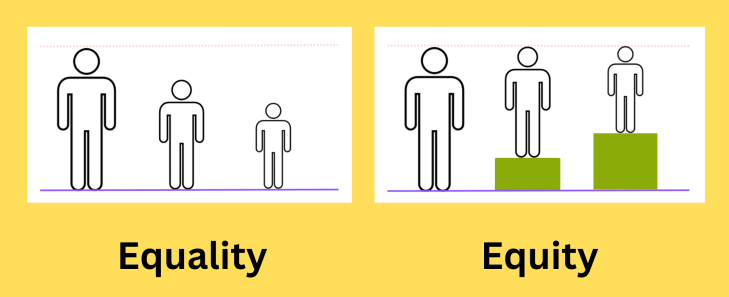
A picture comparing equality with equity.  With equality every person of different height stands on the ground, meaning the shortest cannot reach the ceiling.  With equity, each person stands on a relevantly sized box so all people can reach the ceiling.
Equality versus Equity: A standard representation

This diagram represents the high point of equity in education because it can be presumed that no matter what adjustments are required or desired, the output is one of total welfare satisfaction (3 people sought degrees; and 3 people received degrees). If the diagram was expanded to 5 or 6 people its basic (ideal) form would (and should) remain unchanged.

The problem is that this graphic presumes an external world (to education) of egalitarian abundance. That is, once the educational process ‘levels’ everyone up (or down) then the desired goals (outputs: such as a ‘degree qualification’ and ‘graduate jobs’) are available for ‘all’ who climb to and over the ‘threshold’. On completion there is no scarcity of qualifications and jobs to be conferred and handed out. Degree certificates can, these days, be laser printed in full colour ‘on demand’. And if it is the college principal’s hand falling off, due to signing degrees en masse, that we are concerned about, then there is always the ”auto pen”.

The issue of scarcity in higher education has been considered to exist at the ‘admissions’ (entry) end, so, how many undergrad ‘places’ are available? And that’s a different question (of diversity in initial demographic ‘make up’) than the one I focus on here, namely, the application of equity policies to those students (and staff) already ‘in’ higher educational institutions or about to ‘transition’ out.

Thus, at the ‘entry’ end there is, hopefully, an increasingly diverse population of new students – a demographic with various, even unique, educational needs or ‘additional requirements’ which the HE equity policy manages to ‘level up’ through an unequal application of resources: equity achieved. This aims to give ‘all’ students truly equal opportunities and chances to achieve a deservedly high ‘degree outcome’, with opulence in certification being the ‘ideal world’ condition for HE equity policy.

At this point I should note that another welcome outcome of equity in admission processes is what I call a ‘diversification in common sense’. This refers to the manner in which the University is a democratic forum, which needs diverse perspectives to function in a truly scientific fashion (on this see my blog on the University of Edinburgh’s Teaching Matters site: McGrail, 2026).

From Ideal to ‘Real’ World: The ‘Graduate’ Job Market

The question of ‘graduate jobs’, however, presents a completely different challenge. Once the graduate leaves the educational establishment, award in hand, they are confronted by a highly competitive jobs market and a system focused not on expanding use values (goods and services required by and useful to people) but on valorising value (Heinrich, 2012, notes that Marx defines ‘capital’ as self-valorising value) through the generation of ‘surplus’ (hence, unrequired and unnecessary) output. As Kohei Saito (2024) points out, jobs are created where they are not needed with the aim of producing and ever growing ‘economy’ on a planet with, ultimately, limited resources. The motivation, of course, is to accumulate more and more private wealth (measured in terms of GDP) which comes at the expense of diminishing public wealth (a condition identified in 1804 by James Maitland, 8th Earl of Lauderdale, known as the Lauderdale Paradox: see Saito, 2024, pp.155-156).

This ‘real’ world system – real because it exists and dominates, but unrealistic by dint of being fantastical (e.g., Elon Musk wanting to mine the Moon and Mars once Earth’s natural resources are saturated) – is the very one graduate  qualification and employment structures are intended and designed to supply. Educational ‘equity’ is aimed at ensuring ‘free’ and fair entry to this system based on private (if not personal) domination of others. The more graduates available with a required qualification then the greater the competition for ‘places’.  A process which reduces wages and weakens workers ability to control what they do, how they do it, and to whom they do it.  From a position of ‘educational equity’ we end up in a state of ‘occupational inequity’.

As a conclusion …

The hierarchy of positions found in business and all kinds of institution (including charities as well as government) is one clear form of the imposition of scarcity since, according to this understanding of ‘leadership’, there can only be a certain number (proportion) of people ‘in control’ (making the decisions). As Saito (2024) also points out, capitalism generates a constant crisis of decision making, where decisions have to be made quickly in response to events beyond the control of managers and owners of ‘investments’ (capital). Such structures are intrinsically anti-democratic, having ‘no time’ for the ‘luxury’ of equitable and fair decision making.

In contrast, real democracy is an open system which can and should easily let new people join. Thus, the corollary of educational equity is the generation of a public space in which the creation of public wealth (non-monetary, focused on the quality of human time) is given priority over the accumulation of private wealth.  Without the latter, educationalists who promote diversity, equality and inclusion (DEI) policies and programmes really have to ask themselves ‘why the hell am I doing what I do?’ Whilst there is the critique that educationalists cannot wait until wider society is emancipated or made equal before they tackle inequity in the classroom, its twin argument is also true: trying to create equity within one confined social space (that of the classroom) cannot produce a ‘citadel’ under constant siege. The emancipation of one place implies and is intimately bound up with others.

References:

Arshad, R. (2021) From Inclusion to Transformation to Decolonisation. Teaching Matters blog. https://www.teaching-matters-blog.ed.ac.uk/from-inclusion-to-transformation-to-decolonisation/ [accessed: 28.09.2026]. 

Heinrich, M. (2012) An Introduction to the Three Volumes of Karl Marx’s Capital. [Translated by Alexander Locascio]. New York: Monthly Review Press.

McGrail, B. A. (2026) Why does classroom diversity make common sense? Teaching Matters blog. Why does classroom diversity make common sense? – Teaching Matters [accessed: 25.10.26].

Saito, K. (2024) Slow Down: How Degrowth Communism Can Save the Earth. London: Weidenfeld & Nicolson.

Theses on the Mirage of “Left” Unity

Introduction

A teaching and union colleague recently pointed out that one of the 2025 Reith Lectures claimed disunity on the “Left” was incapacitating struggle against the new authoritarianism. This disunity leaves the “Left” unable to combat the rise of the Far Right. Like most theories, this claim contains its moment of truth. There seems to be little obvious opposition to the politics of isolation. Self-immolation in an era of capitalist crises and state austerity stands unchallenged.

However, such calls to arms overlook or ignore not just the historical reasons for “Left” disunity. They neglect to consider why, philosophically, there have been incompatible positions on the “Left”. Indeed, we should ask this question. Has there ever been such a thing as “Left unity” (producing a unified position, movement, group, or identity)?

The Left should be associated with ‘radicalism’ (a desire to change the status quo). This creates its ‘identity’ in opposition to ‘conservatism’ (a desire to maintain the status quo). However, there has never been agreement amongst “the Left” as to what counts as the ‘status quo’. Hence, what is it that needs to be ‘changed’? If this cannot be agreed upon, radicals (change seekers) face a crossroads. They are bound to head off in different directions. Thus, disunity is built into the so-called ‘march of progress’!

Analysing the Options

Here I will argue there are 3 fundamental positions on “the Left”. Everyone involved may want to ‘change society’ (and clearly they hope to do this ‘for the better’). But, as noted, their positions are fundamentally, in both theoretical and practical terms, incompatible. I call these three positions: (1) State Takers, (2) State Makers, and (3) State Breakers.

All three stand in relation to ‘capitalism’ as the currently existing mode of production. And each wants to present their own position as the ‘best way forward’ or ‘best available option … in reality’. I say ‘stand in relation to’ and not ‘stand against’. The first major division arises between those ‘radicals’ who see capitalist relations of production grounded in ‘human nature’ (and thereby inevitable or insurmountable). Others see capitalism as running against ‘human nature’ (and thereby flawed and historically dangerous; working its way towards barbarism). Yet, things are never this ‘neat’ and sub-positions emerge as there are those who ‘think’ they are overthrowing capitalism whenever the state nationalises or incorporates services and institutions, despite widespread awareness of the modern nation state’s role in advancing capitalist relations of production (i.e., the wage labour form, laws on community dispossession, the promotion of monetary command over life).

What is a ‘State’?

First I am required to give a definition of what I mean by ‘state’. I understand a ‘state’ to be a permanent structure or condition which entails a political division between rulers and ruled. Typically, there are politicians and non-politicians. One section of the social totality (the polity) makes decisions in relation to the other (who take instruction).

A classic account of a ‘state’ is Plato’s Republic. In this account, the community is divided into three distinct classes: (a) philosophers, (b) soldiers, and (c) traders (techne). Plato argued against democracy. He did not envision a properly functioning society where everyone (within the polity) had the capacity, skills, time, or inclination to govern. Rulers (the government or governors) had to be ‘trained’ to rule properly. Indeed, the most effective rulers had to be philosophers. And these philosophers had to be communists not ‘corrupted’ by private interests. Philosophers were placed above techne. They were not ‘encumbered’ with everyday requirements, such as producing the material needs of the polity. Their sole job was to ‘rule’.

Of course, Plato’s arrangements involved permanent classes reproduced through genetic isolation from each other. The philosophers were a nobility, though a physically weak one which needed protecting by a second class (level or layer) of ‘rulers’, the soldier guardians, who had physical strength. Naturally, the head (philosophy or wisdom) ruled the body (might) and in Plato’s Republic it was ‘impossible’ for individuals to move between classes (defined by ‘birth’).

Our contemporary ‘states’ differ in so far as everyone is abstractly ‘equal’ before the law. Anyone, under the American Dream, has the ability to rise among the ‘ranks’ and become a ‘ruler’ (politician). But this social mobility does not mean there is no permanent division between rulers and ruled in modern society. Whilst ‘individuals’ can change rank and swap places, at any moment in time/space rulers (politicians) are still a class apart from the ruled. Each empowered individual has temporary privileges (the ability to take part in meaningful votes) which others do not, but as a ruling class politicians are a ‘permanent’ feature and division.

Whereas in Plato’s Republic both the individuals and their class divisions are permanent, with modern states individuals are ‘free’ to move between or across classes, becoming ‘temporary’ rulers. But the classes themselves (politicians versus non-politicians) remain ‘permanent’. An individual can be elected or co-opted into the ruling (governing) class. And they can also exploit their way into being a desirable and co-optable character via accumulation of monetary wealth (capital).

Elections give a semblance of democratic engagement (in contrast to Plato’s Republic). As the philosopher Hegel notes, there is democracy merely one day every 4 years; an event through which a temporary tyrant or oligarch is selected to serve ‘their’ term. During that term the elected are a class apart. Democratic events (‘the election’) are rarer than the 29th of February (1 in 1,461 days). Such is ‘the state’ we are in!

(1) State Takers

The first position on “the Left’ is populated by those willing to work with the ‘existing’ class-divided system and its peculiar arrangements. They put themselves forward to be selected as one of the temporary dictators (or club of would-be dictators) under such a system. [A kind of reversal of The Hunger Games, in which a champion for the exploiting class – to carry it forward – is chosen by and from amongst the exploited class.]

The aim is to ‘take over’ the state in its current condition, with our ‘champions’ firmly believing they are ‘the one’ – an incorruptible Messianic ‘ruler’ who will represent and govern in the interests of ‘the workers’ (the working class or techne). There are clear echoes of Plato in this; minus the preference for ‘democratic’ selection of the philosopher-guardians. Plato’s philosophical machinations were all about coping with the potential for guardians to be ‘corrupted’. But with a social system which eulogises the corruptible there is no need to bother with Plato’s concerns.

Meanwhile, modern political science knows too much about familial and genetic corruption (via primogeniture) and, consequently, desires to draw the polity’s governors from what it perceives as the endless ‘talent pool’ of a mass population that has been legally and commercially equalised through market trading (i.e., every commodity owner is formally equal – the same – except those who do get ‘chosen’ tend to have socially desirable exploitative ‘talents’ indicating they deserve a chance at power and ‘ruling’).

Whilst the “Left” State Taker position may be widely identified with social democracy, it also covers democratic socialism, Fabianism, and movements such as social liberalism and market socialism. Figures and characters range (in UK politics) from Tony Blair to Jeremy Corbyn, from Jenny Lee to George Galloway. Some appear more ‘radical’ than others, but the primary goal has always been to take charge of the existing state apparatus and run it ‘for the good’ or ‘the betterment’ of the lower orders.

After all, can such a state (as the existing one) remain in the hands of Right-wingers or even Centrists? Wouldn’t that be worse for ‘the working class’? Aren’t State Taker arguments reasonable? Don’t they make sense? Let’s ‘take the state’! Couldn’t anything be more obvious?

The criticism is that after more than two centuries of such ‘Left’ (radical) reformist argumentation and action the tension (or contradiction) between progress and regress is nothing except heightened. There is no lack of food, but use of food banks continues to rise. And the arrival of state welfare has introduced another control mechanism with which to discipline and punish the universal working class (constantly filtering people into deserving and undeserving ‘classes’ despite movement of the ‘means testing’ slide ruler). There has always been a ‘dark side’ to social democratic politics – a complicity with ‘the beast’ through which the permanent class division perseveres.

(2) State Makers

This has always been considered a ‘more radical’ stance on the existing state, and its promises features more fundamental change. There are a range of methods involved, from the democratic ‘take over’ (which quickly aims to become a ‘make over’), through guerrilla movement (often based on ethnic, national, cultural, or racial differences in a supposedly ‘cosmopolitan’ colony), to the militaristic General’s coup d’état.

Having read Robert Service’s work on the Russian Revolution, I am never sure how to treat and place Lenin. He wore a civilian suit but, at the same time, was the puppet master of Bolshevik action undertaken by armed units managed by Trotsky. Though the real coup took place after the only free elections returned a majority of Mensheviks and Socialist-Revolutionaries to the post-provisional Assembly. So, Lenin and the Bolsheviks ‘suspended’ the Assembly (at gun point).

The Russian Revolution (as Arendt, 1963, notes: ‘modelled’ on the French and not the American Revolution) is a clear example of state making. This was no mere ‘take over’ of the old apparatus and its class divisions. The monarchy was executed (multiple generations), the nobility fled overseas, and the peasants refused to be subservient (to anyone: Kerensky and Lenin included). For about six months (Feb-Oct) there was what Ernst Bloch would call an ‘opening’. If there was a ‘state’ it was one of flux (so really a ‘non-state’ given the absence of permanency [see my definition of ‘state’ above]).

Then Lenin and Bolshevik Co., stepped into build up a ‘new state’. Despite the theoretical proposal that this would be a state which would ‘wither away’, it never did. Or, it took 70 years and then ‘withered’ into an “illiberal” oligarchic state and not ‘away’. The Bolsheviks were classic state makers. They ‘radically’ changed the structural components and ‘classes’ of the Russian (Imperial) state. The Dictatorship of the Proletariat was the new ruling class. But since this particular class could not be found outside the major cities of Imperial Russia, it was Bolshevik Party membership (and obedience to Party organs, structured in a strict hierarchy) that defined the ‘new’ permanent ruling class.

As a piece of state making this became a proven success which, subsequently, was followed, copied and mimicked across the globe (primarily for its acclaimed ‘success’): China; North Korea; Cuba, Vietnam; Syria; Libya; Afghanistan; Venezuela. Therefore, as a ‘model’ for “Left” (radical) politics it remains prominent and powerful if not as predominant as it used to be.

And, of course, this kind of state making (overthrowing one state system and replacing it with another) does not have to be “Left” wing. Unlike Socialist Afghanistan, ‘socialist’ Iran never made it beyond the revolutionary period due to the radical Clerics and their supporters becoming the ‘vanguard’ which remade the state. The Islamic Caliphate in Iraq/Syria (ISIS) is another example of such ‘regressive’ radicalism.

Contemporary ‘successful’ Leftist state making may be associated with ‘civic nationalist’ movements or with the downtrodden / wretched ‘side’ in civil and colonialist wars. But in what manner do the remade nation ‘states’ of Ireland, Tanzania or Bosnia-Herzegovina now count as “Left” good causes? And what of advocates for a Palestinian State? Surely this is a contemporary highly-reasonable case for “Leftist” ‘state making’? But the history of hitherto state making does not sit well with any prefigurative attempts to make ‘the state’ work for the people.

(3) State Breakers

Finally, we reach the anarchist “Left”. In that the ‘state’ is a permanent division between ‘rulers’ and ‘ruled’, no matter what form that class division takes (e.g., ‘dictatorship of the proletariat’; plutocracy; meritocratic and labour aristocracy), the state breaker’s aim is to do away with permanent social division – to create an indivisible political community, a true ‘polity’ (where the people rule in the people’s interest). Out go ‘charismatic’ “leaders of the people” and “representative” forms of democracy, with their election of one part of the population into positions of power over another.

The state breaker “Left” is, therefore, associated with the more extreme forms of democracy; so-called direct democracy involving participatory action, delegation, and consensus. The latter forms need to be grassroots based, such that the local is free to engage with the federal and global (which are nothing except the conglomeration of local polities).

The objections to state breaking are that it is ‘impractical’ and will lead to ‘anarchy’ (objectors mean ‘chaos’, since ‘anarchy’ is, indeed, the goal). But anarchy simply means ‘without a state’ (so, without a permanent division between rulers and ruled). Used pejoratively, ‘anarchy’ is shouted by those within an existing ruling class as a form of defense against change. That is, their own removal from power.

Of course, given a history of state makers managing to produce even worse systems that what preceded them, the real ‘chaos’ in modern history has been produced by a perpetuation of ruler/ruled divisions (a ‘state’) that promote ‘terror’ (and what is ‘war’ if not terror) in order to ‘keep the state going’.

State breaking remains ‘fanciful’ – the most utopian of the three “Leftist” positions. But it does exist, and always has, bubbling away and percolating through historically-made institutions (which would rather pretend, and do pretend, they are an outcome of ‘nature’). We find remnants of delegatory democracy in trade unions – where the ‘branch’ and not the ‘representative’ votes at conference. Such leftovers are a reminder of past attempts to break the state (during the French Revolution, the Paris Commune, the post-World War 1 revolutions – see Tomba).

Conclusion

Given the above positions, what does “Left” unity look like? There may be some ‘abstract’ desires which ‘all’ can agree upon (remember: these do not even include an ‘end to capitalism’), but what are concrete examples of these? An example might be ‘an end to poverty’? Everyone on the “Left”, surely, will agree to this as ‘an end’ of the “Left”?

But then we simply move on to differences over action and ‘policy’ (‘the means’), where the above positions once more make themselves felt as disunity. Furthermore, the latter ‘assertion’ soon becomes a ‘charge’ against any ‘opposing’ position, such that ‘dissent’ from a policy or strategy enables the charge of disunity to become a ‘control’ mechanism!

What then becomes of “Left” unity? Does it mean ‘everyone’ getting behind a (state taker) “representative” of “all”, such as Starmer, Corbyn, Mélenchon, or Saunders? Or does it mean signing up to a specific ‘leadership’ organisation (the vanguard party or a rainbow coalition), in the hope of ‘changing the system’ by creating an alternate system?

Such demands for “Left” unity can ultimately become ‘suspect’ within themselves – a means of disabling certain forms of resistance and refusal. Hence, calls for ‘unity’ are but mirages – the unreachable sites of an ‘identity group’ formed purely in opposition to the “Right”, and not by any autonomous agenda. Instead of trying to “unite” the mutually exclusive positions of the “Left”, would it not be better to work out what is required for real emancipation?

History produces nothing but Barbarism

In a recent video interview for publisher Unherd, Yanis Varoufakis asked the question: “Why is the Left the loser of history?’ He went on to argue that the Left failed to “take its opportunity” in the wake of the crisis of capitalism in 2008. Consequently, the ground remained wide-open, only to be filled by the politics of the Far Right.

Of course, since the Left failed in its historic duty to take up the reigns of ‘power’, it has the unenviable position of remaining religiously pure and untainted as the rightful and righteous outcome of ‘history’. It can live for another day, though such a position leads to the inevitable question, given there are ‘right’ and ‘wrong’ sides of history, of ‘why, so far, has the Right always ended up as the victor of history?’

There is a deeper question here: ‘What is history?’

To ‘Left revolutionaries’, Rosa Luxembourg is famous for stating that ‘the’ class struggle will end in either “Socialism or Barbarism”. The openness of the ‘choice’ with which she confronted her comrades indicates Luxembourg did not see ‘socialism’ as an automatic outcome of the ‘historical process’. But her statement does leave two interpretations: (1) that ‘socialism’ is one possible outcome of ‘the historical process’ (for Varoufakis, socialism can be ‘the victor’), and, alternately, (2) that human action – struggle – is the means by which to avoid the inevitable barbarism that ‘the historical process’ will produce (so, ‘socialism’ can never be ‘the victor’ of a socio-historical process humanity must struggle against).

Following the latter interpretation, a key question is ‘what form should the required struggle take?’ Well, aiming to take up the reigns of political ‘power’ (electoral politics; state capture, Social Democracy, Democratic Socialism, Bolshevism, Leninism, Trotskyism, Maoism, Black Power, and Matriarchy) has been tried on numerous occasions. Luxembourg was murdered in 1919, so didn’t live to see the historical outcome of ‘actually existing socialism’.

That is, Varoufakis, no matter how he, himself, sees the world, or understands contemporary ‘history’, needs to deal with the fact that for many people, in certain places and times, socialism has been ‘the victor of history’ and has done nothing but produce barbarism. When socialism has been ‘the victor of history’ then, to change Luxembourg’s quotation: Socialism becomes Barbarism! To the ‘victors’ the spoils.

What has Varoufakis missed?

Varoufakis clearly understands ‘socialism’ to be part and parcel of the historical process – it is a component of the current system which can ‘guide’ history towards a positive outcome. This ‘positivity’ is a theoretical descendant of early utopian socialists (heavily criticised by Marx) such as John Bray and Proudhon – who believed in nationalised banks and ‘fair’ labour exchanges on the basis (as Bonefeld, 2023 puts it) that they could get rid of ‘the capitalist’ but keep ‘capital’ (i.e., the waged labour relationship or social form).

Incidentally, I find Varoufakis’ coining of the ‘concept’ technofeudalism very confusing – a jumble of definitions and meanings. By ‘feudalism’ he appears to serfdom (in a similar way as Hayek referred to ‘The Road to Serfdom’). But this forgets that the tech-bros’ goal is to produce ‘surplus value’ and NOT garner tribune (rents/taxes) under a system of ‘extra-economic’ devine-rights (imposed by ‘direct’ violence). In short, Greece had a Finance Minister who never really understood ‘capitalism’ (conceptually nor practically).

I surmise that Varoufakis has never read the Frankfurt School Critical Theorists (Benjamin, Horkheimer, Adorno), or, if he has, he hasn’t understood them. Benjamin’s Theses on the Philosophy of History reminds us that the point of history is to break with it, not “swim” with its tide. Rather, the struggle is to bring the historical process to a ‘stop’ (to serve the needs of the present) and not drive history to its ‘completion’ (towards some Messianic ‘vision’). Adorno brilliantly sums the same point up: “There is a history which leads from the slingshot to the atom bomb, but not one that goes from barbarism to humanity”.

History is on the wrong side of class struggle – it is a process which runs against the presently-existing needs of humanity. Rather, history (the perpetuation of tradition) is an accumulating “nightmare” which weighs heavily on the “brains of the living” (Marx from 18th Brumaire), compelling them forward on grounds of ‘lack of alternative’. The struggle is to wake up and leave the nightmare; not stay in it to find out who will be ‘victors’. If we stay in it (do not wake up) and keep ‘falling’, then the urban myth tells us there will be just one outcome: Thump!

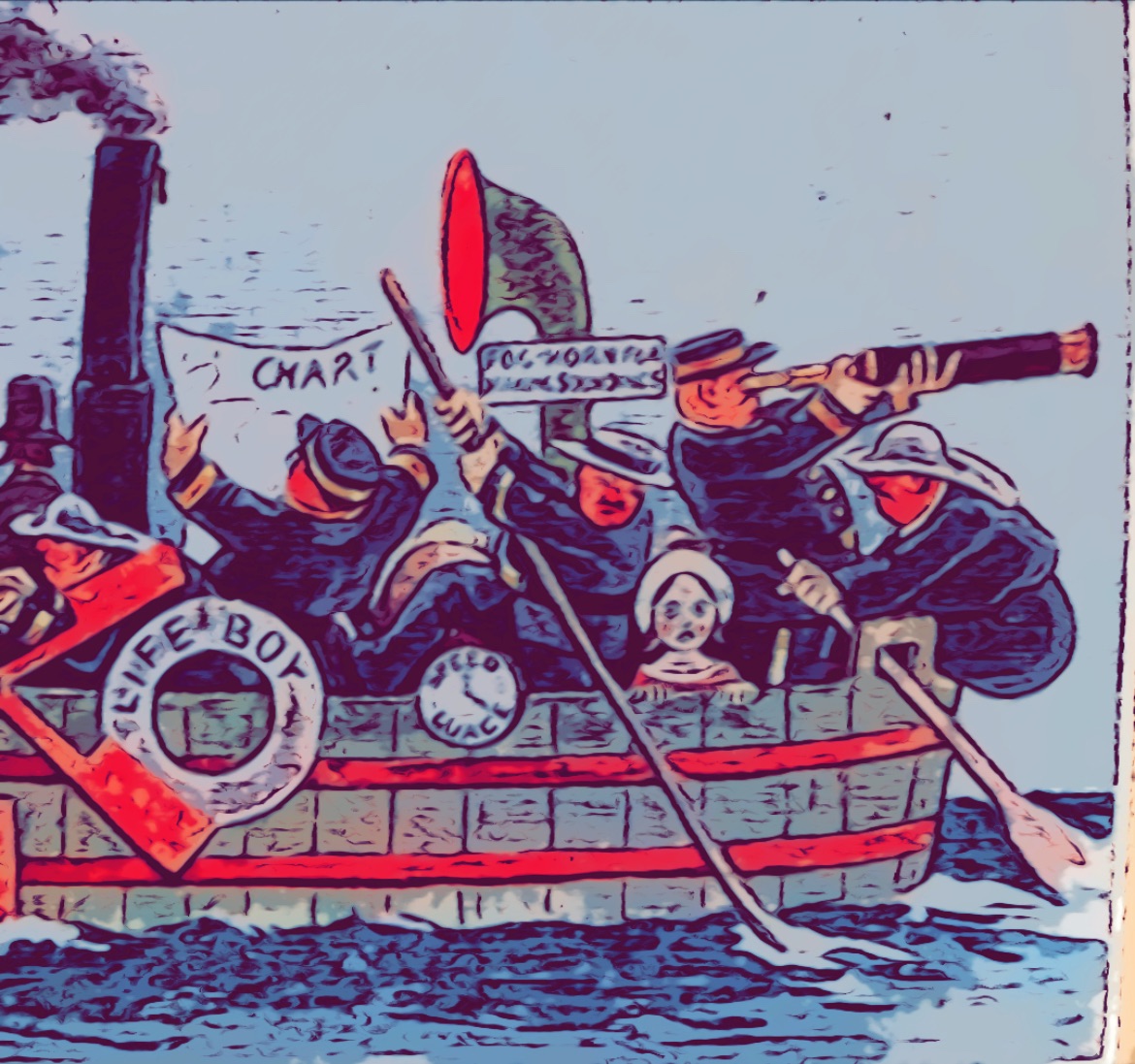
Notes: The featured image is from a photo of holiday postcards I took in a museum – I’ve entitled it ‘History Sails Forward’. It’s an image captured from ‘the past’, held within a time-capsule.

References:

Bonefeld, W. (2023) A Critical Theory of Economic Compulsion: Wealth, Suffering, Negation London: Routledge.

Marx’s Anarchism and the Politics of Capitalism

On the relevance of Marx in times of ‘Zombie Capitalism?’

Studying an author hermeneutically refers to understanding a writer by standing in their shoes and seeing the world from their perspective.  Studying political writings in such a manner was advanced in the mid-20th century by scholars like those in the ‘Cambridge School’ of history of political thought.  

When Karl Marx was writing Capital, in mid 19th century, the term ‘left’ (on the political spectrum) meant being ‘radical’ whilst ‘right’ referred to being ‘conservative’.  The designations (literally positions or ’wings’) were taken from the post-revolutionary Constituent Assembly of France, with the colours derived from the Republican tricolour flag. 

However, by the mid 20th century, during the post-war consensus, ‘the left’ was associated with support for state control of the economy and government social intervention whilst ‘the right’ had come to be associated with anti-state individualism and ‘liberalism’ (or Hayekian ‘market non-interventionism’).  By the 1970s and ‘80s a new breed of ‘post-consensus’ right-wing politicians emerged who were deemed (in many respects correctly) ‘radical’.

Reagan and Thatcher were the most prominent ’radicals’ to have ideologies named after them (Reaganism and Thatcherism).  Such radical right-wingers wanted to tear down what they saw as a ’statist’ establishment which, of course, many left-wingers wanted to ‘conserve’.  The switch in meanings of left and right was completed in the form of conservative left-wingers (whether Bolsheviks, Maoists, Post-colonialists, Keynesians, Swedish Social Democrats, British reformers, or any other version of left ’state power’ grabbers who felt they had something to preserve, a status quo).

This kind of ‘conservative’ left statism was not unknown to Marx.  Marx’s awareness can be detected in his many critiques of ‘utopian’ socialists during his lifetime, from Robert Owen to his Critique of the Gotha Programme (of the German Social Democratic Party, SPD). But Marx describes workers taking control of (rather than power over) society on very few occasions, with his most prominent account featured in news articles published (later) by Engels as The Civil Wars in France (1871).

This was Marx’s account of the rise and fall of the Paris Commune (1870).  Importantly, what he describes in these articles is a delegate-based anti-statist workers’ council or commune system (the word ‘commune’ meaning grassroots council).  ’Councils’ were both local (geographically-centred – the rural village) and vocational (workplace or activity centred – e.g., a weavers’ collective) to ensure different elements of society were heard, but significantly that no-one living off the private expropriation of production (performed by others) would be (easily) heard.  This was a reversal of the prior situation where a separate class of politicians (who expropriated or represented expropriators, and even proprietors of private ‘labour power’) formed the state and government. 

Furthermore, when Marx was asked if the ‘stage’ between pre-capitalist and communist societies could be by-passed or skipped, he eventually nodded to a positive answer regarding the development of existing Russian ‘communes’ (in a letter to a Narodniki).  To be clear, I consider him hinting that ‘industrialisation’ and ‘urbanisation’ were not prerequisites to the fulfilment of some objectified ’inevitable’ historical progression working ‘at the backs of people’ towards ‘socialism’ and then ‘communism’ in a compulsory stadial trajectory.

As ‘communes’ already existed in Russia they could form the basis of an emancipated society, without a deranged detour through ‘capitalism’!  However, Marx still thought that the experience of capitalism would be more likely to produce a social revolution, given the nascent conservatism of the rural commune – put another way, more advanced industrial countries should see a revolution first given the (contradictory) life conditions they generate.  Also, given capitalism’s existence (historical arrival, even by accident) hopes of a direct transition from peasant communes were, simply, after the fact even in the mid-Victorian era.  The social form that gave rise to such hopes (the peasant village eulogised by the Narodniki) was already disappearing, specifically in the advanced and developing industrial nations who had the power to colonise and suppress every other type of social form or mode of production. 

Nevertheless, and this is a salient point, I would argue that for most (if not all) of his political life Marx was what would be known, in both 19th and 20th centuries, as an ‘anarchist’!  The point of the Paris Commune’s mandatory delegation system was to ensure there would be no separation between a (professional) political class and the rest of the population.  Thus, parliamentary ‘representation’ with its political leadership (elites or vanguards) was simply not good enough since it would reproduce one of the fundamental social / political divisions which Marx wished to see the back of.

Indeed, one way of outlining how Marx understood the ‘politics’ of capitalism, compared to feudalist and ancient slave modes of production, was that capitalism makes what was obvious in the others (direct political domination) an inconspicuous, or ‘hidden’, process (via indirect economic domination under the ‘guise’ of ‘fair’ trade – see Ellen Meiskins Wood, 2002).

But how did the previously noted transition in meaning, from the 19th century radical left / conservative right to the 20th century conservative left / radical right, take place?  The answer, not surprisingly, was via successful social revolution in the early 20th century!  The conceptual and analytical problem here is that all too often activists (those present at the time) and commentators (contemporary or later) have focused attention on the ‘trees’ whilst failing to see the ’wood’!  Hence, we end up with histories and analyses of ‘The Russian Revolution’ (1917), ‘The German Revolution’ (1918-19), ‘The Hungarian Revolution’ (1919-20), but don’t hear much about ‘The Irish Revolution’ (1916), the Syrian democratic constitution (1919-20), ‘The Finnish Revolution’ (1917-22) nor ‘The British Revolution’ (1918-22).  Generally, a global move towards universal suffrage, imposed from below as part of a working class revolution in political practice (namely, direct democracy), gets overlooked. 

The dominant analytical time frames and intellectual interests tend to be centred on what can be described as moments of coup d’etat (significant but fleeting changes within forms of political ‘representation’) which merely punctuated much broader social changes.  With the latter including changes in working practices, shifts in artistic practices and possibilities in communication, but also developments in social roles and recognition – the rise of married women in the workplace, the emergence of state welfare recipients (like working-class ‘pensioners’ in Britain), the emergence of ‘childhood’, and the extended legal reach of the state (such as compulsory purchase of land, military conscription, and nationalisation of banking). 

One way of taking a wider survey of the workers’ revolution is to frame it in terms of all those socio-politico-economic changes taking place between the start of the Great War (1914) and a final capitulation of ‘traditional’ (pre-fiat money) capitalism in the Wall Street Crash (1929); a fifteen year period after which things can never go back to the way they were before though the desire to do so (right-wing radicalism) continues to be felt as an echo – the march of the Zombies.

Whether we understand ‘the revolution’ as having succeeded (the eventual emergence of the Soviet Union as a ‘workers’ state’) or failed (the crushing of the German Revolution by the freikorp in 1919), by the early 1930s states (and/or public, centralised institutions associated with them, such as central banks) are everywhere taking the lead role in forming (and/or reforming) the most advanced ’capitalist?’ economies.  From here on, I place a question mark on ‘capitalism?’ to indicate the far-away hills distance of the classic liberal model or mode.  Both the ideology and practice of classical ‘liberal’ political-economy was ’dead’ but also ‘alive’ as a zombie.

Whereas before 1914 capitalist enterprises mostly got on with the job of reproducing, disciplining, exploiting workers in an autonomous manner (with little to no state intervention), by the early 1930s the state becomes, increasingly, an integral part of the social process, including the production of surplus value (profit) via a national organisation of surplus labour time (e.g. how to manage unemployment).  States did take different forms, such as ’total‘ states (a singularity, as in the Soviet Union and Nazi Germany) compared to ‘hegemonic’ ones (pluralities dominated by mass cultures and technocratic control), but the main task of all states / governments was to reproduce (provide subsistence to), discipline, and (successfully) exploit workers directly as the key means of sustaining the wage-labour mode of production. The purpose of the modern nation-state, after all, is to ensure the compliance of the population (whether worker, manager, capitalist, or politburo member) under its territorial control with the accumulation of capital.

By exploitation, of course, I include the ideological elements of emotional exploitation (something Gramsci picked up on as hegemonic cultural domination): “Heave away lads, put your backs into it, for the benefit and sake of the nation!”  A new ‘social contract’ between political elite (the state) and the people (workers) was being founded, and in many experimental forms – Soviet Communism, Italian Fascism, Japanese Imperialism, Irish and Finnish nationalism, German Nazism, the American New Deal, Jewish Zionism, and ‘Greater’ Britishness (re-modelling the Empire as ‘Commonwealth’).  The last of these was even mooted, at one point, as a new country, called Greater Britain.

Some of these were ethno-nationalist (Nazism / Zionism) whilst others were pan- or trans-nationalist (the Soviet federation and British unionism), but almost all (excepting the smaller nations) led to expansionism (ultimately, war).  In contrast with the era of joint-stock ‘liberalism’, state-control of economic and social life was now in the driving seat.  Many of these subsequently failed (losers to others in war) and the leading ideologies emerged as those of (Western) ‘Keynesianism’ and (Eastern) ‘Communism’, with a common connection in ‘state-led’ social formation.  It is not inaccurate to describe the outcome as socialism, with socialism as the natural religion (‘binding’) of capitalist alienation.

In this sense, ‘a’ social revolution did take place in the early 20th century, but one with a compromised, synthetic outcome.  In Gunn and Wilding’s (2022) Hegelian terms: mis-recognition pertained.  Workers gaining universal suffrage in Britain was ‘a revolution’, but one that is almost always overlooked!  Sometimes the achievement of suffrage is deemed a mere ‘concession’ by a ruling class determined to retain their power through more subtle methods (the hegemonic control of education and broadcast media, as pinpointed by Gramsci’s early analysis of Italian Fascism).  But to rob the period and Gramsci of their ‘openness’ produces an historiography which makes the ruling class ‘oh-so clever’, as if it was their ‘Revolution’. 

More tellingly, the same social revolution produced a crisis in surplus value production (and the rate at which accumulation could proceed) – the Wall Street Crash both questioned the emerging fascist conceptions of a ‘New Man’ (much admired by elite figures such as the British Royals: Edward Prince of Wales and Albert Duke of York) whilst also hastening change.  As Thomas Piketty’s (2018) empirical data has demonstrated, before 1914 capital accumulation grew at a rate faster than wage growth, but throughout the mid-20th century the reverse was true (wages grew faster than profits).  ‘Capitalism?’ had been saved by socialist collectivism (the amalgamation of multiple capitals into a singularity), but at massive economic and social (status) cost to the conventional ruling class and its practices.  Workers, in their role as waged workers (subjects central to the accumulation system), had imposed their interests and gained decision-making power within the capitalist state mechanism, even if their so-called ‘class consciousness’ remained ‘corrupted’.

In his overview of Keynes’ theoretical work, and reformation of capitalist strategy, Negri, in Revolution Retrieved (1988), coins the term positive Keynesianism to refer to the immediate post-war period (1945-1973) when state welfare benefits and full employment policies were used to encourage and entice employees to work hard and raise their productivity.  This ever-rising productivity was central to the strategy and was baked-in to a social necessity for endless economic growth and, so long as the economy could be grown at a sufficient rate, the fact wage earners (as property owners) were making distributional ground on recipients of profits, rents and taxes was an acceptable trade-off, especially as any class relying on unearned income was on the back foot.  But with ‘stagnation’ in the 1970s the situation grew desperate for profiteers, rentiers and public servants (tax-takers) meaning something needed to be done – the rise of the right-wing radical was witnessed just as open ‘class conflict’ surfaced or re-emerged.

This conflict produced a shift in the social contract, but not one from Keynesianism back to Liberalism, despite the hopes of the radical right-wing ideology known as ‘Neoliberalism’.  Rather, Negri describes the shift as one towards negative Keynesianism.  That is, rather than the state taking a reduced and fading (or to use Marx’s phrase, vanishing) role in ‘the economy’, which is what Neoliberals like Thatcher may have ‘thought’ was going to happen (or wished would happen in a return to the ‘classic’ era), negative Keynesianism maintained levels of state intervention in social life (and its prominence in guaranteeing the reproduction, discipline, and exploitation of the working class).

Instead of positive encouragements (material benefits; socialised myths of ‘we are all in it together’), negative Keynesianism ‘liberated’ the representatives of monied-capital only by ‘oppressing’ worker dissent to capital’s imposition that people remain ’waged labour’.  Militarisation of society (higher prison populations; investment in security, securitisation, and surveillance), the piling on of indebtedness (for housing, education, and health), and creeping isolation (social individualisation and insulation: gated communities; financial ‘independence’) were the negative Keynesian modes of operation.

So, what is the importance of the above analysis of social change over the last 100 years with regards to studying Marx’s Capital?  On the one hand, when we read Marx via his original writings his anti-statist (radical) position must be kept in mind – his anarchism means he was against political systems containing social divisions between rulers and ruled.  He would have been appalled by the ‘Soviet’ regime produced not just by ‘Stalin’ (that is too easy a cop-out) but Bolshevism from its inception (in 1892). Marx would have recognised the ‘council communist’ and even ’liberal democratic’ revolution that occurred in Russia in Feb (or March) 1917 as progressive whilst reserving criticism for remnants of expropriator influence and power. 

Whilst Bolshevism did get a ‘populist’ upper-hand on (the more ‘reformist’) Menshivist movement (largely related to ending the war immediately), leading to the ‘October Revolution’ (a coup d’etat), the dismantling of the Soviet (‘council’) system and democratic ‘reforms’ happened very quickly under Lenin’s centralisation of political institutions.  The democratic arrangements of Feb-Oct 1917 may not have led to a ‘non-statist’ system, as Marx would have desired, but they could have produced a different outcome for both Russia and Germany in the 1920s (Luxembourg did not feel the time was right for the kind of ‘coup’ attempted by workers in Germany).  Probably the ‘revolution’ would have developed more along lines of what happened in the Western world.  Marx reserves his ‘ire’ for statist politicians of all shades in his political writings, as well as those who try to ‘force’ history and recognition forward (e.g., the professional ‘revolutionary’)!

On the other hand, a standard objection to taking Marx seriously is that, given all the social and technical ‘change’ that took place during the 20th century, surely Marx’s writings are limited to the kind of 19th century capitalism he witnessed (of the classic liberal type)?  Namely, he is good at excoriating Mr MoneyBags, the woefully selfish carpetbagger and child-exploitative industrialist of Victorian slum cities, but modern capitalist corporations are operated by equality, diversity and inclusion-qualified executives who are socially aware and just don’t operate in the same way as the Victorian businessman!  I would point out that whilst Marx is often associated with writing a ‘grand narrative’ (an overarching account of the large sweep of history, a la The Communist Manifesto) his study in Capital is highly specific. 

Capital is an examination of just one type of social relation (or mode of production) – the wage labour / capital relationship.  Marx’s work analyses (breaks down) this relationship and identifies its complex and multifarious derivative forms – that is, if we find ‘the commodity’ (which is produced and appears everywhere in daily life – part of our immediate experience) then we will also find both mutual recognition and value (defined as socially necessary labour) – anyone producing ‘commodities’ must recognise others as equivalents (owners) and produce at a socially-recognised rate (e.g., items per hour).

If we then find that human ‘labour power’ is one of the commodities available for purchase, then we will find ‘surplus value’, which is produced via ‘absolute’ and ’relative’ processes, and so on.  The argument in Capital Is not an ‘historical’ story but Marx’s way of laying out a conceptual ‘unfolding’.  One difficulty, compared to earlier classical political economists, is in getting the order of conceptual presentation correct, so that the reader does not go off on the wrong foot by starting with something which is ‘derivative’ (e.g., ‘profit’).

In summary, Capital is a study of one kind of social relation, and wherever that social relation (waged labour) is found then Marx’s analysis remains applicable, no matter how technologically-advanced or different a ‘society’ might happen to appear.  The main question, therefore: is ‘our society’ still based on waged labour (capital)?  If so, then Marx’s Capital is [remains] relevant. The flesh of the elephant may have fallen away, but to the trained anatomist what stands before them is still an elephant.

Publication Note:

I wrote (started) this article in February 2024, but it then lay dormant and unfinished (on my cloud drive) until September 2025. Reading my friend Werner Bonefeld’s (2023) book (A Critical Theory of Economic Compulsion Routledge) inspired me to return to it and at least publish, in a still unfinished form (the referencing is incomplete; if / when I get the time I will return to this element).

References:

Bonefeld, W. (2023) A Critical Theory of Economic Compulsion: Wealth, Suffering, Negation London: Rutledge.

Gunn, R. & Wilding, A. (2022) Revolutionary Recognition

Negri, T. (1988) Revolution Retrieved

Piketty, T. (2018) Capital in the 21st Century

Wood, E. M. (2002) The Origins of Capitalism: A Longer View