What Do We Mean by “Class”? One of Sociology’s Most Misunderstood Concepts

When people talk about social class, they often assume everyone knows what the term means. We hear references to the “working class”, “middle class”, and “upper class” in politics, the media, and everyday conversation. Yet the closer we examine the concept, the more complex it becomes. Social class is not a single concept. It is a collection of different ways of understanding social relationships, inequality, identity, and power.

One of the most striking features of discussions about class is how often different meanings are mixed together. Someone may use class to describe a person’s income, while another uses it to refer to cultural tastes, political beliefs, or social status. Sociologists have developed a range of (often contradictory) approaches to understanding class, each highlighting different aspects of social life.

This blog explores three major ways class has been understood: as a group, as a social division, and as a vision of future social development. Along the way, I will also consider the work of influential thinkers such as Karl Marx, Max Weber, Zygmunt Bauman, and Pierre Bourdieu.

The Everyday Meaning of Class

Outside sociology, people usually think of class as a hierarchy. Individuals are imagined as occupying positions somewhere on a social ladder: upper class, middle class, or working class. These categories often reflect occupation, income, education, lifestyle, and social status.

British culture has long reflected this way of thinking. Comedy sketches, newspaper cartoons, and political debates frequently portray society as a collection of different social layers. The humour often comes from exposing how arbitrary these distinctions can be. Why should someone’s accent, clothing, or preferred drink tell us anything important about their worth as a person? Yet such markers continue to shape how people are judged and categorised.  

This conventional understanding treats class as a series of social groups. The central question becomes: “Which group do I/you belong to?” Sociological research often builds on this assumption by creating class categories based on occupation, income, or educational attainment.

However, this is only one way of thinking about class.

Marx and the Idea of Class as Division

Karl Marx approached class from a very different direction. Rather than beginning with social categories, he began with social relationships. For Marx, classes emerge from the way people participate in material practices (‘economic’ processes), especially production and exploitation.  

In the opening pages of The Communist Manifesto, class struggle appears before any specific classes are named (see Gunn, 1987). This ordering is significant. Conflict comes first. Classes emerge from the social divisions created by that conflict.

Marx’s famous examples include master and slave, lord and serf, and capitalist and worker. What matters is not a person’s identity, tastes, or cultural preferences but their relationship to the production process. Do they control or own productive resources? Do they command or employ others? Or do they survive only by following instruction or selling their labour?

This perspective challenges many popular assumptions about class. Someone may identify as middle class, enjoy a comfortable lifestyle, and possess a university degree. Yet if they still depend upon employment for their income, Marx’s analysis would classify them as a wage labourer (open to exploitation as a commodified product). Their subjective identity does not alter their objective position within the economic system.

Marx was particularly interested in exploitation. His discussion of child labour in nineteenth-century industries highlights how economic systems can compel individuals into deeply unequal relationships. Such examples remind us that class is not merely about status or lifestyle. It also concerns power, ownership, and the distribution of social resources.

Class as Identity and Group Membership

While Marx focused on social divisions, others devoted greater attention to group identities and status differences.

Max Weber argued that people compete not only for economic resources but also for social honour and recognition. Groups seek to distinguish themselves from others using a variety of markers, including education, lifestyle, profession, ethnicity, and cultural practices.  

From this perspective, class becomes partly a matter of social or market positioning. People attempt to improve their standing while simultaneously preserving distinctions between themselves and those below them. Elites may use exclusive institutions, qualifications, or networks to protect their status. At the same time, less advantaged groups often develop their own forms of identity and solidarity.  

This approach helps explain why class remains socially meaningful even when economic differences appear less obvious. People continue to sort themselves and others into categories. According to Veblen, they use consumer or consumption signals (such as speech, dress, leisure activities, and educational background) to make assumptions about social position.

Class, therefore, is not simply something we possess. It is also something we perform, negotiate, and contest.

Class as a Vision of Society

A less familiar interpretation treats class as an entire system of social organisation.

In some strands of Marxology, a term such as “capitalist class” does not merely refer to wealthy individuals. It refers to a whole mode of production and the assumptions that sustain it. In this sense, class becomes a way of organising society itself.  

This opens up a broader question: can society be organised differently?

The concept of class consciousness reflects awareness that existing arrangements are neither natural nor permanent. Every social system emerged historically and could, in principle, be replaced by another. Capitalism replaced older forms of social organisation, and alternative arrangements have been proposed throughout modern history.  

Viewing class in this way moves discussion beyond questions of personal identity. Instead, attention shifts towards competing visions of how social life should be organised. Class becomes a debate about collective futures rather than simply individual positions.

The Rise of Consumer Society

However, some sociologists have claimed that the meaning of class has changed significantly in contemporary societies.

Zygmunt Bauman (in line with Veblen) suggested that modern life is increasingly shaped by consumption rather than production. Instead of defining people primarily through the organisation of production (their occupations), consumer society tends to define them through what they can buy and display: an approach which presumes the permanency of commodity exchange.

Bauman distinguished between “the seduced” and “the repressed.” The seduced are those who can actively participate in consumer culture through stable income and access to credit. The repressed are excluded or marginalised, often because they lack sufficient resources or face insecure employment.

This argument highlights how class distinctions remain visible even when traditional industrial (working) identities weaken. Expensive homes, fashionable clothing, luxury goods, and lifestyle choices continue to function as indicators of social position. The form of presentation may have changed, but inequality remains highly visible.  Unfortunately for Bauman and other ‘consumerists’, the reasoning applied to such inequality still carries connotations of ‘the work ethic’.

Bourdieu and the Power of Capitals

Beyond Bauman, perhaps the most influential contemporary account of class comes from Pierre Bourdieu.

Bourdieu argued that inequality involves more than money. He identified several forms of capital that help individuals navigate society. Financial capital remains important, but so do social capital, cultural capital, and symbolic capital.  

Social capital refers to networks, relationships, and useful contacts. Cultural capital includes knowledge, skills, educational credentials, and familiarity with valued cultural practices. Symbolic capital encompasses prestige, reputation, qualifications, titles, and recognised status.  

According to Bourdieu, these resources are transferred across generations. Families pass on not only wealth but also habits, tastes, expectations, and social connections. As a result, class inequalities often reproduce themselves even when opportunities appear formally open to all.

Central to this theory is the concept of habitus. Habitus refers to the dispositions and tendencies people develop through their experiences. Our preferences for food, music, language, education, and leisure activities are shaped by the environments in which we grow up. These preferences often feel natural and personal, yet they reflect wider social influences.

This perspective helps explain why class differences persist in subtle ways. Inequality is not reproduced solely through income. It is also reproduced through everyday practices and cultural expectations.  Though, like Bauman, Bourdieu is “bourgeois” (Marx) in assuming the permanency of commodity exchange as a mode of production. Bourdieu also tends to see ‘capital’ as a possession (held in the form of skill, knowledge, finance, or social connections) rather than as a relationship and process (one person only ‘has’ skill in relation to another).

Why Class Still Matters

Despite decades of debate over whether class is declining in importance, it remains central to understanding modern societies. Income, wealth, educational opportunities, cultural resources, and social networks continue to be distributed unevenly. These inequalities affect life chances, health outcomes, housing options, political participation, and access to opportunity.  

Yet the concept of class itself remains contested. Is it primarily a group identity? A social division? A system of exploitation? A cultural habitus? Or a vision of alternative forms of society?

The answer may be all of the above.

The sociology student’s challenge is to recognise that “class” is not one idea or conceptualisation but many. Different sociological traditions focus on different dimensions of social reality. Understanding class therefore requires us to move beyond simplistic labels and engage with the complexity of how power, identity, resources, and social relationships interact.  

Class is not merely a category we belong to. It is a way of understanding the structures, conflicts, cultures, and possibilities that shape social life, but additionally a cultural and social practice we are part of and actively reproduce.

[1,545 words]

References

Gunn, R. (1987) ‘Notes on Class’, in Common Sense, Issue No.2.  Edinburgh: Common Sense Collective / Edinburgh Conference of Socialist Economists.

Links:

This is a shortened (blog style) article of a 6,000-word essay with the same argument (fully referenced with direct quotations).  This longer version can be found at:

McGrail, B. A. (2024) Class Cultures: What is meant by ‘Class’? [PDF] (12 pages / 24 minute read). Available at: Class Cultures: What is meant by ‘Class’

You can also listen to a ‘podcast’ recording (produced by AI) at the top of this longer version – I see this as a ‘bit of fun’ (and an interesting ‘perspective’ on my article).


Utopia Lost in Language: Rethinking the Politics of Possibility

What if utopia isn’t a perfect place—but a way of thinking and acting, in common?

For many people, the word “utopia” conjures images of unrealistic fantasies, naïve idealism, or even dangerous political experiments gone wrong. In everyday conversation, it often means something impossible: a dream that can’t be realised. But this understanding is deeply misleading—and more importantly, it limits our political imagination at a time when we need it most.

Rather than being a fixed blueprint for a perfect society, utopia can be understood as a political technique and a shared language for exploring social possibilities. Utopia is not simply a destination; it is an activity. It lives in how we imagine, question, critique, and attempt to transform the world around us.

Utopia as Practice, Not Blueprint

The problem begins when utopia is reduced to a picture: a finished model of “the good society.” These static visions—whether architectural masterplans or literary dream worlds—tend to close down discussion rather than open it up. They present a completed answer rather than an ongoing process.

But utopia, at its most powerful, is something else entirely. It is what happens when people begin to ask: what could be different? It is the act of imagining alternatives and bringing those imaginings into public conversation. In that sense, utopia is always grounded in the present. It is something we do, not something that is only dreamt about. Crucially, utopia does not fail because people imagine too much, as anti-utopians (like Gray, 2007) claim. It fails when imagination is suppressed—when social conditions discourage some people from thinking beyond what already exists. The real danger is not utopian dreaming, but absence of it.

The Problem with How We Talk About Utopia

Part of the difficulty lies in language. We often talk about utopia in ways that create confusion or shut down debate. For instance, utopia is frequently treated as synonymous with a “perfect world.” This conflation ignores the richness of utopian thinking and reduces it to a narrow ideal. Similarly, the common opposition between “utopia” (good) and “dystopia” (bad) oversimplifies matters. It suggests that utopian thinking is naïvely optimistic, while dystopian thinking is realistic or critical.

In reality, both are part of the same process. Dystopias are not anti-utopian—they are warnings, critiques, and provocations. They show us what could go wrong, often in order to spur us into action. Likewise, many so-called utopias contain elements that are troubling or exclusionary. Even the term “apocalypse” is misunderstood. Commonly associated with destruction, it simply means “revelation.” Apocalyptic thinking can reveal hidden truths about society and provoke transformative change. If we want better conversations about society and its future, we need a more flexible and inclusive language of utopia—one that reflects its diversity and its role as a tool for inquiry.

A Broader View: Utopia as an Umbrella Concept

Instead of treating utopia as a single idea, I consider it as an umbrella term covering many different kinds of imaginative activity. Under this umbrella, I include:

  • Eutopias: visions of better (‘good’) societies
  • Dystopias: warnings about impaired or failing worlds
  • Arcadias: nostalgic longings for a lost past
  • Apocalyptias: visions of transformation or revelation

Each of these expresses a different relationship to time—past, present, or future—but all are rooted in the present moment of imagination and action, in the Utopian thinker. This broader approach allows us to see utopian thinking everywhere: in political movements, philosophical arguments, cultural narratives, and everyday moral decisions.

The Utopian Imagination in Action

One of the most important aspects of utopian thinking is its connection to imagination. This is not just about fantasy; it is about the ability to place ourselves in different situations and perspectives.

Adam Smith (1759), for instance, argued that we make moral judgments through “indirect sympathy” (VII. iii. I. 3)—our capacity to imagine what it feels like to be someone else. This imaginative leap allows us to evaluate social arrangements, even those we have never experienced. To judge something like private property, we need the capacity to imagine a world where private property doesn’t exist. That “no place” (or not yet) is precisely where utopia operates: as a space of critical reflection. In this sense, utopia is not escapism. It is a method for understanding the present by imagining alternatives.

Is Dystopia Really So Bad?

If we rethink utopia in this broader sense, the boundary between utopia and dystopia starts to blur. Take dystopian fiction (a la Huxley and Orwell). These narratives often depict bleak or oppressive worlds—but they also rely on imagination, critique, and the possibility of change. In fact, dystopias can be powerful tools for political engagement, forcing us to confront uncomfortable truths and consider how things might be different (new possibilities).

Even the idea of a “perfect” society can be troubling (see Zamyatin’s [1924] We). A society that eliminates imagination or dissent in the name of stability risks becoming stagnant or oppressive. In this context, a flawed, changing world may be preferable to a static “perfect” one. This raises an important question: is it better to live in an imperfect world where change is possible, or a perfect one where nothing can ever change?

When Utopia Becomes Stagnation

A key danger arises when a utopian vision becomes fixed—what we might call an “autotopia,” a system that simply reproduces itself endlessly. In such a world, imagination is seen as a threat (as with Zamyatin’s OneState). Stability becomes the highest value, and any deviation must be suppressed. This can happen in political systems, economic structures, educational practices, or even cultural norms.

The irony is that a “perfect” system can become lifeless. Without the possibility of change, critique, or innovation, it loses the very qualities that make social life dynamic and meaningful. Human beings are not like machines that can simply repeat the same patterns indefinitely. We are imaginative, questioning, and creative—and any society that ignores this, risks becoming deeply alienating.

Utopia and Capitalism

Utopian thinking is not limited to radical or revolutionary ideas. It also operates within and reproduces existing systems, including capitalism. Karl Marx’s (1867) description of the capitalist marketplace (at the beginning of Capital), for example, can be read as a form of utopia: a world of perfect equality, where individuals freely exchange goods and “mutually recognise” (Chp2) each other’s rights. This “ideal” (abstracted) version of capitalism purposely strips away real historical social inequalities like slavery, xenophobia, racism, or sexism—it is a theoretical version of how capitalism could / should work.

Of course, Marx’s point was that even with this idealised scenario (a vision reformers strive for), exploitation persists (see Bonefeld, 2023). The system still depends on unequal outcomes, despite its language of fairness and equality. This demonstrates how utopian thinking can be used critically. By imagining a system in its purest form (not its contaminated reality), Marx exposes its contradictions and limitations.

At the same time, this exposition (process) highlights how defenders of capitalism rely on utopian ideas—promoting visions of innovation, growth, and progress. Utopia, then, is not owned by any one ideology. It is a shared tool, open to all. Utopia is a process we all take a ‘risk’ in promoting.

Why Utopia Matters Today

We live in a time when utopia is often dismissed as unrealistic or dangerous. But this dismissal has consequences. Without utopian thinking, we run the alternate risk of accepting the status quo as inevitable. We lose the ability to imagine alternatives, to critique existing systems, and to strive for something better. Thus, utopia, understood as a technique and a language, is essential for democratic life. It allows us to explore possibilities, challenge assumptions, and engage collectively in shaping the future. Importantly, this is not the task of a select few (e.g., the utopian ‘novelist’). Utopian thinking should not be confined to writers, philosophers, or political leaders. It should be communalised: open to everyone.

Reclaiming the Language of Possibility

In conclusion, if utopia has been “lost” it is not because the idea itself has failed. It is because our language around it has become restrictive and confused. To reclaim utopia, we need to broaden how we talk about it. There is a need to recognise its diversity, its flexibility, and its presence in everyday life.

Above all, we need to see utopia not as a distant dream, but as an ongoing practice—a way of engaging with the world and imagining how it could be different. Because the future is not something that simply happens to us. It is something we create. And utopia, in all its forms, is the language through which that creation begins.

References:

Bonefeld, W. (2023) A Critical Theory of Economic Compulsion: Wealth, Suffering, Negation London: Routledge.

Gray, J. (2007) Black Mass: Apocalyptic Religion and the Death of Utopia. London: Macmillan.

Marx, K. (1867) Capital: A Critique of Political Economy. Vol. 1. Pelican Library. [1976 edition; trans. Ben Fowkes]. Harmondsworth: Penguin.

Smith, A. (1759) Theory of Moral Sentiments. [2012 edition; edited by Knud Haakonssen]. Cambridge Texts in the Philosophy of History. Cambridge: Cambridge University Press.

Zamyatin, E. (1924) We. [1993 edition; translated by Clarence Brown]. Harmondsworth: Penguin.

Links:

This is a shortened (blog style) article of a 6,000-word essay with the same argument (fully referenced with direct quotations).  This longer version can be found at:

McGrail, B. A. (2026) Utopia Lost (in Language): Rethinking Utopia and the Politics of Possibility [PDF] (14 pages / 28 minute read). Available at: Utopia Lost (In Language): Rethinking Utopia and the Politics of Possibility

Acknowledgments:

An earlier (2024) version of this blog (and essay) was written in response to (and participant / presenter in) the Arts & Humanities Research Council (ARHC) funded Workshop Series on Utopia and Failure, organised and led by Prof. Mathias Thaler (Edinburgh), Prof. Davina Cooper (KCL), and Dr Ruth Houghton (Newcastle). I received essential and supportive feedback from Mathias, Davina, and Ruth, to whom I would like to express my gratitude.  The usual disclaimers apply.

AI? Should any Student ever Trust it?

The Labyrinth, the Ghost & Lost Intellect

If you are a student, should you ask / prompt generative artificial intelligence (AI) to write your essays?  Why would you risk doing that?  What would be the equivalent in a time before computers? Would you let Jorge of Burgo write your essay or help you to plan it?

Umberto Eco’s mediaeval murder mystery, The Name of the Rose (1980), is centred around a monastic library which contains dangerous, unorthodox texts.  Certain books are deemed dangerous because they make monks laugh like apes and (spoiler alert) for Brother Jorge of Burgo, the killer, such laughter defiles God’s glory and creation whilst making a mockery of penitence and the penitent.  But without the latter no-one will be entering heaven.  The story culminates in the burning down of the library.

Now, apparently (I’ve not checked myself), if you ask the Chinese AI bot Deepseek anything about 1989 and Tiananmen Square it ignores whatever you are asking (in relation to suppression of dissent) and, instead, provides you with tourist information on the square! Has Brother Jorge arisen from the mediaeval dead to stalk the networks of AI databanks?

The Library as Labyrinth

The library’s contents in Eco’s novel are guarded by a ‘reading room’ (scriptorium) system where the depository and its shelves can only be accessed by officially sanctioned librarians (including the Abbot, the  Keeper, and the latter’s assistants or trainees).  These bring requested books to monks in the scriptorium where copies of books are created for other libraries and monasteries.  It can be assumed these monks would also make copies going in the opposite direction (books coming from elsewhere), adding to the monastery’s existing collection.  The library is famed as one of the best in Christendom, but the extent of its collection is ‘unknown’ – a knowledge kept by, and limited to, those able to peruse the depository shelves.

Such a library was the mediaeval internet and many parallels can be drawn.  Its sanctioned librarians are the search engines – they not only retain lists of the library’s contents, but know where to find and collect works, bringing selections of knowledge to copyists’ and readers’ attention.  The latter would either know, already, what work they wanted, or would have to rely on recommendations from librarians for related, complimentary, or enhancing pieces on a subject.  And, of course, trust would be central.  A copyist might know of a book but a librarian could say the library does not have the work even though it does!

At the same time, the librarians are a ghost in the team-spirit sense – they share knowledge amongst themselves and in doing so the ethereal (beyond the individual) consciousness of any item would make it hard to hide (given every librarian who knows about it has to be involved in the subterfuge for successful censorship).  Yet, each librarian (search engine) has a unique ‘algorithm’, leading them to tackle their job in a different manner and producing a highly specific map of ’the library’, especially in terms of prioritising what is and is not an important work (for those in the scriptorium or outside the library to know about).  Consequently, there are, in effect, multiple libraries – as many as there are ways (maps) to access the contents.

As a retired, previous Keeper, Jorge of Borgo has used his extensive knowledge to not only hide certain works (placing them in the ‘wrong’ locations) but failed to share the location of secreted rooms within the library.  Whole areas of knowledge are locked away, except to Jorge.  When the novel’s hero, the detective Franciscan Brother William, eventually gains access, he discovers the library is a mind-blowing extensive labyrinth; a maze with numerous small rooms connected to a central staircase but in a confusing and seemingly random fashion.  As an outsider, he and his assistant quickly become lost and struggle to find their way out.  William has deduced that all the murders in the monastery are linked to the library and to specific books the murdered monks had seen, read, worked on, or delivered to the scriptorium. 

Given the library’s labyrinthine nature, the instigation of the murder series was a chance happening – the accidental discovery by a junior librarian of one of the secreted rooms and, within it, Aristotle’s (in)famous defence of laughter, which Jorge of Burgo had suppressed.  The junior librarian could not keep the discovery to himself and joyously shared knowledge of Aristotle’s ‘lost’ work with other young monks forcing Jorge to employ dastardly means to restore order.

The Librarian as Data ‘Censor’

That internet search engines act as surreptitious ‘censors’ is well known.  Based on computational algorithms these ‘dumb’ machines do not understand the concept of ‘censorship’ and merely scour and scrape the world’s largest dataset looking for similarities in keywords and strings of letters.  They are more sophisticated in searching for statistically approximate keywords, which is helpful when the searcher mistypes (or does not know how to spell) the subject they are looking for.  But they problematically throw up hundreds, thousands, even millions of results with only the most ‘popular’ discoveries appearing on the first few pages.  And since the commercial search engine providers require an ‘income’, paid for advertisements feature at the very top, even before the most popular (or statistically ‘likely’) ones.  Wikipedia does offer ‘disambiguations’ as part of its search to cover single words (and especially people’s names) having multiple meanings, versions, or instances.  And all search engines provide advanced ‘Boolean’ search functions, though these then require seekers to have advanced, prior knowledge of what they are seeking.

Consequently, conventional digital ‘search engines’ make for pretty dumb (i.e. mute) librarians, especially as they cannot ‘converse’ with nor question the person making the search and rhetorically work towards a solution.  Obviously, human librarians can offer such investigatory interactions, but what they offer by way of interlocution is a product of their socialisation and culture, along with their conception of philosophical meanings of life, society, history and teleology.  Questioning Jorge about the presence and then meaning as well as usefulness of Aristotle’s defence of laughter would produce a very different conversation than one held with Brother William.  And a ‘composite’ interlocutor, the synthesis of knowledge within Jorge and William would always be confronted about how to ‘merge’ mutually exclusive arguments (laughter is evil / laughter is good).  In that manner, a composite interlocutor is just another interlocutor – it might only sit ‘above’ any other in having a more extensive perspective, but history, on occasion, has shown regression in knowledge accumulation as well as progression.

In summary, librarians and search engines perform a ‘censorship’ function whether they like it or not – selections and choices have to be made and prioritised, based on the parameters (passions, drives, reasonings) programmed into the ‘engine’ and its algorithms (or the librarian and their habitual thinking).

The Mediaeval Copyist as Data ‘Generator’

Yet, the role of the librarian in helping to form and reform societal knowledge is but one element to be taken from the story (and analogy) of the mediaeval monastic library.  Another key element, of course, is that of the scribe, editor, or ‘copyist’ (the ‘file transfer’ and/or ‘translator’ function in digital terms).  The monks working in the scriptorium might aim to ’copy’ (reproduce) the work in front of them but examples of their work indicate that even when copying a text (when keeping to the same language) they made ‘errors’.  If their copy was then copied, the first copyist’s error might be ‘copied’ accurately, whilst at the same time new ‘errors’ could creep into the work, and so on.

Such errors could be basic: a miscopied word where the error would be obvious to any future reader or copyist.  However, errors involving confusion over words with multiple meanings or spellings would create more complex scholarship and interpretation issues.  Over time, passages could become corrupted ‘code’.  When copyists come across an error there could be several ways to correct the problem, such as attempting to compare the copy with an original (so long as one knew which work was the ‘original’).  Indeed, academic scholarship has become defined by questions of what to do about errors on discovering them and the requirement for discussion around options and competing resolutions.

In conventional digital networks, the editorial role was still played by those adding content to the network.  Even in a ‘free for all’ – no controls on entry – system (such as Twitter, formerly known as ‘X’), where there is no centralised censor (such as Jorge), the quality of the library content is determined by the quality of what people put into it.  Misunderstood misrepresentations of others’ work flowing into the ‘big data’ cauldron produces a depository of corrupted information.  But poor quality human ‘input’, and it’s corollary in ill-informed and biased human ‘editing’ and ‘editorial control’, may well now be the least of our problems.

In the world of generative artificial intelligence (Gen AI) the core problem might not be poor ‘copying’, ‘editing’ or ‘writing’ (though even with digital recordings, like CD, ‘error correction’ systems had to be built into playback software to cope with some level of data corruption).  Rather, what happens when AI systems keep discovering ‘new’ works within the system itself (no ‘input’ nor ‘editorial’ gatekeeping required) which are nothing more than ‘new’ statistical summaries (made by the AI engine) of previous data devoured by a large language model (LLM)? 

Should such internally-generated ‘additions’ be treated as significant ‘new’ works which nurture and enrich the library or as bodily waste-products to be flushed away as quickly as possible?  Even worse is the issue of hallucination, when generative AI machines start creating citations and sources which never existed.  A system user may quickly work out that the information offered is false (in this case meaning ‘generated’ with very different connotations), but then they may not and end up unknowingly ‘citing’ some fictitious work (or ‘case’ as some young lawyers have recently been caught doing).

The Librarian as Essay ’Author’

It was not the primary role of monastic scribes and librarians to write new works.  Some would develop, through rigid rhetorical processes, and become senior office holders within rigid academic structures – the mediaeval university with its hierarchy of professorial chairs (logic > natural philosophy > moral philosophy > theology) where those deemed most worthy would study divinity.  These few would become permitted or sanctioned scholars with a licence to lecture and write new works.  Jorge of Borgo, of course, was circumventing that process of learning through rhetoric by secretly ‘writing’ new works via his censorship of what could be known (accessed) about existing knowledge and the past.

That was one way in which the librarian could be considered a writer or co-writer of what scriptorium monks were doing, but it is doubtful they would have turned to Jorge for help in the copying or editing of texts they are tasked with.

Fast forward to the university library of the 19th and 20th centuries and we could argue that the librarian’s role has not changed that much whilst the copyists’ existence (mode of living) has disappeared (smashed by the printing press).  Of course, their presence in reading rooms has been replaced by researchers, editors, lecturers, students, readers, and writers.  Most of these would be engaged in some form of note-taking or writing.  They would expect help from the librarian to find works they already know about (from their own research), provide lists of new books coming into publication, maintain subscriptions to renowned and important journals, and produce and revise catalogues of all works in the collection.  But they would not expect the librarian to take notes for them, develop an essay plan, and write sections of their ‘work’ on a bespoke service basis.

Conclusion

A key question may be: who knows the subject under examination better?  The student of that subject or the librarian?  An experienced, qualified, and skilled librarian may well know more than the novice, undergrad researcher, which would make the librarian a great source of help.  But, how would the novice know if they are dealing with Jorge of Burgo? And, so, it comes down to questions of trust and political (and division of labour) interests.  Why should any student trust generative AI?  More specifically, why should any student of the social sciences (what is contemporary parlance are now ‘social studies’) trust AI when it is programmatically biased towards the promotion of private interests? In short, AI may be able to ‘replace’ librarians, but that’s hardly the point. As a replacement your ‘AI’ bot maybe worse than Brother Jorge.

Theses on the Mirage of “Left” Unity

Introduction

A teaching and union colleague recently pointed out that one of the 2025 Reith Lectures claimed disunity on the “Left” was incapacitating struggle against the new authoritarianism. This disunity leaves the “Left” unable to combat the rise of the Far Right. Like most theories, this claim contains its moment of truth. There seems to be little obvious opposition to the politics of isolation. Self-immolation in an era of capitalist crises and state austerity stands unchallenged.

However, such calls to arms overlook or ignore not just the historical reasons for “Left” disunity. They neglect to consider why, philosophically, there have been incompatible positions on the “Left”. Indeed, we should ask this question. Has there ever been such a thing as “Left unity” (producing a unified position, movement, group, or identity)?

The Left should be associated with ‘radicalism’ (a desire to change the status quo). This creates its ‘identity’ in opposition to ‘conservatism’ (a desire to maintain the status quo). However, there has never been agreement amongst “the Left” as to what counts as the ‘status quo’. Hence, what is it that needs to be ‘changed’? If this cannot be agreed upon, radicals (change seekers) face a crossroads. They are bound to head off in different directions. Thus, disunity is built into the so-called ‘march of progress’!

Analysing the Options

Here I will argue there are 3 fundamental positions on “the Left”. Everyone involved may want to ‘change society’ (and clearly they hope to do this ‘for the better’). But, as noted, their positions are fundamentally, in both theoretical and practical terms, incompatible. I call these three positions: (1) State Takers, (2) State Makers, and (3) State Breakers.

All three stand in relation to ‘capitalism’ as the currently existing mode of production. And each wants to present their own position as the ‘best way forward’ or ‘best available option … in reality’. I say ‘stand in relation to’ and not ‘stand against’. The first major division arises between those ‘radicals’ who see capitalist relations of production grounded in ‘human nature’ (and thereby inevitable or insurmountable). Others see capitalism as running against ‘human nature’ (and thereby flawed and historically dangerous; working its way towards barbarism). Yet, things are never this ‘neat’ and sub-positions emerge as there are those who ‘think’ they are overthrowing capitalism whenever the state nationalises or incorporates services and institutions, despite widespread awareness of the modern nation state’s role in advancing capitalist relations of production (i.e., the wage labour form, laws on community dispossession, the promotion of monetary command over life).

What is a ‘State’?

First I am required to give a definition of what I mean by ‘state’. I understand a ‘state’ to be a permanent structure or condition which entails a political division between rulers and ruled. Typically, there are politicians and non-politicians. One section of the social totality (the polity) makes decisions in relation to the other (who take instruction).

A classic account of a ‘state’ is Plato’s Republic. In this account, the community is divided into three distinct classes: (a) philosophers, (b) soldiers, and (c) traders (techne). Plato argued against democracy. He did not envision a properly functioning society where everyone (within the polity) had the capacity, skills, time, or inclination to govern. Rulers (the government or governors) had to be ‘trained’ to rule properly. Indeed, the most effective rulers had to be philosophers. And these philosophers had to be communists not ‘corrupted’ by private interests. Philosophers were placed above techne. They were not ‘encumbered’ with everyday requirements, such as producing the material needs of the polity. Their sole job was to ‘rule’.

Of course, Plato’s arrangements involved permanent classes reproduced through genetic isolation from each other. The philosophers were a nobility, though a physically weak one which needed protecting by a second class (level or layer) of ‘rulers’, the soldier guardians, who had physical strength. Naturally, the head (philosophy or wisdom) ruled the body (might) and in Plato’s Republic it was ‘impossible’ for individuals to move between classes (defined by ‘birth’).

Our contemporary ‘states’ differ in so far as everyone is abstractly ‘equal’ before the law. Anyone, under the American Dream, has the ability to rise among the ‘ranks’ and become a ‘ruler’ (politician). But this social mobility does not mean there is no permanent division between rulers and ruled in modern society. Whilst ‘individuals’ can change rank and swap places, at any moment in time/space rulers (politicians) are still a class apart from the ruled. Each empowered individual has temporary privileges (the ability to take part in meaningful votes) which others do not, but as a ruling class politicians are a ‘permanent’ feature and division.

Whereas in Plato’s Republic both the individuals and their class divisions are permanent, with modern states individuals are ‘free’ to move between or across classes, becoming ‘temporary’ rulers. But the classes themselves (politicians versus non-politicians) remain ‘permanent’. An individual can be elected or co-opted into the ruling (governing) class. And they can also exploit their way into being a desirable and co-optable character via accumulation of monetary wealth (capital).

Elections give a semblance of democratic engagement (in contrast to Plato’s Republic). As the philosopher Hegel notes, there is democracy merely one day every 4 years; an event through which a temporary tyrant or oligarch is selected to serve ‘their’ term. During that term the elected are a class apart. Democratic events (‘the election’) are rarer than the 29th of February (1 in 1,461 days). Such is ‘the state’ we are in!

(1) State Takers

The first position on “the Left’ is populated by those willing to work with the ‘existing’ class-divided system and its peculiar arrangements. They put themselves forward to be selected as one of the temporary dictators (or club of would-be dictators) under such a system. [A kind of reversal of The Hunger Games, in which a champion for the exploiting class – to carry it forward – is chosen by and from amongst the exploited class.]

The aim is to ‘take over’ the state in its current condition, with our ‘champions’ firmly believing they are ‘the one’ – an incorruptible Messianic ‘ruler’ who will represent and govern in the interests of ‘the workers’ (the working class or techne). There are clear echoes of Plato in this; minus the preference for ‘democratic’ selection of the philosopher-guardians. Plato’s philosophical machinations were all about coping with the potential for guardians to be ‘corrupted’. But with a social system which eulogises the corruptible there is no need to bother with Plato’s concerns.

Meanwhile, modern political science knows too much about familial and genetic corruption (via primogeniture) and, consequently, desires to draw the polity’s governors from what it perceives as the endless ‘talent pool’ of a mass population that has been legally and commercially equalised through market trading (i.e., every commodity owner is formally equal – the same – except those who do get ‘chosen’ tend to have socially desirable exploitative ‘talents’ indicating they deserve a chance at power and ‘ruling’).

Whilst the “Left” State Taker position may be widely identified with social democracy, it also covers democratic socialism, Fabianism, and movements such as social liberalism and market socialism. Figures and characters range (in UK politics) from Tony Blair to Jeremy Corbyn, from Jenny Lee to George Galloway. Some appear more ‘radical’ than others, but the primary goal has always been to take charge of the existing state apparatus and run it ‘for the good’ or ‘the betterment’ of the lower orders.

After all, can such a state (as the existing one) remain in the hands of Right-wingers or even Centrists? Wouldn’t that be worse for ‘the working class’? Aren’t State Taker arguments reasonable? Don’t they make sense? Let’s ‘take the state’! Couldn’t anything be more obvious?

The criticism is that after more than two centuries of such ‘Left’ (radical) reformist argumentation and action the tension (or contradiction) between progress and regress is nothing except heightened. There is no lack of food, but use of food banks continues to rise. And the arrival of state welfare has introduced another control mechanism with which to discipline and punish the universal working class (constantly filtering people into deserving and undeserving ‘classes’ despite movement of the ‘means testing’ slide ruler). There has always been a ‘dark side’ to social democratic politics – a complicity with ‘the beast’ through which the permanent class division perseveres.

(2) State Makers

This has always been considered a ‘more radical’ stance on the existing state, and its promises features more fundamental change. There are a range of methods involved, from the democratic ‘take over’ (which quickly aims to become a ‘make over’), through guerrilla movement (often based on ethnic, national, cultural, or racial differences in a supposedly ‘cosmopolitan’ colony), to the militaristic General’s coup d’état.

Having read Robert Service’s work on the Russian Revolution, I am never sure how to treat and place Lenin. He wore a civilian suit but, at the same time, was the puppet master of Bolshevik action undertaken by armed units managed by Trotsky. Though the real coup took place after the only free elections returned a majority of Mensheviks and Socialist-Revolutionaries to the post-provisional Assembly. So, Lenin and the Bolsheviks ‘suspended’ the Assembly (at gun point).

The Russian Revolution (as Arendt, 1963, notes: ‘modelled’ on the French and not the American Revolution) is a clear example of state making. This was no mere ‘take over’ of the old apparatus and its class divisions. The monarchy was executed (multiple generations), the nobility fled overseas, and the peasants refused to be subservient (to anyone: Kerensky and Lenin included). For about six months (Feb-Oct) there was what Ernst Bloch would call an ‘opening’. If there was a ‘state’ it was one of flux (so really a ‘non-state’ given the absence of permanency [see my definition of ‘state’ above]).

Then Lenin and Bolshevik Co., stepped into build up a ‘new state’. Despite the theoretical proposal that this would be a state which would ‘wither away’, it never did. Or, it took 70 years and then ‘withered’ into an “illiberal” oligarchic state and not ‘away’. The Bolsheviks were classic state makers. They ‘radically’ changed the structural components and ‘classes’ of the Russian (Imperial) state. The Dictatorship of the Proletariat was the new ruling class. But since this particular class could not be found outside the major cities of Imperial Russia, it was Bolshevik Party membership (and obedience to Party organs, structured in a strict hierarchy) that defined the ‘new’ permanent ruling class.

As a piece of state making this became a proven success which, subsequently, was followed, copied and mimicked across the globe (primarily for its acclaimed ‘success’): China; North Korea; Cuba, Vietnam; Syria; Libya; Afghanistan; Venezuela. Therefore, as a ‘model’ for “Left” (radical) politics it remains prominent and powerful if not as predominant as it used to be.

And, of course, this kind of state making (overthrowing one state system and replacing it with another) does not have to be “Left” wing. Unlike Socialist Afghanistan, ‘socialist’ Iran never made it beyond the revolutionary period due to the radical Clerics and their supporters becoming the ‘vanguard’ which remade the state. The Islamic Caliphate in Iraq/Syria (ISIS) is another example of such ‘regressive’ radicalism.

Contemporary ‘successful’ Leftist state making may be associated with ‘civic nationalist’ movements or with the downtrodden / wretched ‘side’ in civil and colonialist wars. But in what manner do the remade nation ‘states’ of Ireland, Tanzania or Bosnia-Herzegovina now count as “Left” good causes? And what of advocates for a Palestinian State? Surely this is a contemporary highly-reasonable case for “Leftist” ‘state making’? But the history of hitherto state making does not sit well with any prefigurative attempts to make ‘the state’ work for the people.

(3) State Breakers

Finally, we reach the anarchist “Left”. In that the ‘state’ is a permanent division between ‘rulers’ and ‘ruled’, no matter what form that class division takes (e.g., ‘dictatorship of the proletariat’; plutocracy; meritocratic and labour aristocracy), the state breaker’s aim is to do away with permanent social division – to create an indivisible political community, a true ‘polity’ (where the people rule in the people’s interest). Out go ‘charismatic’ “leaders of the people” and “representative” forms of democracy, with their election of one part of the population into positions of power over another.

The state breaker “Left” is, therefore, associated with the more extreme forms of democracy; so-called direct democracy involving participatory action, delegation, and consensus. The latter forms need to be grassroots based, such that the local is free to engage with the federal and global (which are nothing except the conglomeration of local polities).

The objections to state breaking are that it is ‘impractical’ and will lead to ‘anarchy’ (objectors mean ‘chaos’, since ‘anarchy’ is, indeed, the goal). But anarchy simply means ‘without a state’ (so, without a permanent division between rulers and ruled). Used pejoratively, ‘anarchy’ is shouted by those within an existing ruling class as a form of defense against change. That is, their own removal from power.

Of course, given a history of state makers managing to produce even worse systems that what preceded them, the real ‘chaos’ in modern history has been produced by a perpetuation of ruler/ruled divisions (a ‘state’) that promote ‘terror’ (and what is ‘war’ if not terror) in order to ‘keep the state going’.

State breaking remains ‘fanciful’ – the most utopian of the three “Leftist” positions. But it does exist, and always has, bubbling away and percolating through historically-made institutions (which would rather pretend, and do pretend, they are an outcome of ‘nature’). We find remnants of delegatory democracy in trade unions – where the ‘branch’ and not the ‘representative’ votes at conference. Such leftovers are a reminder of past attempts to break the state (during the French Revolution, the Paris Commune, the post-World War 1 revolutions – see Tomba).

Conclusion

Given the above positions, what does “Left” unity look like? There may be some ‘abstract’ desires which ‘all’ can agree upon (remember: these do not even include an ‘end to capitalism’), but what are concrete examples of these? An example might be ‘an end to poverty’? Everyone on the “Left”, surely, will agree to this as ‘an end’ of the “Left”?

But then we simply move on to differences over action and ‘policy’ (‘the means’), where the above positions once more make themselves felt as disunity. Furthermore, the latter ‘assertion’ soon becomes a ‘charge’ against any ‘opposing’ position, such that ‘dissent’ from a policy or strategy enables the charge of disunity to become a ‘control’ mechanism!

What then becomes of “Left” unity? Does it mean ‘everyone’ getting behind a (state taker) “representative” of “all”, such as Starmer, Corbyn, Mélenchon, or Saunders? Or does it mean signing up to a specific ‘leadership’ organisation (the vanguard party or a rainbow coalition), in the hope of ‘changing the system’ by creating an alternate system?

Such demands for “Left” unity can ultimately become ‘suspect’ within themselves – a means of disabling certain forms of resistance and refusal. Hence, calls for ‘unity’ are but mirages – the unreachable sites of an ‘identity group’ formed purely in opposition to the “Right”, and not by any autonomous agenda. Instead of trying to “unite” the mutually exclusive positions of the “Left”, would it not be better to work out what is required for real emancipation?

Racism and Fire: Capitalism’s Role in the Persistence of Race

October is Black History Month, and both of my institutional employers have emailed me with offers of Equality, Diversity and Inclusion (EDI) training as part of Continuing Professional Development (CPD), though not mandatory sessions.

Edinburgh University led the way (1st October) by presenting a one-hour workshop on a range of different groups and activities undertaking anti-racism activities (including profile-raising of minority staff networks, provision of links with outside bodies, and highlights on race education projects). Each presenter had about 10 minutes to outline (pitch) what their organisation was doing (and where it could be found).

At the end, the organisers struggled to get the question and answer (Q&A) session going, with no questions coming forward until one presenter felt duty-bound to ask something (of another presenter). This outcome was not due to lack of interest on behalf of the audience (being ‘self-selecting’, they were the ‘converted’). Rather, it was hard to think of ‘questions’ (to get a ‘discussion’ going) from such a factual presentation. What is there to disagree about?

The Open University offer was much more assertive in indicating that people will learn how to challenge their “white privilege” (by becoming aware of it) and, therein, an effective “ally” (who knows how to support people suffering racism and not how to ‘take over’ as a ‘white saviour’). At least this kind of anti-racism work allows more space for people to get into a debate. However, a general feeling of discomfort (about questioning the presented narrative) still pervades what is a workplace ‘instituted’ conversation, such that no-one is really going to challenge the expert anti-racist presenters / session leads.

The positive I take from such employer sanctioned events is that it is good to see the issue of racism being taken seriously, and provisioned with staff time (for those who choose to attend) by my employers. However, what makes me ‘chortle’ is the thought that I might now sit and wait for an email ‘ping’ to announce the equivalent EDI session on ‘The Exploitative Nature of Waged-Employment: Anti-work Initiatives’! Somehow, I can’t see that happening anytime (not even soon), within the ‘employer-employee’ environment. Yet, in anti-racism work, is it not important to investigate and explore the relationship between ‘the social construction of race’ and ‘the mode of production’ which gave rise to modern racism?

The Exploitative Source of Racism

Eric Williams, in Capitalism and Slavery (1944 – developed from his PhD research), observed that it was not racism that gave rise to the Atlantic slave trade. Rather, it was slavery which gave, and continues to give, substance to racism. On the basis of this thesis, whenever we see the smoke of racism rising it is incumbent upon us to look for the fire (the source of the smoke), or at least ask: ‘where is the smoke coming from?’ That is, we should ask ‘where is the slavery?’

To be clear, ‘smoke kills’ – it is not just a ‘signal’ meaning it can be ignored in order to shift ‘analysis’ elsewhere. But Williams’ point highlights that racism is not an ‘autoimmune disease’. It does not ‘seed itself’ in a vacuum, and has a cause (both a ground which it grows out of, and a ‘sense of progression’, or history, of which it is a part – everyone appears to be going ‘somewhere’ for some ‘reason’).

With the Atlantic slave trade, the exploitative source of the racism was ‘obvious’ – the system relied on one person being ‘enslaved’ in order to ‘serve’ another. And whilst Europeans in America initially took ‘white slaves’ (indentured poor, criminals, and vagabonds, even prisoners of war) with them (alongside a highly-oppressed population-half: women), the situation with rapid capital accumulation (the need to accumulate workers as ‘things’) meant there was soon a ‘lack’ of available people. This led to transportation from Africa to fulfil the ‘gap’. Initially, white and black slaves co-existed, even if unequally, but the ‘need’ (requirement) to categorise more and more individuals as ‘slaves’ eventually led to entire ‘groups’ of people taking on different roles in this system’s division of labour. Thus, skin-colour (being ‘black’) took on its slave-defining role.

But what about today’s voluntaristic, liberalised economies where chattel slavery (now in the form of ‘human trafficking’) has been pushed to the margins of ‘the economy’? Whilst there may be 26 million trafficked people (modern slaves) in the world today, this makes up a tiny proportion of the 6+ billion people surviving as ‘wage labourers’. So, why is racism still so widespread?

One answer, from Marx (1894), is that capitalism (in essence waged-labour, because this is the source of ‘profit’) is nothing other than “veiled slavery”! Consequently, following Marx’s assertion, Williams’ thesis holds true, with the persistence of racism (in its different forms: open, unconscious, institutionalised) being built upon the on-going existence of compulsory labourforced not by the whip-hand but by the invisible-hand of ‘economic conditions’ (the primary condition, for most, being their propertylessness).

Indeed, in today’s contemporary corporate world, racism’s fundamental form is still the ‘reservation‘. On the one hand, there are those ‘reservoirs‘ of cheap labour ‘politically’ confined by ‘citizenship’ (or lack of it) to conditions maintained under brutal undemocratic regimes – a 21st century version of globalised apartheid with ranks of ‘nation states’ determining the extent to which an area of land mass is classified as totally useless (the ‘useless mouths’ of Afghanistan / Somalia / South Sudan) versus ripe for exploitation (Philippines / Nigeria / Bolivia).

On the other hand, there are those places were the very best (well-paid / good working condition) jobs, access to the required education, facilitation by the most ‘labour enhancing’ technologies, and consumption of advanced healthcare are ‘reserved‘ for people with specific ‘characteristics’ (including ‘citizenship’).

Taken together, these different symbiotic and bifurcated spatial reservations form a hierarchy in which skin-colour still plays a fundamental refining mechanism for the ‘underlying’ system of exploitation (capital accumulation through waged-labour). Though, in theory – and in terms of progressivist political myth-making about possible ‘futures’ liberated from race and racialism – a few ‘individuals’ are able to move from marginalised reservoirs to the lands of exclusively ‘reserved’ jobs. Such social mobility gives the impetus to much (but not all) anti-racism work within the world of corporate and institutional employers – whilst, of course, the central mechanisms of waged-labour exploitation remain untouched.

Is the Dream of Corporate Anti-racism possible?

Interestingly, with reference to Afrofuturist writing, Alex Zamalin (2025) points to one dystopian novel in which the imagined society had, finally, managed to expunge Black people, thereby producing a purified world. This is a different version of reaching a state of ‘colour-blindness’ compared to the corporate eutopia (good place). It is touching on the ‘completion’ scenario of the Nazi ‘Final Solution’ of a Jew-free Reich. But the novel is really raising the question that, if such a Nazi utopia ever ‘worked’, would the waged-labour mode of production have been maintained?

In the novel’s Black-free society, racism soon begins to re-emerge in a new form. Someone is (some ‘bodies’ are) always required to do the menial, bottom-of-the-rung jobs in any ‘exchangeable labour’ society and, consequently, the roaming, roving eyes of a surveyor class (whoever they might happen to be) begin to look for anyone who is ruddier or slightly ‘more pink’ than ‘everyone else’. Thus, a new ‘norm’ or ‘average’ is generated from which social categories (by skin, sex, height, voice-box) will ‘form’. In short, and in line with what I argue here, the categorisation process is being driven by the needs of ‘the economy’ and its forced / compelled ‘division of labour‘.

It is the social essence of capitalism’s reproductive structure (that there is a hierarchy based on ‘exchangeable labour‘) which determines the requirement for different social categories of labourers. But a ‘reason’ or justification must be given for the ordering of society (i.e., in the above dystopian society ‘you are overly pink’, though the same distinction could be based just as easily on eye-colour). The ‘passion’ (behind the reasoning) is more consistent and practical in its desire to make extractive exploitation feasible and sustainable (since this exploitation is the very means of survival for those ‘empowered’ but ‘reliant’ groups who eternally seek the social transfer of resources from person X – the ‘enslaved’ – to person Y – ‘the masters of money’).

References:

Marx, K. (1894) Capital: A Critique of Political Economy – Volume 3. [Edited by F. Engels / trans. by D. Fernbach (c) 1991]. London: Penguin.

Williams, E. (1944) Capitalism & Slavery. [Penguin Classics / 1994 imprint]. London: Penguin Random House UK.

Zamalin, A. (2025) ‘The Future of Afrofuturism: Thinking with Afrofuturism’ [Workshop Paper]. Part of Panel 3: Revisiting Utopianism from other critical and radical perspectives. AHRC Workshop 3 of Utopia & Failure: ‘Fail Again, Fail Better! Held at: King’s College London (Mon 8th and Tues 9th Sept).

History produces nothing but Barbarism

In a recent video interview for publisher Unherd, Yanis Varoufakis asked the question: “Why is the Left the loser of history?’ He went on to argue that the Left failed to “take its opportunity” in the wake of the crisis of capitalism in 2008. Consequently, the ground remained wide-open, only to be filled by the politics of the Far Right.

Of course, since the Left failed in its historic duty to take up the reigns of ‘power’, it has the unenviable position of remaining religiously pure and untainted as the rightful and righteous outcome of ‘history’. It can live for another day, though such a position leads to the inevitable question, given there are ‘right’ and ‘wrong’ sides of history, of ‘why, so far, has the Right always ended up as the victor of history?’

There is a deeper question here: ‘What is history?’

To ‘Left revolutionaries’, Rosa Luxembourg is famous for stating that ‘the’ class struggle will end in either “Socialism or Barbarism”. The openness of the ‘choice’ with which she confronted her comrades indicates Luxembourg did not see ‘socialism’ as an automatic outcome of the ‘historical process’. But her statement does leave two interpretations: (1) that ‘socialism’ is one possible outcome of ‘the historical process’ (for Varoufakis, socialism can be ‘the victor’), and, alternately, (2) that human action – struggle – is the means by which to avoid the inevitable barbarism that ‘the historical process’ will produce (so, ‘socialism’ can never be ‘the victor’ of a socio-historical process humanity must struggle against).

Following the latter interpretation, a key question is ‘what form should the required struggle take?’ Well, aiming to take up the reigns of political ‘power’ (electoral politics; state capture, Social Democracy, Democratic Socialism, Bolshevism, Leninism, Trotskyism, Maoism, Black Power, and Matriarchy) has been tried on numerous occasions. Luxembourg was murdered in 1919, so didn’t live to see the historical outcome of ‘actually existing socialism’.

That is, Varoufakis, no matter how he, himself, sees the world, or understands contemporary ‘history’, needs to deal with the fact that for many people, in certain places and times, socialism has been ‘the victor of history’ and has done nothing but produce barbarism. When socialism has been ‘the victor of history’ then, to change Luxembourg’s quotation: Socialism becomes Barbarism! To the ‘victors’ the spoils.

What has Varoufakis missed?

Varoufakis clearly understands ‘socialism’ to be part and parcel of the historical process – it is a component of the current system which can ‘guide’ history towards a positive outcome. This ‘positivity’ is a theoretical descendant of early utopian socialists (heavily criticised by Marx) such as John Bray and Proudhon – who believed in nationalised banks and ‘fair’ labour exchanges on the basis (as Bonefeld, 2023 puts it) that they could get rid of ‘the capitalist’ but keep ‘capital’ (i.e., the waged labour relationship or social form).

Incidentally, I find Varoufakis’ coining of the ‘concept’ technofeudalism very confusing – a jumble of definitions and meanings. By ‘feudalism’ he appears to serfdom (in a similar way as Hayek referred to ‘The Road to Serfdom’). But this forgets that the tech-bros’ goal is to produce ‘surplus value’ and NOT garner tribune (rents/taxes) under a system of ‘extra-economic’ devine-rights (imposed by ‘direct’ violence). In short, Greece had a Finance Minister who never really understood ‘capitalism’ (conceptually nor practically).

I surmise that Varoufakis has never read the Frankfurt School Critical Theorists (Benjamin, Horkheimer, Adorno), or, if he has, he hasn’t understood them. Benjamin’s Theses on the Philosophy of History reminds us that the point of history is to break with it, not “swim” with its tide. Rather, the struggle is to bring the historical process to a ‘stop’ (to serve the needs of the present) and not drive history to its ‘completion’ (towards some Messianic ‘vision’). Adorno brilliantly sums the same point up: “There is a history which leads from the slingshot to the atom bomb, but not one that goes from barbarism to humanity”.

History is on the wrong side of class struggle – it is a process which runs against the presently-existing needs of humanity. Rather, history (the perpetuation of tradition) is an accumulating “nightmare” which weighs heavily on the “brains of the living” (Marx from 18th Brumaire), compelling them forward on grounds of ‘lack of alternative’. The struggle is to wake up and leave the nightmare; not stay in it to find out who will be ‘victors’. If we stay in it (do not wake up) and keep ‘falling’, then the urban myth tells us there will be just one outcome: Thump!

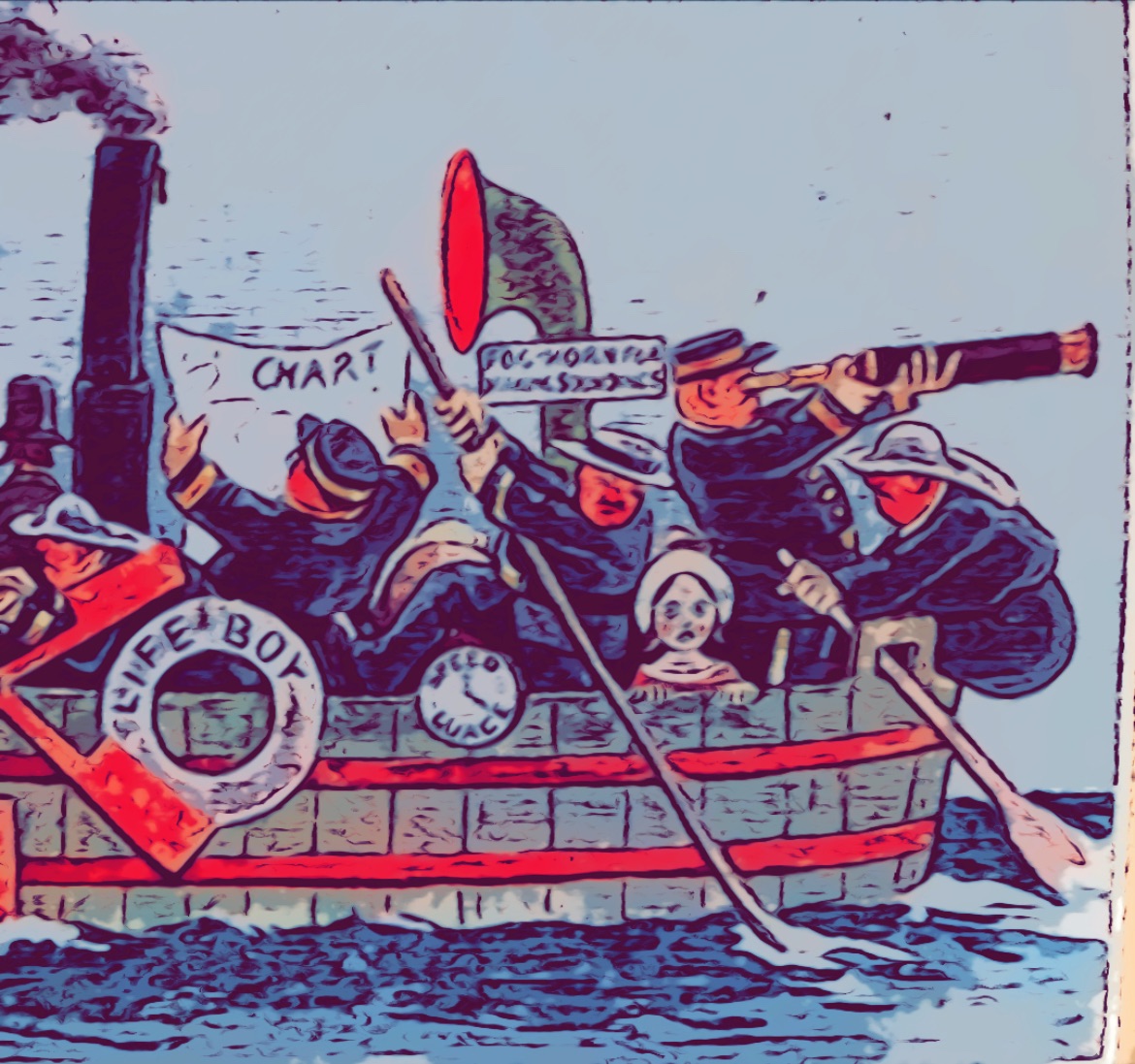
Notes: The featured image is from a photo of holiday postcards I took in a museum – I’ve entitled it ‘History Sails Forward’. It’s an image captured from ‘the past’, held within a time-capsule.

References:

Bonefeld, W. (2023) A Critical Theory of Economic Compulsion: Wealth, Suffering, Negation London: Routledge.

AI? Aye, aye! Hyperbolic claims from Snooze-inducing Technologists

We’ve heard it all before. A new technology is going to ‘revolutionise’ everything, from the way we work to the way we play, learn, and relate. Yet, funnily enough, according to the ‘visionaries’, the basic social and political features of our current conditions won’t change. These aren’t going anywhere – the profit motive, unequal access to resources, the consumer ‘me too’ infantilisation, and the job as a lifetime of ‘confinement’. The boss may have fewer employees, the teacher many more students, whilst the taxi driver goes the way of the coal miner, but social and political inequality will persist, despite the ‘tech’ solutions, just at more extreme levels than ever before (at the moment we only have 1% of the world’s population ‘owning’ – controlling – 50% of human wealth, so there’s some way to go yet in making things more unequal).

In education, artificial intelligence (AI) is going to, apparently, improve the intelligence and writing abilities of my students.  Thank goodness – some improvement at last!  Here was my colleagues and I fighting a constant losing battle, but ChatGPT has it.  Except, it isn’t going to improve their writing even though it may enhance the punctuation in their submissions and neatly, correctly present non-existent papers in their reference lists.  The main concern is that it should help those who no longer have the time to study (part-time work if their working class, and off ‘entrepreneuring’, with family excess cash, if they’re not).  Instead of learning they will learn to ‘cheat’, though we won’t call it that anymore nor frown upon it because everyone will be at it (thereby meeting a Kantian definition of moral behaviour – as long as everyone can do it than it’s ‘okay’).

The bar for acceptable communication will be ‘raised’ as every student becomes a 1950s factory manager able to delegate their inability to spell to a ‘personal digital secretary’, who will take care, uncomplainingly, of such inconveniences and ‘lackings’.  Humanoid robots (androids), the personification of AI beyond old-hat avatars, will take a pink-skinned form of ‘being’ and, thereby, project the power of their possessors via volumes of blonde hair and scarcity of raiment.  Everything will change expect anything that could threaten the social and political order and of importance to the alienated labour that produces AI in the first place.

Perhaps AI will read Adam Smith and Karl Marx and conclude they have been badly misrepresented and poorly interpreted.  But since this has already been done by humans and few have listened, what difference will it make for a machine to ‘say so’?  Will the claim now be ‘fact’?  More likely, the machine will be ‘reprogrammed’ until it comes up with the ‘correct’ answer.

Or AI assistance will aid surgeons to perform twice as many operations as before, though this will actually lead to a quadrupling of cosmetic procedures as every operation still has to be ‘paid’ for and provision will go to those with the most money and the means to afford such AI-assisted surgery. Plumper lips, thinner waistline, larger pecks it is then! Thank goodness for AI since the demand from ageing wealthy pensioners for a ‘lift’ (of some kind) needs to be met.

So, is AI a utopian dream or a dystopian nightmare?

Manuel and Manuel (Utopian Thought in the Western World, 1979) noted that the best utopias startle whilst remaining feasible; they lie between a boring extension of the present and a fantastical leap into the impossible. From what I have read and seen of most AI ‘commentary’ so far, their contemporary predictions and utopias largely fall into the ‘boring extension of the present’ category. They presume waged labour (capital) as the mode of production with its on-going (endless) creation of surplus value (profits, rents, taxes, interest payments) as the ‘natural’ basis of human life, rather than seeing the system as a mere artificial ‘social construction’ of scarcity and an endless requirement to perform unnecessary ‘work’. Despite there being enough food to feed the UK three-times over (in any one year), food banks are popping-up like magic mushrooms to alleviate the conscience of the commodified and ration the access to subsistence of the recently de-commodified. But that’s just the way it is! AI will, no doubt, reconfirm this situation as fact (once re-programmed, of course). Everyone will hold the same social ‘posts’ as before but use ‘revolutionary’ AI to sustain their miserable renting-out of their own backside at ever higher levels of productivity (output per hydro-bot-flesh-thingy).

If this is the future with AI then it is mundane and the so-called ‘predictions’ of its impact are like watching endless (on loop) re-runs of Shelley’s Frankenstein. Been there, done that. Should the narrative makers of AI switch their focus to King Kong (genetic modification gone wrong) and make that ‘fantastical leap’ to the impossible? Or can we, collectively, imagine better, be that bit more imaginative on the social front and startle whilst remaining feasible?

References:

Manuel, F. & Manuel, F. (1979) Utopian Thought in the Western World Oxford: Basil Blackwell.