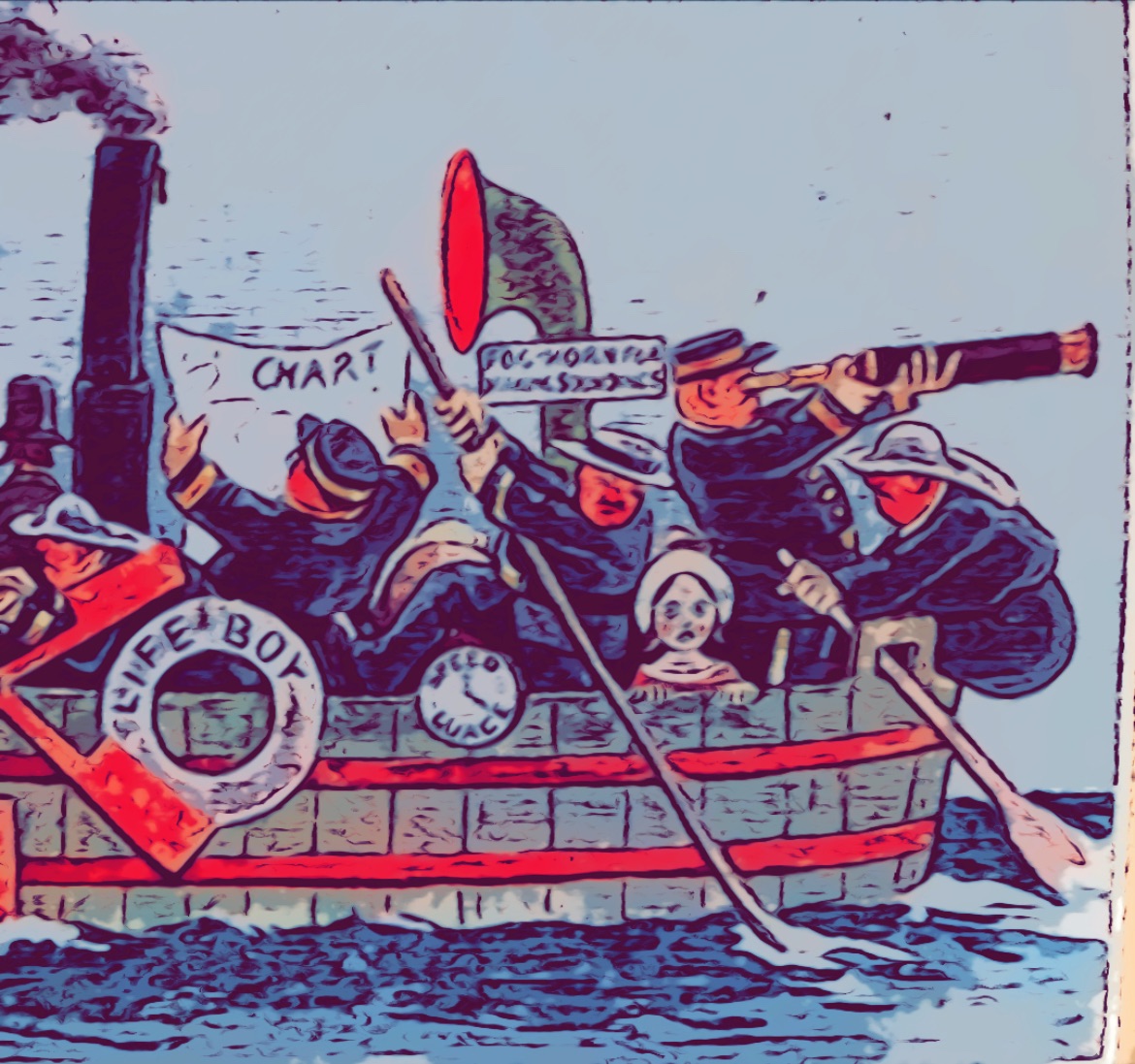
In a recent video interview for publisher Unherd, Yanis Varoufakis asked the question: “Why is the Left the loser of history?’ He went on to argue that the Left failed to “take its opportunity” in the wake of the crisis of capitalism in 2008. Consequently, the ground remained wide-open, only to be filled by the politics of the Far Right.
Of course, since the Left failed in its historic duty to take up the reigns of ‘power’, it has the unenviable position of remaining religiously pure and untainted as the rightful and righteous outcome of ‘history’. It can live for another day, though such a position leads to the inevitable question, given there are ‘right’ and ‘wrong’ sides of history, of ‘why, so far, has the Right always ended up as the victor of history?’
There is a deeper question here: ‘What is history?’
To ‘Left revolutionaries’, Rosa Luxembourg is famous for stating that ‘the’ class struggle will end in either “Socialism or Barbarism”. The openness of the ‘choice’ with which she confronted her comrades indicates Luxembourg did not see ‘socialism’ as an automatic outcome of the ‘historical process’. But her statement does leave two interpretations: (1) that ‘socialism’ is one possible outcome of ‘the historical process’ (for Varoufakis, socialism can be ‘the victor’), and, alternately, (2) that human action – struggle – is the means by which to avoid the inevitable barbarism that ‘the historical process’ will produce (so, ‘socialism’ can never be ‘the victor’ of a socio-historical process humanity must struggle against).
Following the latter interpretation, a key question is ‘what form should the required struggle take?’ Well, aiming to take up the reigns of political ‘power’ (electoral politics; state capture, Social Democracy, Democratic Socialism, Bolshevism, Leninism, Trotskyism, Maoism, Black Power, and Matriarchy) has been tried on numerous occasions. Luxembourg was murdered in 1919, so didn’t live to see the historical outcome of ‘actually existing socialism’.
That is, Varoufakis, no matter how he, himself, sees the world, or understands contemporary ‘history’, needs to deal with the fact that for many people, in certain places and times, socialism has been ‘the victor of history’ and has done nothing but produce barbarism. When socialism has been ‘the victor of history’ then, to change Luxembourg’s quotation: Socialism becomes Barbarism! To the ‘victors’ the spoils.
What has Varoufakis missed?
Varoufakis clearly understands ‘socialism’ to be part and parcel of the historical process – it is a component of the current system which can ‘guide’ history towards a positive outcome. This ‘positivity’ is a theoretical descendant of early utopian socialists (heavily criticised by Marx) such as John Bray and Proudhon – who believed in nationalised banks and ‘fair’ labour exchanges on the basis (as Bonefeld, 2023 puts it) that they could get rid of ‘the capitalist’ but keep ‘capital’ (i.e., the waged labour relationship or social form).
Incidentally, I find Varoufakis’ coining of the ‘concept’ technofeudalism very confusing – a jumble of definitions and meanings. By ‘feudalism’ he appears to serfdom (in a similar way as Hayek referred to ‘The Road to Serfdom’). But this forgets that the tech-bros’ goal is to produce ‘surplus value’ and NOT garner tribune (rents/taxes) under a system of ‘extra-economic’ devine-rights (imposed by ‘direct’ violence). In short, Greece had a Finance Minister who never really understood ‘capitalism’ (conceptually nor practically).
I surmise that Varoufakis has never read the Frankfurt School Critical Theorists (Benjamin, Horkheimer, Adorno), or, if he has, he hasn’t understood them. Benjamin’s Theses on the Philosophy of History reminds us that the point of history is to break with it, not “swim” with its tide. Rather, the struggle is to bring the historical process to a ‘stop’ (to serve the needs of the present) and not drive history to its ‘completion’ (towards some Messianic ‘vision’). Adorno brilliantly sums the same point up: “There is a history which leads from the slingshot to the atom bomb, but not one that goes from barbarism to humanity”.
History is on the wrong side of class struggle – it is a process which runs against the presently-existing needs of humanity. Rather, history (the perpetuation of tradition) is an accumulating “nightmare” which weighs heavily on the “brains of the living” (Marx from 18th Brumaire), compelling them forward on grounds of ‘lack of alternative’. The struggle is to wake up and leave the nightmare; not stay in it to find out who will be ‘victors’. If we stay in it (do not wake up) and keep ‘falling’, then the urban myth tells us there will be just one outcome: Thump!
Notes: The featured image is from a photo of holiday postcards I took in a museum – I’ve entitled it ‘History Sails Forward’. It’s an image captured from ‘the past’, held within a time-capsule.
References:
Bonefeld, W. (2023) A Critical Theory of Economic Compulsion: Wealth, Suffering, Negation London: Routledge.
 Socialising Sense