“Fascism” and the Myth of a Good Capitalism

With the rise of contemporary authoritarian regimes (including those of Duterte, Bolsonaro, Orbán, and Erdoğan) in notional, or prior, ‘liberal democracies’ and especially with the revival of Trump in the US, the term ‘Fascist’ has become a popular and widely applied descriptive term – a quick means of summing up both recent changes and the possible dangers that lie ahead. Of course, like any term, it can suffer from ‘Crying Wolf’ syndrome if it is applied too easily and widely. Indeed, it is known that far-right ‘Libertarians’ can call their more socially-conservative brethren ‘Fascists’, due to differing stances on state-church ‘authorities’ and their political usage. Criticising use of the term ‘Fascist’, however, should not forget that there are connections between a phenomena like the 2nd Trump ‘administration’ and Nazi Germany (and other ‘totalitarian’ states), such as the scapegoating of minority populations, attempts at (and actualised) mass deportations, and a clawing culture of fellow-travelling loyalty to a false-god patriotism. Yet, my criticism here is aimed at the distractive use of “Fascism” in deflecting attention away from the bubbling-stream source of such turns towards reactionary politics, namely, capitalist crises (both with small ‘c’), and the underlying desire for a reconstruction of not just ‘authority’ but, more importantly, profitability.

That recent changes are to be summed up and identified as ‘Fascist’ overlooks two key facts: (1) that there is no form of ‘good’ capitalism against which to contrast the “Fascist” (the latter was/is a product of the former: it’s off-spring); and (2) that Fascism (now in ‘bold’ type) was a specific historic social movement which arose in a pre-Keynesian (so pre-‘planner state’) era, where Fascism represented one ‘possible’ alternate means of capitalism’s ‘evolution’ out of crisis at a specific moment in time (1920s-40s). Furthermore, it competed with Stalinism, Keynesianism, and Japanese Imperialism (all different responses to a global crisis in ‘world markets’, i.e., capital accumulation); only two of which managed to ‘survive’ the war.

Social historian Ellen Meiksins Wood (2002), in The Origin of Capitalism: A Longer View, described the French Ancien Regime as a social form (mode of production) which withered on the tree of life – it literally had its head cut-off by the French Revolution. Nevertheless, in 19th century France there were several attempts at a monarchial revival, and there were certainly members of the French nobility knocking about Europe (never mind France) providing mimetic vocabulary to garnish constitutional debates with their liberal adversaries. Though such nobles did traverse the world with bankers’ drafts in their pocket – not the quick rents nor corvee (labour taxes) of Ancien Regime peasants, ‘incomes’ which were abolished with their ancestors’ ‘offices’ in 1793 (the political positions that had enabled a historically and geographically peculiar form of extra-economic domination). While the idea of aristocratic rule then ‘echoed’ down the decades, the generator of this increasingly-distant sound wave had disappeared in any physical/practical sense.

Hence, today we may have the silhouette of what a reactionary politics coping (or not coping) with a crisis in capitalism accumulation looks like, but in drawing attention to the silhouette do we run the risk ignoring its source: the fire and the people making shadows?

When is a capitalist a “Fascist”?

Let me now turn to matters much more mundane. On Monday 15th September 2025, I spotted an investigative report by the BBC World Service entitled “Ex-London bus driver runs degrading sex-trade ring in Dubai’s glamorous neighbourhoods”. Mr Charles Mweisgwa claimed he “could provide women for a sex party at a starting price of $1,000 (£740), adding that many can do ‘pretty much everything’ clients want them to”. According to women involved, one client “regularly asks to defecate on the women”. The women come from poor countries, notably, rural areas of Uganda; so are being exploited due to their lack of jobs and their desperation to earn a living, to survive. They are drawn to Dubai on promises of obtaining work in “supermarkets or hotels”, and face violence if they want to go back home when the promise (expectation) of normal work is not fulfilled. Reporters were also informed by the women “that clients were mostly white Europeans, and included men with extreme fetishes” – which, of course, can only be fulfilled through cold, hard financial transaction.

Of course, Mr Mweisgwa denies the allegations that he’s a pimp who abuses visa ‘rights’ and uses violence. He merely “helps women find accommodation through landlords, and that women follow him to parties because of his wealthy Dubai contacts”. Thus, it’s the women’s free-willed desire for and chase after money that leads them into such situations – everyone wants a piece of action in Dubai! And Mr Mweisgwa doesn’t appear to be a Fascist, even though he facilitates arrangements which are clearly racist. As one witness noted: [The white clients] “want somebody who is going to cry and scream and run. And that somebody [in their eyes] should be a black person”. But if they turn to the police, they are told: “You Africans cause problems for each other. We don’t want to get involved”.

Indeed, Mr Mweisgwa is a worker (a former wage slave) ‘made good’. From starting out as a bus driver in London, he now appears to be ‘living the dream’ in a posh part of Dubai. He doesn’t seem to be bothered by either racism (he is Black living alongside Dubai’s police, who wouldn’t care about offering him protection) nor nationalism (after all, his business is international and multi-national, offering Europeans the services of Africans in a Western Asian/Arab setting). As far as the Dubai authorities are concerned, nothing illegal is taking place, as it’s just Africans hurting each other. Tightened rules on immigration would harm his profitability. Mr Mweisgwa has moved from being one of life’s exploited to being one its successful exploiters. He’s now making more money than he did before, when he was an ‘honest’ bus driver. That’s business. That’s good business. This is the outcome of societal values instilled within Mr Mweisgwa. Once he ‘makes’ enough money the red carpet will be rolled out for him. Dirty money will be cleaned; it will go on to be invested in all sorts of ‘wholesome’ essential businesses (from tyre manufacturing to artificial intelligence and fast-food outlets). After this point, all taxes will be paid, and respect ‘earned’. There is nothing unusual here, as this is everyday capitalism.

Holding on to Capitalism without “Fascism”

Can we imagine Mr Mweisgwa’s ‘enterprise’ operating under the keen eye of ‘inspector capitalism’, that is, the left-leaning social marketeers of socialist heritage who, apparently, want to regulate their nation’s workplaces into conditions of ‘social justice’? The BBC are bringing our attention to this specific case because of its extremities. But it is not just because someone defecating on another (abused) person will gain readers and ‘clicks’ (an instrumental requirement of the media industry, for it to make money or at least justify journalists’ existence). Rather, Mr Mweisgwa’s enterprise does not meet the ‘ideal’ (utopian) standards of how capitalism should operate, as set down by large multi-national corporations such as McDonalds, Walmart, Elbit Systems, Coca Cola, Astra Zeneca, Pfizer, Lush, Ben & Gerry’s, Shell, Mobile, Starbucks, etc. The BBC are reminding us that this is not the way in which things ‘should be’ organised under capitalism – the ‘good’ capitalism that everybody loves and is ‘in favour’ of as “the worst system available, except for all the others” (Churchill).

But the ‘good’ capitalism is mythical as it always relies on memory loss. It’s a product of dementia, literally, being driven demented. Money ‘earned’ during the slave era was reinvested, reinvested and reinvested. But more importantly, as Bonefeld (2023) puts it, today’s workers are employed with money stolen from the very same workers the day before. The system is continuous, with no ‘break’ between the bad and the good days.

Yes, people are suffering under the new “Fascist” Trumpian regime; but people also suffered under Obama, who increased the number of drone strikes in Afghanistan and Iraq on his predecessor, George W Bush, who launched an illegal war leading to the deaths of 1.6 million people. Prior to this Bill Clinton bombed Iraq several times. All of them supported Israel and its use of ‘administrative detention’, based on a law introduced by the British in the 1920s. All of these, along with Western European ‘democracies’, saw regimes such as the Dubai, Qatari, Bahraini, and Saudi ‘monarchies’ as allies (who regularly used torture). Meanwhile, take up a ‘counter-hegemonic’ stand with Second and Third World ‘nations’ and governments isn’t going to help in the classification of Trump as ‘weirdly’ out of sync with what has gone before: Putin, Xi, the Kims, Modi, the Egyptian-Pakistani-Brazilian-Greek-Turkish-Argentine military ‘juntas’, then there are the Black Nationalist ‘socialists’ of East Africa, the Apartheid of South Africa. Can or should we redefine ‘Fascism’ as when suffering ‘comes home’?

My point, to be clear, is not that type of ‘regime’ does not make a difference to ordinary peoples lives, and especially to some people (the lucky ones). Of course regime change can make a difference. But calling Trump a “Fascist” simply takes away from the fact he is a “Capitalist”. And he is the latter first and foremost! Trump has always been motivated by money and capital accumulation; as have his entourage. They are all motivated just like Mr Mweisgwa. Trump’s policies, which he himself has given no overall ‘ideological’ shape to (we see this in his erratic swings and shifts), are an experimental, hotch-potch attempt (similar to Thacther’s) to reconstruct ‘capital’, by which I mean the relationship of labour to capital, between workers and money. The days of seeing the ‘capitalist’ as a top-hat wearing Mr Scrooge are long gone – such people never controlled, individually, the dispossession of indigenous communities, enclosure of land, the enforcement of private property ‘entitlements’ (‘rights’), the privation and starvation of needless / ‘useless’ mouths, programmed reductions in the cost of living (e.g., the reproduction of workers through cheap, subsidised housing), nor the ‘required’ education (indoctrination) of workers and the wider population. It is the (capitalist) State that has always been tasked with ensuring the population of its territorial area (domain) becomes and remains compliant with the core, self-evident truth of modern (bourgeois) society, namely, the successful accumulation of capital: that (as Mr Mweisgwa discovered) money can somehow, magically, become more money. Grabbing the state’s levers hasn’t just been a tactic of Fascists – its been done by Leninists, Conservatives and Social Democrats – but the results have always been some form of reconstruction of ‘capital’, and never the State’s own “withering away”.

So, is Trump a “Fascist”? Well, let’s say he is. The question becomes ‘so what?’ He’s a capitalist, and it is the ‘idea’ (notion) that there can be some form of better or ‘good’ capitalism (a utopia of cold monetary relations) that needs to be questioned!

References:

Bonefeld, W. (2023) A Critical Theory of Economic Compulsion: Wealth, Suffering, Negation London: Routledge.

Wood. E. M. (2002) The Origin of Capitalism: A Longer View London: Verso.

History produces nothing but Barbarism

In a recent video interview for publisher Unherd, Yanis Varoufakis asked the question: “Why is the Left the loser of history?’ He went on to argue that the Left failed to “take its opportunity” in the wake of the crisis of capitalism in 2008. Consequently, the ground remained wide-open, only to be filled by the politics of the Far Right.

Of course, since the Left failed in its historic duty to take up the reigns of ‘power’, it has the unenviable position of remaining religiously pure and untainted as the rightful and righteous outcome of ‘history’. It can live for another day, though such a position leads to the inevitable question, given there are ‘right’ and ‘wrong’ sides of history, of ‘why, so far, has the Right always ended up as the victor of history?’

There is a deeper question here: ‘What is history?’

To ‘Left revolutionaries’, Rosa Luxembourg is famous for stating that ‘the’ class struggle will end in either “Socialism or Barbarism”. The openness of the ‘choice’ with which she confronted her comrades indicates Luxembourg did not see ‘socialism’ as an automatic outcome of the ‘historical process’. But her statement does leave two interpretations: (1) that ‘socialism’ is one possible outcome of ‘the historical process’ (for Varoufakis, socialism can be ‘the victor’), and, alternately, (2) that human action – struggle – is the means by which to avoid the inevitable barbarism that ‘the historical process’ will produce (so, ‘socialism’ can never be ‘the victor’ of a socio-historical process humanity must struggle against).

Following the latter interpretation, a key question is ‘what form should the required struggle take?’ Well, aiming to take up the reigns of political ‘power’ (electoral politics; state capture, Social Democracy, Democratic Socialism, Bolshevism, Leninism, Trotskyism, Maoism, Black Power, and Matriarchy) has been tried on numerous occasions. Luxembourg was murdered in 1919, so didn’t live to see the historical outcome of ‘actually existing socialism’.

That is, Varoufakis, no matter how he, himself, sees the world, or understands contemporary ‘history’, needs to deal with the fact that for many people, in certain places and times, socialism has been ‘the victor of history’ and has done nothing but produce barbarism. When socialism has been ‘the victor of history’ then, to change Luxembourg’s quotation: Socialism becomes Barbarism! To the ‘victors’ the spoils.

What has Varoufakis missed?

Varoufakis clearly understands ‘socialism’ to be part and parcel of the historical process – it is a component of the current system which can ‘guide’ history towards a positive outcome. This ‘positivity’ is a theoretical descendant of early utopian socialists (heavily criticised by Marx) such as John Bray and Proudhon – who believed in nationalised banks and ‘fair’ labour exchanges on the basis (as Bonefeld, 2023 puts it) that they could get rid of ‘the capitalist’ but keep ‘capital’ (i.e., the waged labour relationship or social form).

Incidentally, I find Varoufakis’ coining of the ‘concept’ technofeudalism very confusing – a jumble of definitions and meanings. By ‘feudalism’ he appears to serfdom (in a similar way as Hayek referred to ‘The Road to Serfdom’). But this forgets that the tech-bros’ goal is to produce ‘surplus value’ and NOT garner tribune (rents/taxes) under a system of ‘extra-economic’ devine-rights (imposed by ‘direct’ violence). In short, Greece had a Finance Minister who never really understood ‘capitalism’ (conceptually nor practically).

I surmise that Varoufakis has never read the Frankfurt School Critical Theorists (Benjamin, Horkheimer, Adorno), or, if he has, he hasn’t understood them. Benjamin’s Theses on the Philosophy of History reminds us that the point of history is to break with it, not “swim” with its tide. Rather, the struggle is to bring the historical process to a ‘stop’ (to serve the needs of the present) and not drive history to its ‘completion’ (towards some Messianic ‘vision’). Adorno brilliantly sums the same point up: “There is a history which leads from the slingshot to the atom bomb, but not one that goes from barbarism to humanity”.

History is on the wrong side of class struggle – it is a process which runs against the presently-existing needs of humanity. Rather, history (the perpetuation of tradition) is an accumulating “nightmare” which weighs heavily on the “brains of the living” (Marx from 18th Brumaire), compelling them forward on grounds of ‘lack of alternative’. The struggle is to wake up and leave the nightmare; not stay in it to find out who will be ‘victors’. If we stay in it (do not wake up) and keep ‘falling’, then the urban myth tells us there will be just one outcome: Thump!

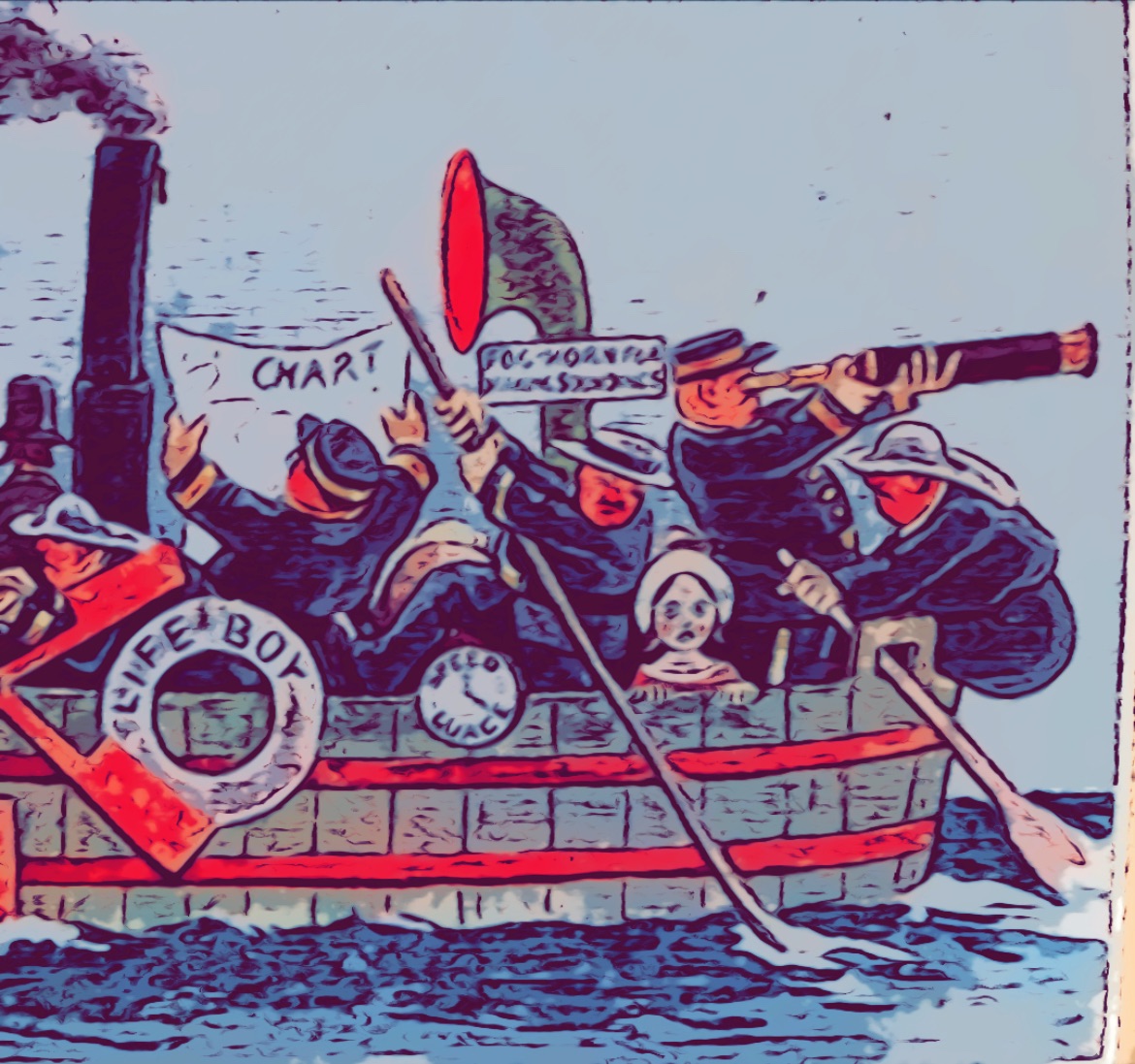
Notes: The featured image is from a photo of holiday postcards I took in a museum – I’ve entitled it ‘History Sails Forward’. It’s an image captured from ‘the past’, held within a time-capsule.

References:

Bonefeld, W. (2023) A Critical Theory of Economic Compulsion: Wealth, Suffering, Negation London: Routledge.

Marx’s Anarchism and the Politics of Capitalism

On the relevance of Marx in times of ‘Zombie Capitalism?’

Studying an author hermeneutically refers to understanding a writer by standing in their shoes and seeing the world from their perspective.  Studying political writings in such a manner was advanced in the mid-20th century by scholars like those in the ‘Cambridge School’ of history of political thought.  

When Karl Marx was writing Capital, in mid 19th century, the term ‘left’ (on the political spectrum) meant being ‘radical’ whilst ‘right’ referred to being ‘conservative’.  The designations (literally positions or ’wings’) were taken from the post-revolutionary Constituent Assembly of France, with the colours derived from the Republican tricolour flag. 

However, by the mid 20th century, during the post-war consensus, ‘the left’ was associated with support for state control of the economy and government social intervention whilst ‘the right’ had come to be associated with anti-state individualism and ‘liberalism’ (or Hayekian ‘market non-interventionism’).  By the 1970s and ‘80s a new breed of ‘post-consensus’ right-wing politicians emerged who were deemed (in many respects correctly) ‘radical’.

Reagan and Thatcher were the most prominent ’radicals’ to have ideologies named after them (Reaganism and Thatcherism).  Such radical right-wingers wanted to tear down what they saw as a ’statist’ establishment which, of course, many left-wingers wanted to ‘conserve’.  The switch in meanings of left and right was completed in the form of conservative left-wingers (whether Bolsheviks, Maoists, Post-colonialists, Keynesians, Swedish Social Democrats, British reformers, or any other version of left ’state power’ grabbers who felt they had something to preserve, a status quo).

This kind of ‘conservative’ left statism was not unknown to Marx.  Marx’s awareness can be detected in his many critiques of ‘utopian’ socialists during his lifetime, from Robert Owen to his Critique of the Gotha Programme (of the German Social Democratic Party, SPD). But Marx describes workers taking control of (rather than power over) society on very few occasions, with his most prominent account featured in news articles published (later) by Engels as The Civil Wars in France (1871).

This was Marx’s account of the rise and fall of the Paris Commune (1870).  Importantly, what he describes in these articles is a delegate-based anti-statist workers’ council or commune system (the word ‘commune’ meaning grassroots council).  ’Councils’ were both local (geographically-centred – the rural village) and vocational (workplace or activity centred – e.g., a weavers’ collective) to ensure different elements of society were heard, but significantly that no-one living off the private expropriation of production (performed by others) would be (easily) heard.  This was a reversal of the prior situation where a separate class of politicians (who expropriated or represented expropriators, and even proprietors of private ‘labour power’) formed the state and government. 

Furthermore, when Marx was asked if the ‘stage’ between pre-capitalist and communist societies could be by-passed or skipped, he eventually nodded to a positive answer regarding the development of existing Russian ‘communes’ (in a letter to a Narodniki).  To be clear, I consider him hinting that ‘industrialisation’ and ‘urbanisation’ were not prerequisites to the fulfilment of some objectified ’inevitable’ historical progression working ‘at the backs of people’ towards ‘socialism’ and then ‘communism’ in a compulsory stadial trajectory.

As ‘communes’ already existed in Russia they could form the basis of an emancipated society, without a deranged detour through ‘capitalism’!  However, Marx still thought that the experience of capitalism would be more likely to produce a social revolution, given the nascent conservatism of the rural commune – put another way, more advanced industrial countries should see a revolution first given the (contradictory) life conditions they generate.  Also, given capitalism’s existence (historical arrival, even by accident) hopes of a direct transition from peasant communes were, simply, after the fact even in the mid-Victorian era.  The social form that gave rise to such hopes (the peasant village eulogised by the Narodniki) was already disappearing, specifically in the advanced and developing industrial nations who had the power to colonise and suppress every other type of social form or mode of production

Nevertheless, and this is a salient point, I would argue that for most (if not all) of his political life Marx was what would be known, in both 19th and 20th centuries, as an ‘anarchist’!  The point of the Paris Commune’s mandatory delegation system was to ensure there would be no separation between a (professional) political class and the rest of the population.  Thus, parliamentary ‘representation’ with its political leadership (elites or vanguards) was simply not good enough since it would reproduce one of the fundamental social / political divisions which Marx wished to see the back of.

Indeed, one way of outlining how Marx understood the ‘politics’ of capitalism, compared to feudalist and ancient slave modes of production, was that capitalism makes what was obvious in the others (direct political domination) an inconspicuous, or ‘hidden’, process (via indirect economic domination under the ‘guise’ of ‘fair’ trade – see Ellen Meiskins Wood, 2002).

But how did the previously noted transition in meaning, from the 19th century radical left / conservative right to the 20th century conservative left / radical right, take place?  The answer, not surprisingly, was via successful social revolution in the early 20th century!  The conceptual and analytical problem here is that all too often activists (those present at the time) and commentators (contemporary or later) have focused attention on the ‘trees’ whilst failing to see the ’wood’!  Hence, we end up with histories and analyses of ‘The Russian Revolution’ (1917), ‘The German Revolution’ (1918-19), ‘The Hungarian Revolution’ (1919-20), but don’t hear much about ‘The Irish Revolution’ (1916), the Syrian democratic constitution (1919-20), ‘The Finnish Revolution’ (1917-22) nor ‘The British Revolution’ (1918-22).  Generally, a global move towards universal suffrage, imposed from below as part of a working class revolution in political practice (namely, direct democracy), gets overlooked. 

The dominant analytical time frames and intellectual interests tend to be centred on what can be described as moments of coup d’etat (significant but fleeting changes within forms of political ‘representation’) which merely punctuated much broader social changes.  With the latter including changes in working practices, shifts in artistic practices and possibilities in communication, but also developments in social roles and recognition – the rise of married women in the workplace, the emergence of state welfare recipients (like working-class ‘pensioners’ in Britain), the emergence of ‘childhood’, and the extended legal reach of the state (such as compulsory purchase of land, military conscription, and nationalisation of banking). 

One way of taking a wider survey of the workers’ revolution is to frame it in terms of all those socio-politico-economic changes taking place between the start of the Great War (1914) and a final capitulation of ‘traditional’ (pre-fiat money) capitalism in the Wall Street Crash (1929); a fifteen year period after which things can never go back to the way they were before though the desire to do so (right-wing radicalism) continues to be felt as an echo – the march of the Zombies.

Whether we understand ‘the revolution’ as having succeeded (the eventual emergence of the Soviet Union as a ‘workers’ state’) or failed (the crushing of the German Revolution by the freikorp in 1919), by the early 1930s states (and/or public, centralised institutions associated with them, such as central banks) are everywhere taking the lead role in forming (and/or reforming) the most advanced ’capitalist?’ economies.  From here on, I place a question mark on ‘capitalism?’ to indicate the far-away hills distance of the classic liberal model or mode.  Both the ideology and practice of classical ‘liberal’ political-economy was ’dead’ but also ‘alive’ as a zombie.

Whereas before 1914 capitalist enterprises mostly got on with the job of reproducing, disciplining, exploiting workers in an autonomous manner (with little to no state intervention), by the early 1930s the state becomes, increasingly, an integral part of the social process, including the production of surplus value (profit) via a national organisation of surplus labour time (e.g. how to manage unemployment).  States did take different forms, such as ’total‘ states (a singularity, as in the Soviet Union and Nazi Germany) compared to ‘hegemonic’ ones (pluralities dominated by mass cultures and technocratic control), but the main task of all states / governments was to reproduce (provide subsistence to), discipline, and (successfully) exploit workers directly as the key means of sustaining the wage-labour mode of production. The purpose of the modern nation-state, after all, is to ensure the compliance of the population (whether worker, manager, capitalist, or politburo member) under its territorial control with the accumulation of capital.

By exploitation, of course, I include the ideological elements of emotional exploitation (something Gramsci picked up on as hegemonic cultural domination): “Heave away lads, put your backs into it, for the benefit and sake of the nation!”  A new ‘social contract’ between political elite (the state) and the people (workers) was being founded, and in many experimental forms – Soviet Communism, Italian Fascism, Japanese Imperialism, Irish and Finnish nationalism, German Nazism, the American New Deal, Jewish Zionism, and ‘Greater’ Britishness (re-modelling the Empire as ‘Commonwealth’).  The last of these was even mooted, at one point, as a new country, called Greater Britain.

Some of these were ethno-nationalist (Nazism / Zionism) whilst others were pan- or trans-nationalist (the Soviet federation and British unionism), but almost all (excepting the smaller nations) led to expansionism (ultimately, war).  In contrast with the era of joint-stock ‘liberalism’, state-control of economic and social life was now in the driving seat.  Many of these subsequently failed (losers to others in war) and the leading ideologies emerged as those of (Western) ‘Keynesianism’ and (Eastern) ‘Communism’, with a common connection in ‘state-led’ social formation.  It is not inaccurate to describe the outcome as socialism, with socialism as the natural religion (‘binding’) of capitalist alienation.

In this sense, ‘a’ social revolution did take place in the early 20th century, but one with a compromised, synthetic outcome.  In Gunn and Wilding’s (2022) Hegelian terms: mis-recognition pertained.  Workers gaining universal suffrage in Britain was ‘a revolution’, but one that is almost always overlooked!  Sometimes the achievement of suffrage is deemed a mere ‘concession’ by a ruling class determined to retain their power through more subtle methods (the hegemonic control of education and broadcast media, as pinpointed by Gramsci’s early analysis of Italian Fascism).  But to rob the period and Gramsci of their ‘openness’ produces an historiography which makes the ruling class ‘oh-so clever’, as if it was their ‘Revolution’. 

More tellingly, the same social revolution produced a crisis in surplus value production (and the rate at which accumulation could proceed) – the Wall Street Crash both questioned the emerging fascist conceptions of a ‘New Man’ (much admired by elite figures such as the British Royals: Edward Prince of Wales and Albert Duke of York) whilst also hastening change.  As Thomas Piketty’s (2018) empirical data has demonstrated, before 1914 capital accumulation grew at a rate faster than wage growth, but throughout the mid-20th century the reverse was true (wages grew faster than profits).  ‘Capitalism?’ had been saved by socialist collectivism (the amalgamation of multiple capitals into a singularity), but at massive economic and social (status) cost to the conventional ruling class and its practices.  Workers, in their role as waged workers (subjects central to the accumulation system), had imposed their interests and gained decision-making power within the capitalist state mechanism, even if their so-called ‘class consciousness’ remained ‘corrupted’.

In his overview of Keynes’ theoretical work, and reformation of capitalist strategy, Negri, in Revolution Retrieved (1988), coins the term positive Keynesianism to refer to the immediate post-war period (1945-1973) when state welfare benefits and full employment policies were used to encourage and entice employees to work hard and raise their productivity.  This ever-rising productivity was central to the strategy and was baked-in to a social necessity for endless economic growth and, so long as the economy could be grown at a sufficient rate, the fact wage earners (as property owners) were making distributional ground on recipients of profits, rents and taxes was an acceptable trade-off, especially as any class relying on unearned income was on the back foot.  But with ‘stagnation’ in the 1970s the situation grew desperate for profiteers, rentiers and public servants (tax-takers) meaning something needed to be done – the rise of the right-wing radical was witnessed just as open ‘class conflict’ surfaced or re-emerged.

This conflict produced a shift in the social contract, but not one from Keynesianism back to Liberalism, despite the hopes of the radical right-wing ideology known as ‘Neoliberalism’.  Rather, Negri describes the shift as one towards negative Keynesianism.  That is, rather than the state taking a reduced and fading (or to use Marx’s phrase, vanishing) role in ‘the economy’, which is what Neoliberals like Thatcher may have ‘thought’ was going to happen (or wished would happen in a return to the ‘classic’ era), negative Keynesianism maintained levels of state intervention in social life (and its prominence in guaranteeing the reproduction, discipline, and exploitation of the working class).

Instead of positive encouragements (material benefits; socialised myths of ‘we are all in it together’), negative Keynesianism ‘liberated’ the representatives of monied-capital only by ‘oppressing’ worker dissent to capital’s imposition that people remain ’waged labour’.  Militarisation of society (higher prison populations; investment in security, securitisation, and surveillance), the piling on of indebtedness (for housing, education, and health), and creeping isolation (social individualisation and insulation: gated communities; financial ‘independence’) were the negative Keynesian modes of operation.

So, what is the importance of the above analysis of social change over the last 100 years with regards to studying Marx’s Capital?  On the one hand, when we read Marx via his original writings his anti-statist (radical) position must be kept in mind – his anarchism means he was against political systems containing social divisions between rulers and ruled.  He would have been appalled by the ‘Soviet’ regime produced not just by ‘Stalin’ (that is too easy a cop-out) but Bolshevism from its inception (in 1892). Marx would have recognised the ‘council communist’ and even ’liberal democratic’ revolution that occurred in Russia in Feb (or March) 1917 as progressive whilst reserving criticism for remnants of expropriator influence and power. 

Whilst Bolshevism did get a ‘populist’ upper-hand on (the more ‘reformist’) Menshivist movement (largely related to ending the war immediately), leading to the ‘October Revolution’ (a coup d’etat), the dismantling of the Soviet (‘council’) system and democratic ‘reforms’ happened very quickly under Lenin’s centralisation of political institutions.  The democratic arrangements of Feb-Oct 1917 may not have led to a ‘non-statist’ system, as Marx would have desired, but they could have produced a different outcome for both Russia and Germany in the 1920s (Luxembourg did not feel the time was right for the kind of ‘coup’ attempted by workers in Germany).  Probably the ‘revolution’ would have developed more along lines of what happened in the Western world.  Marx reserves his ‘ire’ for statist politicians of all shades in his political writings, as well as those who try to ‘force’ history and recognition forward (e.g., the professional ‘revolutionary’)!

On the other hand, a standard objection to taking Marx seriously is that, given all the social and technical ‘change’ that took place during the 20th century, surely Marx’s writings are limited to the kind of 19th century capitalism he witnessed (of the classic liberal type)?  Namely, he is good at excoriating Mr MoneyBags, the woefully selfish carpetbagger and child-exploitative industrialist of Victorian slum cities, but modern capitalist corporations are operated by equality, diversity and inclusion-qualified executives who are socially aware and just don’t operate in the same way as the Victorian businessman!  I would point out that whilst Marx is often associated with writing a ‘grand narrative’ (an overarching account of the large sweep of history, a la The Communist Manifesto) his study in Capital is highly specific

Capital is an examination of just one type of social relation (or mode of production) – the wage labour / capital relationshipMarx’s work analyses (breaks down) this relationship and identifies its complex and multifarious derivative forms – that is, if we find ‘the commodity’ (which is produced and appears everywhere in daily life – part of our immediate experience) then we will also find both mutual recognition and value (defined as socially necessary labour) – anyone producing ‘commodities’ must recognise others as equivalents (owners) and produce at a socially-recognised rate (e.g., items per hour).

If we then find that human ‘labour power’ is one of the commodities available for purchase, then we will find ‘surplus value’, which is produced via ‘absolute’ and ’relative’ processes, and so on.  The argument in Capital Is not an ‘historical’ story but Marx’s way of laying out a conceptual ‘unfolding’.  One difficulty, compared to earlier classical political economists, is in getting the order of conceptual presentation correct, so that the reader does not go off on the wrong foot by starting with something which is ‘derivative’ (e.g., ‘profit’).

In summary, Capital is a study of one kind of social relation, and wherever that social relation (waged labour) is found then Marx’s analysis remains applicable, no matter how technologically-advanced or different a ‘society’ might happen to appear.  The main question, therefore: is ‘our society’ still based on waged labour (capital)?  If so, then Marx’s Capital is [remains] relevant. The flesh of the elephant may have fallen away, but to the trained anatomist what stands before them is still an elephant.

Publication Note:

I wrote (started) this article in February 2024, but it then lay dormant and unfinished (on my cloud drive) until September 2025. Reading my friend Werner Bonefeld’s (2023) book (A Critical Theory of Economic Compulsion Routledge) inspired me to return to it and at least publish, in a still unfinished form (the referencing is incomplete; if / when I get the time I will return to this element).

References:

Bonefeld, W. (2023) A Critical Theory of Economic Compulsion: Wealth, Suffering, Negation London: Rutledge.

Gunn, R. & Wilding, A. (2022) Revolutionary Recognition

Negri, T. (1988) Revolution Retrieved

Piketty, T. (2018) Capital in the 21st Century

Wood, E. M. (2002) The Origins of Capitalism: A Longer View