Anti-Racism, Capitalism, and the University: A Reconsideration

Universities have invested significant time and resources in anti-racism initiatives designed to address inequality, challenge discrimination, and create more inclusive environments. At the University of Edinburgh, one such initiative is Anti-racism at Edinburgh, a programme that combines institutional reform, staff development, and educational resources intended to foster anti-racist awareness and practice. Yet, an important question remains largely unexplored: can racism be understood apart from capitalism itself?


In my open-access essay, A Critique of “Anti-Racism at Edinburgh”: Race, Commodity Exchange, and the University (McGrail, 2026), I argue that contemporary anti-racism has drifted away from earlier traditions that viewed racism, colonialism, class exploitation, and capitalism as deeply interconnected phenomena. Rather than rejecting anti-racism, my aim is to challenge what anti-racism has become within modern institutions and ask whether meaningful anti-racist practice is possible without an attendant critique of capitalism (with the latter understood as commodity exchange).


From Radical Critique to Corporate Anti-Racism

I will begin by drawing attention to a contrast between contemporary institutional anti-racism and the work of earlier ‘racial capitalism’ thinkers such as Frantz Fanon, C.L.R. James, Eric Williams, Angela Davis, Selma James, and Cedric Robinson. The analyses of these mid-20th century activists did not treat racism primarily as a problem of representation, distribution, or unconscious bias. Rather, they understood racism as emerging from historical social processes connected to empire, colonial conquest, labour exploitation, and capital accumulation – in short, commodity exchange and its various alienations.


For such writers, anti-racism was inseparable from broader struggles against capitalist institutions of domination, including the exploitation of enslaved labour, the extraction of colonial resources, and the development of global capitalism that formed the historical foundations of racial inequality. Anti-racism, therefore, demands more than personal reflection or institutional reform. It requires the confronting of social and economic systems that produced racial hierarchies in the first place, and continue to do so.

I would contend that much contemporary anti-racism has moved away from this tradition. Universities, corporations, and public sector organisations increasingly focus on diversity, inclusion, representation, and equitable access to opportunities. But, while these goals are valuable, they rarely involve any sustained nor deep examination of capitalism, the social effects of commodity exchange, the associated need for managerial authority (i.e., elitism), nor the principal drives behind economic inequality (across all population ‘groups’, or as Selma James might put it, ‘social castes’).


The result is what I term corporate anti-racism: a form of anti-racism that seeks greater inclusion within existing structures rather than fundamental transformation of the social model of production. Under this approach, the objective is to ensure that positions of influence and power are accessible to a wider range of people rather than questioning the underlying requirement of / drive for domination and power.


The Rise of Whiteness as an Explanatory Framework

A central theme of my critique concerns the growing prominence of Whiteness as a framework for understanding inequality. Within contemporary anti-racist education, concepts such as White privilege, systemic racism, and White supremacy are frequently used to explain persistent social disparities. Such frameworks encourage participants to become aware of the advantages they may ‘possess’, as well as the deeper issues that shape unfair and ‘socially unjust’ opportunities and outcomes.

And I readily acknowledge the usefulness of some of these concepts in revealing inequalities that often remain invisible to those who (supposedly) benefit from them. However, Whiteness frequently functions as a substitute for the political economy of capital and the social power of money. Rather than explaining inequality through systems of production, ownership, labour relations, or private economic power derived from communal dispossession (or the peoples’ separation from public wealth), attention becomes concentrated on racial identity as explanatory motivation.


As a consequence, capitalism itself can disappear from view. Social inequalities become interpreted primarily through racial categories rather than through the broader organisation of society and its hierarchies. Subsequently, race increasingly becomes the ‘master’ explanation (or new ‘grand narrative’), while the ‘socially accepted’ institution of commodity exchange becomes either a non-issue or a set of ‘background conditions’ that receive comparatively little attention.


The question I would raise, therefore, is not whether racial privilege exists (it clearly does) but whether analyses centred on Whiteness can adequately explain why societies repeatedly generate discrimination and inequality in the first place?


The Anti-Racist Journeys

One of the most distinctive aspects of Edinburgh’s anti-racism programme is its use of developmental learning pathways known as the White Anti-Racist Journey, the Mixed Anti-Racist Journey, and the Racially Minoritised Anti-Racist Journey. These frameworks draw upon established theories of racial identity development and seek to help participants move from limited awareness towards deeper critical consciousness.


There is much to admire in this educational approach encouraging self-reflection. After all, Socrates noted that the unexamined life is not worth living. Indeed, I positively recommend the work of Paulo Freire, whose concept of critical consciousness continually emphasised the importance of recognising forms of oppression that often appear natural or invisible.


Yet, I want to question key assumptions embedded within Anti-Racism at Edinburgh’s three-journey model. One concern is that participants are required at the outset to locate themselves within predefined racial categories. Reflection then proceeds from those categories rather than questioning them. And this risks treating race as a fixed foundation of identity when, in reality, identity is a dynamic, contradictory, and historically shaped ‘product’ (or outcome). Human beings are rarely reducible to a single dimension of their social existence under conditions of commodity exchange. Not least because commodities are always two-dimensional (exchange entailing, at minimum, two commodities and two subjects, each present in the mind of the ‘other’).


By beginning from accepted racial categories, acclaimed anti-racist education, therefore, inadvertently reinforces precisely the forms of classification it seeks to challenge.


Image: Transparent Heads (from exhibit at Sunderland Glass Centre) [Photo: Brian McGrail (c) July 2023].


Fanon and the Problem of Identity

A thinker who has always exerted a strong influence on my consideration of ‘race and racism’ is Frantz Fanon. In Black Skin, White Masks (1952), Fanon explored the psychological effects of colonialism and racism. Importantly, his work concentrated on the contradictions experienced by colonised subjects who internalise the values, aspirations, and assumptions of the colonial (and, hence, capitalist) order.


Fanon famously wrote of his desire to become “White”. This was not an endorsement of White identity but a reflection on the psychological distortions produced by a social order in which Whiteness functioned as a value-laden symbol of status, recognition, and even ‘humanity’ (i.e., being ‘civilised’). Fanon, thereby, argues that racial identities cannot be understood as fixed nor self-contained categories. People frequently occupy contradictory positions. They may resist aspects of the dominator while simultaneously desiring inclusion within the process of domination (what George Novack, 1978, refers to as “A is not equal to A”). They may oppose systems of authority and inequality while adopting values generated by those very systems.


This emphasis on contradiction leads us towards a dialectical perspective (influenced, as Fanon was, by Hegel). Rather than seeing social identities as stable entities, dialectical thinking emphasises movement, conflict, and transformation. Individuals continually become something different from what they previously were, even ‘are’. From this perspective, race is less a permanent identity than a (wobbly) social process shaped by relationships, power structures, and historical conditions. It is akin to how Marx treated the categories of commodity, money and capital – they might appear solid, but, from their owners’ perspective, can easily “melt into air”.


Does Race Create Racism?

One of the issues I have been most intrigued by is Fanon’s use of the work of Joachim Marcus, a mid-twentieth-century psychoanalytic theorist. Marcus argued that prejudice develops not because specific groups exist but because social attitudes seek objects onto which their desires can be projected. In his memorable formulation (footnoted by Fanon), “it is the attitude that finds the content and not the latter that creates the attitude.”


This insight reverses a common assumption. Many contemporary discussions proceed as though race exists first and racism (maltreatment of a caste) subsequently develops. But Marcus (and through him, Fanon) suggests the opposite possibility: racism, via acceptance of its generative processes, help to create race (as its object).


In other words, social process (like commodity exchange) generate categories through which people are classified, divided, and ranked. These categories then acquire an appearance of permanence and naturalness. Yet their origins lie in historical struggles and social processes rather than in any ‘biological reality’. And this argument resonates strongly with modern scholarship that understands race as a social construction rather than a fixed natural fact.


Bringing Capitalism Back In

Consequently, as I worked on writing my essay I ultimately wanted to return to the question of capitalism. Drawing upon Karl Marx’s opening chapters of Capital, I assert that capitalism is characterised by processes of dispossession, commodification, competition, and exploitation. Human capacities (their ‘bodies’, so not just their ‘life time’) become labour power (human ‘resources’) to be bought and sold. And socially-sanctioned ‘economic success’ becomes dependent upon the extraction of surplus value (a process of constant expansion in private ownership of wealth) through unequal social relations.


From this perspective, racism cannot be separated from capitalism’s historical development. The transatlantic slave trade, colonialism, and plantation economies were not unfortunate deviations from capitalist development: they were central elements in its expansion. This can be noted in traditions associated with Eric Williams, Cedric Robinson, and Selma James, all of whom explored connections between race and capital accumulation, with Selma James applying the same ‘analysis’ to questions of sex and gender.


The implications are significant. If racism is deeply interconnected with economic systems, then initiatives focused exclusively on representation, awareness, and inclusion may have limited transformative potential. They may provide or improve opportunities for some individuals while leaving untouched the broader social mechanisms through which inequality is reproduced, and inequality ‘gaps’ widen.


To my mind, genuine anti-racism requires grappling with the ‘commodity exchange’ dimension of social life rather than treating race as an isolated, separate phenomenon – as if commodity exchange can ‘continue’ without racial, sexual, or caste-based ‘social divisions of labour’.


The University as a Contradictory Institution

Universities occupy a particularly interesting position within this debate. On the one hand, they have become important centres for anti-racist scholarship, research, and activism. Institutions have invested in curriculum reform, diversification initiatives, decolonisation projects, and anti-racist training programmes. On the other hand, universities are increasingly shaped by competition, marketisation, rankings, performance metrics, tuition fees, and managerial “governance” (under the surveillance of elite “leadership”).


Obviously, this creates a tension and struggle. Universities may seek to challenge inequality while simultaneously operating within systems that generate inequality. Anti-racist commitments coexist alongside institutional pressures associated with market competition and (so-called) economic efficiency (which is more about chrematistic pile-up than gaining benefits from technical improvements in resource use – what economists call the Jevon’s Paradox).

This contradiction raises difficult questions:

  • Can a university fully realise anti-racist objectives while remaining embedded within competitive commodity exchange systems?
  • Can institutional reforms overcome inequalities generated by broader economic structures, but also generated through its own actions, including its ‘reforms’?
  • Or must anti-racism eventually confront capitalism, and become anti-capitalist?

These questions do not admit easy answers. Yet, they cannot be ignored.

Why This Debate Matters

Whatever position one ultimately takes, I hope my essay (A Critique of “Anti-Racism at Edinburgh”: Race, Commodity Exchange, and the University) makes a valuable contribution in reopening questions that have often fallen out of the contemporary debate. As noted above, much discussion of race today focuses on identity, representation, language, and inclusion. It is time to remind readers that earlier generations of anti-racist thinkers often placed class, labour, colonialism, economic power, and communal dispossession at the centre of their analyses.

My essay should act (will hopefully act) as a challenge, not only to Edinburgh’s anti-racism programme (as its specific, empirical target) but to wider trends in contemporary anti-racist thought. The issue is not whether racism exists. Nor is it whether anti-racist work remains necessary. Rather, the question is how racism should be understood and what kinds of social change are required to overcome it.

If racism is rooted primarily in individual prejudice, then education and awareness may be sufficient. If it is embedded within institutions, organisational reform becomes essential. But if racism is intertwined with capitalism (and to be clear and to make it ‘hard’ for everyone who has yet to read Marx’s Capital properly – entwined with commodity exchange), then anti-racism requires a far broader social, political and economic critique than many contemporary approaches currently provide, despite claims to being ‘Critical Theory’.

By returning attention to what I would call foundational questions, I aim to encourage a deeper conversation about race, power (specifically the social power of money), and what social transformation really means. Whether readers agree or disagree with my conclusions, my essay should offer a timely reminder that anti-racism has always involved competing visions of both society and human emancipation.

[2,113 words]


This blog article is based on arguments developed by Brian A. McGrail in A Critique of Anti-Racism at Edinburgh: Race, Commodity Exchange, and the University (2026), available as an open-access publication through Socialising Sense: https://socialisingsense.net/wp-content/uploads/2026/11/mcgrail-2026-a-critique-of-anti-racism-at-edinburgh.pdf


References and Further Reading

  • Davis, A. (1981) Women, Race & Class. London: Penguin Classics.
  • Eddo-Lodge, R. (2017) Why I’m No Longer Talking to White People About Race. London: Bloomsbury.
  • Fanon, F. (1952) Black Skin, White Masks. London: Penguin Classics.
  • Fanon, F. (1961) The Wretched of the Earth. London: Penguin Classics.
  • Freire, P. (1970) Pedagogy of the Oppressed. London: Penguin Classics.
  • Fromm, E. (1942) The Fear of Freedom. London: Routledge Classics.
  • Helms, J.E. (1992) Black and White Racial Identity: Theory, Research, and Practice. Westport, CT: Greenwood Press.
  • James, S. (1975) Sex, Race and Class. Bristol: Falling Wall Press.
  • Marcus, J. (1949) ‘Structures familiales et comportements politiques: L’autorité dans la famille et dans l’État’, Revue Française de Psychanalyse, 13(2), pp. 277-313.
  • Marx, K. (1976 [1875]) Capital: A Critique of Political Economy. Volume 1. Trans.: Ben Fowkes. London: Pelican Books.
  • McGrail, B.A. (2026) A Critique of Anti-Racism at Edinburgh: Race, Commodity Exchange, and the University. Available at: https://socialisingsense.net/wp-content/uploads/2026/11/mcgrail-2026-a-critique-of-anti-racism-at-edinburgh.pdf
  • McIntosh, P. (1989/2005) White Privilege: Unpacking the Invisible Knapsack. Available at: https://admin.artsci.washington.edu/sites/adming/files/unpacking-invisible-knapsack.pdf
  • Robinson, C.J. (1983) Black Marxism: The Making of the Black Radical Tradition. London: Penguin Classics.
  • Williams, E. (1944) Capitalism and Slavery. London: Penguin Classics.

Educating for Hierarchical Scarcity: Moving Beyond Classroom Equity

Introduction

Promoting equity (in theory and practice) has become central to higher education (HE) pedagogy in recent years (Arshad, 2021). This is manifest in HE institutional equality, diversity and inclusion (EDI) programmes emphasising ‘equality of opportunity’ (or ‘level playing field’) policies as insufficient in dealing with historical injustice (colonisation and racism), personal differences (divergence from socially averaged ‘norms’), and a well-established ‘awarding gap’.  That is, treating students equally (‘all the same’) can compound inequalities rather than reduce them. Consequently, HE policies supporting equity (‘enabling’ students with recognised disadvantages) have been advanced (such as ‘schedules of adjustment’ and ‘registers of additional requirements’).

This work is undoubtedly noble, admirable, and (easily) justifiable from the standpoint of a moral educationalist, where fairness in the treatment of students is aimed at a socially just outcome in the awarding of qualifications. The attendant process has produced changing (if still resistant) HE institutions. As opposed to prior expectations that the student should ‘change’ (interpretable as a form of colonisation under which the student is to be ‘brought’ or ‘levelled’ up – or down – in social terms), there has been a shift towards institutional responsibility.  Thus, what used to be known as an ‘attainment gap’ has become the ‘awarding gap’.

In the following, I am not going to criticise HE institutions and educationalists in terms of equity programmes within the ‘awarding’ framework. Problems persist in many areas, from admissions to questions of student funding, and access to both institutions and degrees with better ‘resourcing’ (staff-student ratios; well-equipped labs) or ‘financial’ outcomes (jobs; access to ‘soft’ networks). Rather, I aim to question equity regarding its presentation, its perception (or reception), and social context.

One key issue is that equitable outcomes in terms of awarding qualifications (what happens in and through the HE institution) remain inconsistent with the social structures of employment which graduates are meant to feed. In short, educationalists cannot escape questioning the hierarchical and inequitable nature of the employment market (and society more broadly). This in turn raises the key question: what is the purpose of higher education?

Equity in an Ideal World

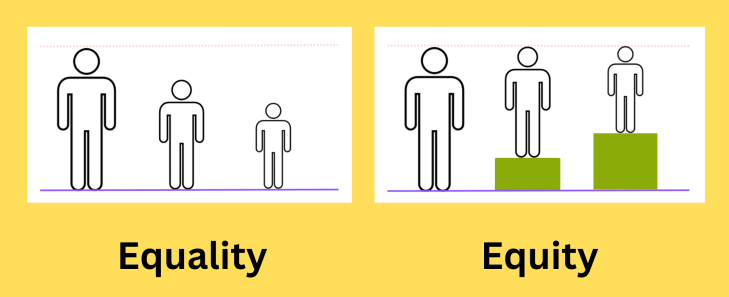
What does the promotion of equity involve and what are its aims?  There are now many versions of a classic meme that appears everywhere from social media posts to educational blogs and institutional policy documents. This is a visual representation tasked with an explanatory role – to make clear the difference between equality policies (treating all students as equal) and equity policies (treating students on an “according to their needs” basis, such that core outcomes are equally attainable whilst processes and support may be ‘unequal’ in their provision).

A core principle behind the latter position is that a student with a disability (physical or mental) or social disadvantage (due to race or class) should not have to work ‘that much harder’ to achieve the same result (e.g., a merit) as a student with no recognised ‘disadvantages’. Indeed, the latter student being a rather mythical or statistical construction (a prejudicial presumption of ‘an average student’), should not form the basis of an expected learner ‘norm’ by institutions, with the consequence that even before a ‘schedule of adjustment’ (for an individual student with a disadvantage) is required courses should be designed for a diverse range of students using Universal Design for Learning (UDL) principles and practices.

Figure 1 (author unknown) reproduces one such diagram that envisions the two positions (of equality versus equity). With ‘lack of height’ being a disadvantage, only the tallest person is able to reach the desired goal (reaching the ceiling, or picking an apple on a tree branch). With the application of ‘equity’, those suffering from ‘lack’ of height are enabled by props to demonstrate they are equally capable of achieving the goal. Instead of just one person reaching to top or possessing an apple (by the end of the process), the application of equity produces three people, all with outcomes / qualifications (of equal size and, presumably, use value).

A picture comparing equality with equity.  With equality every person of different height stands on the ground, meaning the shortest cannot reach the ceiling.  With equity, each person stands on a relevantly sized box so all people can reach the ceiling.
Equality versus Equity: A standard representation

This diagram represents the high point of equity in education because it can be presumed that no matter what adjustments are required or desired, the output is one of total welfare satisfaction (3 people sought degrees; and 3 people received degrees). If the diagram was expanded to 5 or 6 people its basic (ideal) form would (and should) remain unchanged.

The problem is that this graphic presumes an external world (to education) of egalitarian abundance. That is, once the educational process ‘levels’ everyone up (or down) then the desired goals (outputs: such as a ‘degree qualification’ and ‘graduate jobs’) are available for ‘all’ who climb to and over the ‘threshold’. On completion there is no scarcity of qualifications and jobs to be conferred and handed out. Degree certificates can, these days, be laser printed in full colour ‘on demand’. And if it is the college principal’s hand falling off, due to signing degrees en masse, that we are concerned about, then there is always the ”auto pen”.

The issue of scarcity in higher education has been considered to exist at the ‘admissions’ (entry) end, so, how many undergrad ‘places’ are available? And that’s a different question (of diversity in initial demographic ‘make up’) than the one I focus on here, namely, the application of equity policies to those students (and staff) already ‘in’ higher educational institutions or about to ‘transition’ out.

Thus, at the ‘entry’ end there is, hopefully, an increasingly diverse population of new students – a demographic with various, even unique, educational needs or ‘additional requirements’ which the HE equity policy manages to ‘level up’ through an unequal application of resources: equity achieved. This aims to give ‘all’ students truly equal opportunities and chances to achieve a deservedly high ‘degree outcome’, with opulence in certification being the ‘ideal world’ condition for HE equity policy.

At this point I should note that another welcome outcome of equity in admission processes is what I call a ‘diversification in common sense’. This refers to the manner in which the University is a democratic forum, which needs diverse perspectives to function in a truly scientific fashion (on this see my blog on the University of Edinburgh’s Teaching Matters site: McGrail, 2026).

From Ideal to ‘Real’ World: The ‘Graduate’ Job Market

The question of ‘graduate jobs’, however, presents a completely different challenge. Once the graduate leaves the educational establishment, award in hand, they are confronted by a highly competitive jobs market and a system focused not on expanding use values (goods and services required by and useful to people) but on valorising value (Heinrich, 2012, notes that Marx defines ‘capital’ as self-valorising value) through the generation of ‘surplus’ (hence, unrequired and unnecessary) output. As Kohei Saito (2024) points out, jobs are created where they are not needed with the aim of producing and ever growing ‘economy’ on a planet with, ultimately, limited resources. The motivation, of course, is to accumulate more and more private wealth (measured in terms of GDP) which comes at the expense of diminishing public wealth (a condition identified in 1804 by James Maitland, 8th Earl of Lauderdale, known as the Lauderdale Paradox: see Saito, 2024, pp.155-156).

This ‘real’ world system – real because it exists and dominates, but unrealistic by dint of being fantastical (e.g., Elon Musk wanting to mine the Moon and Mars once Earth’s natural resources are saturated) – is the very one graduate  qualification and employment structures are intended and designed to supply. Educational ‘equity’ is aimed at ensuring ‘free’ and fair entry to this system based on private (if not personal) domination of others. The more graduates available with a required qualification then the greater the competition for ‘places’.  A process which reduces wages and weakens workers ability to control what they do, how they do it, and to whom they do it.  From a position of ‘educational equity’ we end up in a state of ‘occupational inequity’.

As a conclusion …

The hierarchy of positions found in business and all kinds of institution (including charities as well as government) is one clear form of the imposition of scarcity since, according to this understanding of ‘leadership’, there can only be a certain number (proportion) of people ‘in control’ (making the decisions). As Saito (2024) also points out, capitalism generates a constant crisis of decision making, where decisions have to be made quickly in response to events beyond the control of managers and owners of ‘investments’ (capital). Such structures are intrinsically anti-democratic, having ‘no time’ for the ‘luxury’ of equitable and fair decision making.

In contrast, real democracy is an open system which can and should easily let new people join. Thus, the corollary of educational equity is the generation of a public space in which the creation of public wealth (non-monetary, focused on the quality of human time) is given priority over the accumulation of private wealth.  Without the latter, educationalists who promote diversity, equality and inclusion (DEI) policies and programmes really have to ask themselves ‘why the hell am I doing what I do?’ Whilst there is the critique that educationalists cannot wait until wider society is emancipated or made equal before they tackle inequity in the classroom, its twin argument is also true: trying to create equity within one confined social space (that of the classroom) cannot produce a ‘citadel’ under constant siege. The emancipation of one place implies and is intimately bound up with others.

References:

Arshad, R. (2021) From Inclusion to Transformation to Decolonisation. Teaching Matters blog. https://www.teaching-matters-blog.ed.ac.uk/from-inclusion-to-transformation-to-decolonisation/ [accessed: 28.09.2026]. 

Heinrich, M. (2012) An Introduction to the Three Volumes of Karl Marx’s Capital. [Translated by Alexander Locascio]. New York: Monthly Review Press.

McGrail, B. A. (2026) Why does classroom diversity make common sense? Teaching Matters blog. Why does classroom diversity make common sense? – Teaching Matters [accessed: 25.10.26].

Saito, K. (2024) Slow Down: How Degrowth Communism Can Save the Earth. London: Weidenfeld & Nicolson.

Racism and Fire: Capitalism’s Role in the Persistence of Race

October is Black History Month, and both of my institutional employers have emailed me with offers of Equality, Diversity and Inclusion (EDI) training as part of Continuing Professional Development (CPD), though not mandatory sessions.

Edinburgh University led the way (1st October) by presenting a one-hour workshop on a range of different groups and activities undertaking anti-racism activities (including profile-raising of minority staff networks, provision of links with outside bodies, and highlights on race education projects). Each presenter had about 10 minutes to outline (pitch) what their organisation was doing (and where it could be found).

At the end, the organisers struggled to get the question and answer (Q&A) session going, with no questions coming forward until one presenter felt duty-bound to ask something (of another presenter). This outcome was not due to lack of interest on behalf of the audience (being ‘self-selecting’, they were the ‘converted’). Rather, it was hard to think of ‘questions’ (to get a ‘discussion’ going) from such a factual presentation. What is there to disagree about?

The Open University offer was much more assertive in indicating that people will learn how to challenge their “white privilege” (by becoming aware of it) and, therein, an effective “ally” (who knows how to support people suffering racism and not how to ‘take over’ as a ‘white saviour’). At least this kind of anti-racism work allows more space for people to get into a debate. However, a general feeling of discomfort (about questioning the presented narrative) still pervades what is a workplace ‘instituted’ conversation, such that no-one is really going to challenge the expert anti-racist presenters / session leads.

The positive I take from such employer sanctioned events is that it is good to see the issue of racism being taken seriously, and provisioned with staff time (for those who choose to attend) by my employers. However, what makes me ‘chortle’ is the thought that I might now sit and wait for an email ‘ping’ to announce the equivalent EDI session on ‘The Exploitative Nature of Waged-Employment: Anti-work Initiatives’! Somehow, I can’t see that happening anytime (not even soon), within the ‘employer-employee’ environment. Yet, in anti-racism work, is it not important to investigate and explore the relationship between ‘the social construction of race’ and ‘the mode of production’ which gave rise to modern racism?

The Exploitative Source of Racism

Eric Williams, in Capitalism and Slavery (1944 – developed from his PhD research), observed that it was not racism that gave rise to the Atlantic slave trade. Rather, it was slavery which gave, and continues to give, substance to racism. On the basis of this thesis, whenever we see the smoke of racism rising it is incumbent upon us to look for the fire (the source of the smoke), or at least ask: ‘where is the smoke coming from?’ That is, we should ask ‘where is the slavery?’

To be clear, ‘smoke kills’ – it is not just a ‘signal’ meaning it can be ignored in order to shift ‘analysis’ elsewhere. But Williams’ point highlights that racism is not an ‘autoimmune disease’. It does not ‘seed itself’ in a vacuum, and has a cause (both a ground which it grows out of, and a ‘sense of progression’, or history, of which it is a part – everyone appears to be going ‘somewhere’ for some ‘reason’).

With the Atlantic slave trade, the exploitative source of the racism was ‘obvious’ – the system relied on one person being ‘enslaved’ in order to ‘serve’ another. And whilst Europeans in America initially took ‘white slaves’ (indentured poor, criminals, and vagabonds, even prisoners of war) with them (alongside a highly-oppressed population-half: women), the situation with rapid capital accumulation (the need to accumulate workers as ‘things’) meant there was soon a ‘lack’ of available people. This led to transportation from Africa to fulfil the ‘gap’. Initially, white and black slaves co-existed, even if unequally, but the ‘need’ (requirement) to categorise more and more individuals as ‘slaves’ eventually led to entire ‘groups’ of people taking on different roles in this system’s division of labour. Thus, skin-colour (being ‘black’) took on its slave-defining role.

But what about today’s voluntaristic, liberalised economies where chattel slavery (now in the form of ‘human trafficking’) has been pushed to the margins of ‘the economy’? Whilst there may be 26 million trafficked people (modern slaves) in the world today, this makes up a tiny proportion of the 6+ billion people surviving as ‘wage labourers’. So, why is racism still so widespread?

One answer, from Marx (1894), is that capitalism (in essence waged-labour, because this is the source of ‘profit’) is nothing other than “veiled slavery”! Consequently, following Marx’s assertion, Williams’ thesis holds true, with the persistence of racism (in its different forms: open, unconscious, institutionalised) being built upon the on-going existence of compulsory labour – forced not by the whip-hand but by the invisible-hand of ‘economic conditions’ (the primary condition, for most, being their propertylessness).

Indeed, in today’s contemporary corporate world, racism’s fundamental form is still the ‘reservation‘. On the one hand, there are those ‘reservoirs‘ of cheap labour ‘politically’ confined by ‘citizenship’ (or lack of it) to conditions maintained under brutal undemocratic regimes – a 21st century version of globalised apartheid with ranks of ‘nation states’ determining the extent to which an area of land mass is classified as totally useless (the ‘useless mouths’ of Afghanistan / Somalia / South Sudan) versus ripe for exploitation (Philippines / Nigeria / Bolivia).

On the other hand, there are those places were the very best (well-paid / good working condition) jobs, access to the required education, facilitation by the most ‘labour enhancing’ technologies, and consumption of advanced healthcare are ‘reserved‘ for people with specific ‘characteristics’ (including ‘citizenship’).

Taken together, these different symbiotic and bifurcated spatial reservations form a hierarchy in which skin-colour still plays a fundamental refining mechanism for the ‘underlying’ system of exploitation (capital accumulation through waged-labour). Though, in theory – and in terms of progressivist political myth-making about possible ‘futures’ liberated from race and racialism – a few ‘individuals’ are able to move from marginalised reservoirs to the lands of exclusively ‘reserved’ jobs. Such social mobility gives the impetus to much (but not all) anti-racism work within the world of corporate and institutional employers – whilst, of course, the central mechanisms of waged-labour exploitation remain untouched.

Is the Dream of Corporate Anti-racism possible?

Interestingly, with reference to Afrofuturist writing, Alex Zamalin (2025) points to one dystopian novel in which the imagined society had, finally, managed to expunge Black people, thereby producing a purified world. This is a different version of reaching a state of ‘colour-blindness’ compared to the corporate eutopia (good place). It is touching on the ‘completion’ scenario of the Nazi ‘Final Solution’ of a Jew-free Reich. But the novel is really raising the question that, if such a Nazi utopia ever ‘worked’, would the waged-labour mode of production have been maintained?

In the novel’s Black-free society, racism soon begins to re-emerge in a new form. Someone is (some ‘bodies’ are) always required to do the menial, bottom-of-the-rung jobs in any ‘exchangeable labour’ society and, consequently, the roaming, roving eyes of a surveyor class (whoever they might happen to be) begin to look for anyone who is ruddier or slightly ‘more pink’ than ‘everyone else’. Thus, a new ‘norm’ or ‘average’ is generated from which social categories (by skin, sex, height, voice-box) will ‘form’. In short, and in line with what I argue here, the categorisation process is being driven by the needs of ‘the economy’ and its forced / compelled ‘division of labour‘.

It is the social essence of capitalism’s reproductive structure (that there is a hierarchy based on ‘exchangeable labour‘) which determines the requirement for different social categories of labourers. But a ‘reason’ or justification must be given for the ordering of society (i.e., in the above dystopian society ‘you are overly pink’, though the same distinction could be based just as easily on eye-colour). The ‘passion’ (behind the reasoning) is more consistent and practical in its desire to make extractive exploitation feasible and sustainable (since this exploitation is the very means of survival for those ‘empowered’ but ‘reliant’ groups who eternally seek the social transfer of resources from person X – the ‘enslaved’ – to person Y – ‘the masters of money’).

References:

Marx, K. (1894) Capital: A Critique of Political Economy – Volume 3. [Edited by F. Engels / trans. by D. Fernbach (c) 1991]. London: Penguin.

Williams, E. (1944) Capitalism & Slavery. [Penguin Classics / 1994 imprint]. London: Penguin Random House UK.

Zamalin, A. (2025) ‘The Future of Afrofuturism: Thinking with Afrofuturism’ [Workshop Paper]. Part of Panel 3: Revisiting Utopianism from other critical and radical perspectives. AHRC Workshop 3 of Utopia & Failure: ‘Fail Again, Fail Better! Held at: King’s College London (Mon 8th and Tues 9th Sept).