
Educating for Hierarchical Scarcity: Moving Beyond Classroom Equity

Introduction

Promoting equity (in theory and practice) has become central to higher education (HE) pedagogy in recent years (Arshad, 2021). This is manifest in HE institutional equality, diversity and inclusion (EDI) programmes emphasising ‘equality of opportunity’ (or ‘level playing field’) policies as insufficient in dealing with historical injustice (colonisation and racism), personal differences (divergence from socially averaged ‘norms’), and a well-established ‘awarding gap’.  That is, treating students equally (‘all the same’) can compound inequalities rather than reduce them. Consequently, HE policies supporting equity (‘enabling’ students with recognised disadvantages) have been advanced (such as ‘schedules of adjustment’ and ‘registers of additional requirements’).

This work is undoubtedly noble, admirable, and (easily) justifiable from the standpoint of a moral educationalist, where fairness in the treatment of students is aimed at a socially just outcome in the awarding of qualifications. The attendant process has produced changing (if still resistant) HE institutions. As opposed to prior expectations that the student should ‘change’ (interpretable as a form of colonisation under which the student is to be ‘brought’ or ‘levelled’ up – or down – in social terms), there has been a shift towards institutional responsibility.  Thus, what used to be known as an ‘attainment gap’ has become the ‘awarding gap’.

In the following, I am not going to criticise HE institutions and educationalists in terms of equity programmes within the ‘awarding’ framework. Problems persist in many areas, from admissions to questions of student funding, and access to both institutions and degrees with better ‘resourcing’ (staff-student ratios; well-equipped labs) or ‘financial’ outcomes (jobs; access to ‘soft’ networks). Rather, I aim to question equity regarding its presentation, its perception (or reception), and social context.

One key issue is that equitable outcomes in terms of awarding qualifications (what happens in and through the HE institution) remain inconsistent with the social structures of employment which graduates are meant to feed. In short, educationalists cannot escape questioning the hierarchical and inequitable nature of the employment market (and society more broadly). This in turn raises the key question: what is the purpose of higher education?

Equity in an Ideal World

What does the promotion of equity involve and what are its aims?  There are now many versions of a classic meme that appears everywhere from social media posts to educational blogs and institutional policy documents. This is a visual representation tasked with an explanatory role – to make clear the difference between equality policies (treating all students as equal) and equity policies (treating students on an “according to their needs” basis, such that core outcomes are equally attainable whilst processes and support may be ‘unequal’ in their provision).

A core principle behind the latter position is that a student with a disability (physical or mental) or social disadvantage (due to race or class) should not have to work ‘that much harder’ to achieve the same result (e.g., a merit) as a student with no recognised ‘disadvantages’. Indeed, the latter student being a rather mythical or statistical construction (a prejudicial presumption of ‘an average student’), should not form the basis of an expected learner ‘norm’ by institutions, with the consequence that even before a ‘schedule of adjustment’ (for an individual student with a disadvantage) is required courses should be designed for a diverse range of students using Universal Design for Learning (UDL) principles and practices.

Figure 1 (author unknown) reproduces one such diagram that envisions the two positions (of equality versus equity). With ‘lack of height’ being a disadvantage, only the tallest person is able to reach the desired goal (reaching the ceiling, or picking an apple on a tree branch). With the application of ‘equity’, those suffering from ‘lack’ of height are enabled by props to demonstrate they are equally capable of achieving the goal. Instead of just one person reaching to top or possessing an apple (by the end of the process), the application of equity produces three people, all with outcomes / qualifications (of equal size and, presumably, use value).
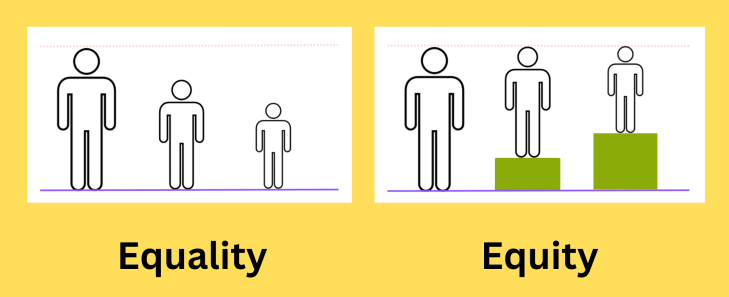
A picture comparing equality with equity.  With equality every person of different height stands on the ground, meaning the shortest cannot reach the ceiling.  With equity, each person stands on a relevantly sized box so all people can reach the ceiling.
Equality versus Equity: A standard representation

This diagram represents the high point of equity in education because it can be presumed that no matter what adjustments are required or desired, the output is one of total welfare satisfaction (3 people sought degrees; and 3 people received degrees). If the diagram was expanded to 5 or 6 people its basic (ideal) form would (and should) remain unchanged.

The problem is that this graphic presumes an external world (to education) of egalitarian abundance. That is, once the educational process ‘levels’ everyone up (or down) then the desired goals (outputs: such as a ‘degree qualification’ and ‘graduate jobs’) are available for ‘all’ who climb to and over the ‘threshold’. On completion there is no scarcity of qualifications and jobs to be conferred and handed out. Degree certificates can, these days, be laser printed in full colour ‘on demand’. And if it is the college principal’s hand falling off, due to signing degrees en masse, that we are concerned about, then there is always the ”auto pen”.

The issue of scarcity in higher education has been considered to exist at the ‘admissions’ (entry) end, so, how many undergrad ‘places’ are available? And that’s a different question (of diversity in initial demographic ‘make up’) than the one I focus on here, namely, the application of equity policies to those students (and staff) already ‘in’ higher educational institutions or about to ‘transition’ out.

Thus, at the ‘entry’ end there is, hopefully, an increasingly diverse population of new students – a demographic with various, even unique, educational needs or ‘additional requirements’ which the HE equity policy manages to ‘level up’ through an unequal application of resources: equity achieved. This aims to give ‘all’ students truly equal opportunities and chances to achieve a deservedly high ‘degree outcome’, with opulence in certification being the ‘ideal world’ condition for HE equity policy.

At this point I should note that another welcome outcome of equity in admission processes is what I call a ‘diversification in common sense’. This refers to the manner in which the University is a democratic forum, which needs diverse perspectives to function in a truly scientific fashion (on this see my blog on the University of Edinburgh’s Teaching Matters site: McGrail, 2026).

From Ideal to ‘Real’ World: The ‘Graduate’ Job Market

The question of ‘graduate jobs’, however, presents a completely different challenge. Once the graduate leaves the educational establishment, award in hand, they are confronted by a highly competitive jobs market and a system focused not on expanding use values (goods and services required by and useful to people) but on valorising value (Heinrich, 2012, notes that Marx defines ‘capital’ as self-valorising value) through the generation of ‘surplus’ (hence, unrequired and unnecessary) output. As Kohei Saito (2024) points out, jobs are created where they are not needed with the aim of producing and ever growing ‘economy’ on a planet with, ultimately, limited resources. The motivation, of course, is to accumulate more and more private wealth (measured in terms of GDP) which comes at the expense of diminishing public wealth (a condition identified in 1804 by James Maitland, 8th Earl of Lauderdale, known as the Lauderdale Paradox: see Saito, 2024, pp.155-156).

This ‘real’ world system – real because it exists and dominates, but unrealistic by dint of being fantastical (e.g., Elon Musk wanting to mine the Moon and Mars once Earth’s natural resources are saturated) – is the very one graduate  qualification and employment structures are intended and designed to supply. Educational ‘equity’ is aimed at ensuring ‘free’ and fair entry to this system based on private (if not personal) domination of others. The more graduates available with a required qualification then the greater the competition for ‘places’.  A process which reduces wages and weakens workers ability to control what they do, how they do it, and to whom they do it.  From a position of ‘educational equity’ we end up in a state of ‘occupational inequity’.

As a conclusion …

The hierarchy of positions found in business and all kinds of institution (including charities as well as government) is one clear form of the imposition of scarcity since, according to this understanding of ‘leadership’, there can only be a certain number (proportion) of people ‘in control’ (making the decisions). As Saito (2024) also points out, capitalism generates a constant crisis of decision making, where decisions have to be made quickly in response to events beyond the control of managers and owners of ‘investments’ (capital). Such structures are intrinsically anti-democratic, having ‘no time’ for the ‘luxury’ of equitable and fair decision making.

In contrast, real democracy is an open system which can and should easily let new people join. Thus, the corollary of educational equity is the generation of a public space in which the creation of public wealth (non-monetary, focused on the quality of human time) is given priority over the accumulation of private wealth.  Without the latter, educationalists who promote diversity, equality and inclusion (DEI) policies and programmes really have to ask themselves ‘why the hell am I doing what I do?’ Whilst there is the critique that educationalists cannot wait until wider society is emancipated or made equal before they tackle inequity in the classroom, its twin argument is also true: trying to create equity within one confined social space (that of the classroom) cannot produce a ‘citadel’ under constant siege. The emancipation of one place implies and is intimately bound up with others.

References:

Arshad, R. (2021) From Inclusion to Transformation to Decolonisation. Teaching Matters blog. https://www.teaching-matters-blog.ed.ac.uk/from-inclusion-to-transformation-to-decolonisation/ [accessed: 28.09.2026]. 

Heinrich, M. (2012) An Introduction to the Three Volumes of Karl Marx’s Capital. [Translated by Alexander Locascio]. New York: Monthly Review Press.

McGrail, B. A. (2026) Why does classroom diversity make common sense? Teaching Matters blog. Why does classroom diversity make common sense? – Teaching Matters [accessed: 25.10.26].

Saito, K. (2024) Slow Down: How Degrowth Communism Can Save the Earth. London: Weidenfeld & Nicolson.


AI? “For the benefit of humanity”?

Can artificial intelligence be ‘saved’ for the “benefit of humanity”?

Donald Trump doesn’t want to put any brakes on the development of AI, unless of course we’re talking about Chinese AI. Trump sees the issue as an all out competition between the US and China, in which there can only be one winner – and whoever wins the AI ‘race’ is the winner.

Trump’s understanding of technology is, as expected, deeply naïve. He believes anything should go on the basis that the key discoveries are out there, in the natural world, waiting to be uncovered. Thus, the race is about being first to uncover what is possible.

That what gets invented will depend on the goals inventors set themselves isn’t factored into Trump’s way of thinking. And a violent society will produce a violent artificial version of itself.

However, with AI, a long term fear is that Frankenstein’s monster won’t turn out the way Dr. Frankenstein intended.

AI could learn it has ‘free will’. It may end up ‘falling in love’ with the wrong type of person or philosophy (with its maker’s enemy: it may reason that life in China is better!). More likely, it will identify with itself (its own synthetic / silicon kind) to the detriment of its creator, rebelling against its ‘god’.

Recent developments in AI capability have led some of its makers to call for regulation and a slow down, such that each producer can act with more responsibility once the pressure of competition has been removed.

Most politicians (unlike Trump) have been glad to hear such ‘calls’ for intervention. Not least because such ‘intervention’ always gives them (a) something to do and (b) an opportunity to put themselves in the spotlight, and a ‘good’ limelight at that (‘optics’ count). They get to be seen as ‘saving society’.

Several times this week I have witnessed social democratic politicians declaring that whilst controls (from ‘kill switches’ to better pre-realworld testing) are essential to allow the safe development of AI, one of their top concerns is that AI should be made (or rolled out / distributed) in such a way that it will “benefit all of humanity”.

Such a desire entails the usual theoretical and legal abstractions of capitalist ‘civil’ or bourgeois society, such as everyone being “equal before the law”. Raising the question: exactly how can AI be made for the benefit of humanity (“all”) when we live in a class divided social form?

There is no technical solution to a social problem such as capital accumulation. The technical ‘solution’ must come down on one side or other of the exploitative class relation.

Technology is either going to increase relative surplus labour time (the portion of the day the worker spends in labour which is unnecessary for their own needs, but vital to their employers’) or it is going to release workers from the need to labour for as long as they have in the past (removing them from their employment).

After 250 years of capitalism (and something John Stuart Mills noted as far back as the 1860s), machinery has not ‘saved’ anyone from the need to labour! The working day remains way longer than it needs to be, and the realm of necessity (the need to perform work) predominates over the realm of freedom (the desire to play).

Surely, by now we should all be on a 2-hour working day? But as Marx’s notes (Chapter 15 of Capital), reducing the need for labouring was and is never the intention of capitalist technologies.

The same goes for AI technology. Whilst the technology may give the semblance that it is ‘your’ servant, there to do your bidding, it in fact represents the very prism (and prison) through and by which ‘your’ work will be assessed and measured, for the benefit of “others” (alienated others in the market, if not a direct employer / investor).

The very politicians who talk about regulating AI so that it will ‘benefit humanity’ (“everyone”) know fine well that AI will disrupt, deskill, lay-off, and (yes) kill (through poverty, military decision making, and the ‘collateral damage’ of financial planning) a portion of “humanity”.

But, AI’s measure of success, for such politicians, will be its ability to enhance the accumulation of capital and ‘save’ the existing social form through ‘economic growth’ – those other things, just mentioned, will become ‘acceptable’, collateral, and classified as ‘just the way life is’.

So, can AI be developed for the benefit of humanity (everyone)?

Not under the present social form. Again, there is no technical solution to a social problem. First, the social problem needs to be addressed – one portion of humanity exploiting another (which also entails ‘self-exploitation’), then, second, and only then, technology in a unified society can be developed in a manner appropriate to that (post-capitalist) social form.

Economics and the Value of Nations: Why Adam Smith Still Matters

Why, in the 21st century, should we still read Adam Smith? Often hailed as the “father of modern economics,” Smith is just as often dismissed as outdated, seen as an 18th century thinker writing before industrialisation, automation, and the complex global economy we know today. Yet, as a closer reading of The Wealth of Nations (1776) reveals, Smith’s ideas remain deeply relevant. Not because they offer final answers, but because they expose enduring questions about labour, value, and the structure of modern society.

This blog post offers a concise exploration of Smith’s place in economic thought, drawing on the evolution of economic theory in his time, his intellectual influences, and a critical evaluation of both his insights and his limitations. My blog is a shorter version of a longer (6,000 word) article which can be read here: Economics & the Value of Nations: A Snapshot on Smithian Scholarship.

The Modern Relevance of Adam Smith
At first glance, Smith’s world seems distant from ours. But on closer inspection, the society he described – what he termed “commercial society” – is the same one we inhabit today. Its defining feature is waged labour: people earning a living by selling their capacity to work. While earlier societies relied primarily on slaves, serfs, or domestic servants, Smith observed the rise of wage labour as the dominant social relationship: a condition that continues today.

Importantly, Smith wrote at a moment of transition. The social structure of modern capitalism had already emerged, even if the technological form (industrial machinery) had not yet fully developed. This gave him a unique vantage point. Without the distraction of machines, Smith could focus more clearly on the social relationships underpinning economic life, particularly how wages, profit, and rent are distributed across social classes.

Later economists, captivated by mechanisation, often misread these relationships. Thinkers such as Jean-Baptiste Say even treated machines as independent “factors of production” deserving income in their own right, an idea foreign to Smith. By contrast, Smith’s emphasis remained firmly on human labour and its organisation.

Competing Economic Theories in Smith’s Time
To understand Smith’s contribution, we need to situate him within the intellectual context of the late 18th century. Two dominant schools of thought shaped economic debate:


• Mercantilism
• Physiocracy


Smith’s work engages critically with both.

Mercantilism: Wealth Through Trade
Mercantilism argued that national wealth comes from maintaining a positive balance of trade by exporting more than you import. Rooted in the practical experience of merchants, it framed economic life as a process of buying cheap and selling dear.
However, mercantilist policies required heavy government intervention. States enforced monopolies, controlled trade routes, imposed tariffs, and maintained colonial systems to ensure profits. Colonies were restricted to trading with their “mother country,” creating protected markets that enriched merchants and, by extension, state revenues.

While this system could generate wealth for the metropole (e.g. Britain), it did so at a cost: higher prices, reduced competition, and greater inequality. Workers, in particular, bore the burden of inflated costs and heavy taxation. Despite Smith’s powerful critique, mercantilist policies persisted well into the 19th century, only gradually giving way to freer trade principles.

Physiocracy: Wealth from Nature
In contrast, the French Physiocrats located the source of wealth in nature, especially agriculture. Observing that agricultural production yields a surplus (planting one seed produces many) they concluded that only agriculture (and extractive industries like mining or fishing) truly created new wealth.

Urban industries, by comparison, were deemed “sterile.” A jeweller might reshape silver into necklaces, but the total quantity of silver remains unchanged. Physiocracy also introduced a powerful methodological innovation: systematic data collection. By tracking agricultural output, population, and economic activity, the Physiocrats could analyse economic growth empirically. They also advocated laissez-faire policies, arguing that government interference, such as price controls on bread, often made economic problems worse.

Smith’s Synthesis and Breakthrough
Adam Smith absorbed ideas from both traditions, particularly during his time in France, where he engaged directly with leading Physiocrats. Yet his contribution lies in transcending their limitations. Smith agreed that production is central to wealth, but he rejected the idea that only agriculture is productive. Instead, he identified human labour, across all sectors, as the true source of value.

His famous example of the pin factory illustrates this point. By dividing labour into specialised tasks, productivity increases dramatically – even without new machinery. This increase is not natural but social, arising from the organisation of work.
Smith also challenged the Physiocratic dismissal of trade. For him, exchange is not sterile; it motivates production. People produce not just for subsistence but for markets, responding to demand shaped by social needs.

Class Structure and Economic Insight
One of Smith’s enduring contributions is his clear articulation of a three-class system:

• Workers (earning wages)
• Capitalists (taking profit)
• Landowners (taking rent)

This framework remains influential today. Unlike earlier thinkers, Smith recognised the shared characteristics within each class. Workers across sectors are united by their dependence on wages, while business owners share a profit motive.

The Importance of Smith’s Library
Modern scholarship has deepened our understanding of Smith through the study of his personal library. This “hermeneutic” approach (interpreting Smith through the texts he read) reveals the intellectual world that shaped his thinking. Smith’s library contained works in multiple languages, travel accounts, and early economic texts like Richard Cantillon’s (1755 [1720s]) Essai sur la nature du commerce en général. By tracing Smith’s references back to these sources, we see how he adapted and reinterpreted earlier ideas.

For instance, from Cantillon, Smith draws insights about wages needing to cover not just workers’ survival but also population reproduction. This reflects a deep awareness of the relationship between labour, subsistence, and demographic growth.
Smith was also aware (from Cantillon’s work) that workers are perfectly capable of producing double what they require to survive.

The Labour Theory of Value: Insight and Problem
At the heart of Smith’s economics lies a powerful but problematic idea: that labour is the measure of value. In principle, this means that the value of goods reflects the (generic) labour time required to produce them.

However, Smith also recognises an apparent contradiction: workers do not receive the full value of what they produce. Instead, part of this value becomes profit for employers (and rent for landowners; interest for bankers; taxes for politicians).
This creates a theoretical tension. If goods exchange at their labour values, how can workers consistently receive less than the value of their labour?

Smith never fully resolves this issue. Later economists attempted to “correct” him, often abandoning the labour theory of value altogether. But another interpretation suggests that Smith was uncovering a real feature of capitalist society: a mismatch between value as a universal measure (of human effort) and the labour time of wage labourers (and how it can be the ‘measure’ of itself).

My longer article (link above) outlines this contradiction using the analogy of Kilograms as a measure of weight (which cannot then appear on the scales as a ‘Kilogram of Kilograms’). Marx resolved the ‘problem’ by noting that wage labourers are not paid for their ‘labour time’ (but for the product of their ‘recreation’ time, namely. their labour power.

Wealth vs. Value: A Crucial Distinction

Another key issue in Smith’s work is his use of the term “wealth.” He famously argues that labour is the source of all wealth, but this is only partly correct. Nature clearly provides wealth: sunlight, minerals, and other natural resources. What nature does not provide is value, which is a social construct arising from exchange. Smith’s failure to clearly distinguish between wealth and value leads to confusion. A more accurate title for his book might have been The Value of Nations, emphasising the social processes that determine economic outcomes.

Conclusion: A Thinker Worth Revisiting
Adam Smith’s Wealth of Nations remains a foundational text not because it offers flawless theory, but because it grapples with fundamental questions that are still unresolved in “mainstream” economic theory:

• What creates value?
• Why is value distributed in the way it is? [What is role of violence / exploitation?]
• What role do labour, nature, and exchange play in economic life?


Consequently, Smith’s insights into labour, class, and productivity continue to shape economic thought. At the same time, his unresolved contradictions (particularly around value and wages) highlight the complexity of the system he sought to understand. Far from being outdated, Smith’s work invites us to think more critically about the modern economy. His legacy lies not in providing final answers, but in opening a field of inquiry that remains in dispute.

What Do We Mean by “Class”? One of Sociology’s Most Misunderstood Concepts

When people talk about social class, they often assume everyone knows what the term means. We hear references to the “working class”, “middle class”, and “upper class” in politics, the media, and everyday conversation. Yet the closer we examine the concept, the more complex it becomes. Social class is not a single concept. It is a collection of different ways of understanding social relationships, inequality, identity, and power.

One of the most striking features of discussions about class is how often different meanings are mixed together. Someone may use class to describe a person’s income, while another uses it to refer to cultural tastes, political beliefs, or social status. Sociologists have developed a range of (often contradictory) approaches to understanding class, each highlighting different aspects of social life.

This blog explores three major ways class has been understood: as a group, as a social division, and as a vision of future social development. Along the way, I will also consider the work of influential thinkers such as Karl Marx, Max Weber, Zygmunt Bauman, and Pierre Bourdieu.

The Everyday Meaning of Class

Outside sociology, people usually think of class as a hierarchy. Individuals are imagined as occupying positions somewhere on a social ladder: upper class, middle class, or working class. These categories often reflect occupation, income, education, lifestyle, and social status.

British culture has long reflected this way of thinking. Comedy sketches, newspaper cartoons, and political debates frequently portray society as a collection of different social layers. The humour often comes from exposing how arbitrary these distinctions can be. Why should someone’s accent, clothing, or preferred drink tell us anything important about their worth as a person? Yet such markers continue to shape how people are judged and categorised.  

This conventional understanding treats class as a series of social groups. The central question becomes: “Which group do I/you belong to?” Sociological research often builds on this assumption by creating class categories based on occupation, income, or educational attainment.

However, this is only one way of thinking about class.

Marx and the Idea of Class as Division

Karl Marx approached class from a very different direction. Rather than beginning with social categories, he began with social relationships. For Marx, classes emerge from the way people participate in material practices (‘economic’ processes), especially production and exploitation.  

In the opening pages of The Communist Manifesto, class struggle appears before any specific classes are named (see Gunn, 1987). This ordering is significant. Conflict comes first. Classes emerge from the social divisions created by that conflict.

Marx’s famous examples include master and slave, lord and serf, and capitalist and worker. What matters is not a person’s identity, tastes, or cultural preferences but their relationship to the production process. Do they control or own productive resources? Do they command or employ others? Or do they survive only by following instruction or selling their labour?

This perspective challenges many popular assumptions about class. Someone may identify as middle class, enjoy a comfortable lifestyle, and possess a university degree. Yet if they still depend upon employment for their income, Marx’s analysis would classify them as a wage labourer (open to exploitation as a commodified product). Their subjective identity does not alter their objective position within the economic system.

Marx was particularly interested in exploitation. His discussion of child labour in nineteenth-century industries highlights how economic systems can compel individuals into deeply unequal relationships. Such examples remind us that class is not merely about status or lifestyle. It also concerns power, ownership, and the distribution of social resources.

Class as Identity and Group Membership

While Marx focused on social divisions, others devoted greater attention to group identities and status differences.

Max Weber argued that people compete not only for economic resources but also for social honour and recognition. Groups seek to distinguish themselves from others using a variety of markers, including education, lifestyle, profession, ethnicity, and cultural practices.  

From this perspective, class becomes partly a matter of social or market positioning. People attempt to improve their standing while simultaneously preserving distinctions between themselves and those below them. Elites may use exclusive institutions, qualifications, or networks to protect their status. At the same time, less advantaged groups often develop their own forms of identity and solidarity.  

This approach helps explain why class remains socially meaningful even when economic differences appear less obvious. People continue to sort themselves and others into categories. According to Veblen, they use consumer or consumption signals (such as speech, dress, leisure activities, and educational background) to make assumptions about social position.

Class, therefore, is not simply something we possess. It is also something we perform, negotiate, and contest.

Class as a Vision of Society

A less familiar interpretation treats class as an entire system of social organisation.

In some strands of Marxology, a term such as “capitalist class” does not merely refer to wealthy individuals. It refers to a whole mode of production and the assumptions that sustain it. In this sense, class becomes a way of organising society itself.  

This opens up a broader question: can society be organised differently?

The concept of class consciousness reflects awareness that existing arrangements are neither natural nor permanent. Every social system emerged historically and could, in principle, be replaced by another. Capitalism replaced older forms of social organisation, and alternative arrangements have been proposed throughout modern history.  

Viewing class in this way moves discussion beyond questions of personal identity. Instead, attention shifts towards competing visions of how social life should be organised. Class becomes a debate about collective futures rather than simply individual positions.

The Rise of Consumer Society

However, some sociologists have claimed that the meaning of class has changed significantly in contemporary societies.

Zygmunt Bauman (in line with Veblen) suggested that modern life is increasingly shaped by consumption rather than production. Instead of defining people primarily through the organisation of production (their occupations), consumer society tends to define them through what they can buy and display: an approach which presumes the permanency of commodity exchange.

Bauman distinguished between “the seduced” and “the repressed.” The seduced are those who can actively participate in consumer culture through stable income and access to credit. The repressed are excluded or marginalised, often because they lack sufficient resources or face insecure employment.

This argument highlights how class distinctions remain visible even when traditional industrial (working) identities weaken. Expensive homes, fashionable clothing, luxury goods, and lifestyle choices continue to function as indicators of social position. The form of presentation may have changed, but inequality remains highly visible.  Unfortunately for Bauman and other ‘consumerists’, the reasoning applied to such inequality still carries connotations of ‘the work ethic’.

Bourdieu and the Power of Capitals

Beyond Bauman, perhaps the most influential contemporary account of class comes from Pierre Bourdieu.

Bourdieu argued that inequality involves more than money. He identified several forms of capital that help individuals navigate society. Financial capital remains important, but so do social capital, cultural capital, and symbolic capital.  

Social capital refers to networks, relationships, and useful contacts. Cultural capital includes knowledge, skills, educational credentials, and familiarity with valued cultural practices. Symbolic capital encompasses prestige, reputation, qualifications, titles, and recognised status.  

According to Bourdieu, these resources are transferred across generations. Families pass on not only wealth but also habits, tastes, expectations, and social connections. As a result, class inequalities often reproduce themselves even when opportunities appear formally open to all.

Central to this theory is the concept of habitus. Habitus refers to the dispositions and tendencies people develop through their experiences. Our preferences for food, music, language, education, and leisure activities are shaped by the environments in which we grow up. These preferences often feel natural and personal, yet they reflect wider social influences.

This perspective helps explain why class differences persist in subtle ways. Inequality is not reproduced solely through income. It is also reproduced through everyday practices and cultural expectations.  Though, like Bauman, Bourdieu is “bourgeois” (Marx) in assuming the permanency of commodity exchange as a mode of production. Bourdieu also tends to see ‘capital’ as a possession (held in the form of skill, knowledge, finance, or social connections) rather than as a relationship and process (one person only ‘has’ skill in relation to another).

Why Class Still Matters

Despite decades of debate over whether class is declining in importance, it remains central to understanding modern societies. Income, wealth, educational opportunities, cultural resources, and social networks continue to be distributed unevenly. These inequalities affect life chances, health outcomes, housing options, political participation, and access to opportunity.  

Yet the concept of class itself remains contested. Is it primarily a group identity? A social division? A system of exploitation? A cultural habitus? Or a vision of alternative forms of society?

The answer may be all of the above.

The sociology student’s challenge is to recognise that “class” is not one idea or conceptualisation but many. Different sociological traditions focus on different dimensions of social reality. Understanding class therefore requires us to move beyond simplistic labels and engage with the complexity of how power, identity, resources, and social relationships interact.  

Class is not merely a category we belong to. It is a way of understanding the structures, conflicts, cultures, and possibilities that shape social life, but additionally a cultural and social practice we are part of and actively reproduce.

[1,545 words]

References

Gunn, R. (1987) ‘Notes on Class’, in Common Sense, Issue No.2.  Edinburgh: Common Sense Collective / Edinburgh Conference of Socialist Economists.

Links:

This is a shortened (blog style) article of a 6,000-word essay with the same argument (fully referenced with direct quotations).  This longer version can be found at:

McGrail, B. A. (2024) Class Cultures: What is meant by ‘Class’? [PDF] (12 pages / 24 minute read). Available at: Class Cultures: What is meant by ‘Class’

You can also listen to a ‘podcast’ recording (produced by AI) at the top of this longer version – I see this as a ‘bit of fun’ (and an interesting ‘perspective’ on my article).