
Introduction
Promoting equity (in theory and practice) has become central to higher education (HE) pedagogy in recent years (Arshad, 2021). This is manifest in HE institutional equality, diversity and inclusion (EDI) programmes emphasising ‘equality of opportunity’ (or ‘level playing field’) policies as insufficient in dealing with historical injustice (colonisation and racism), personal differences (divergence from socially averaged ‘norms’), and a well-established ‘awarding gap’. That is, treating students equally (‘all the same’) can compound inequalities rather than reduce them. Consequently, HE policies supporting equity (‘enabling’ students with recognised disadvantages) have been advanced (such as ‘schedules of adjustment’ and ‘registers of additional requirements’).
This work is undoubtedly noble, admirable, and (easily) justifiable from the standpoint of a moral educationalist, where fairness in the treatment of students is aimed at a socially just outcome in the awarding of qualifications. The attendant process has produced changing (if still resistant) HE institutions. As opposed to prior expectations that the student should ‘change’ (interpretable as a form of colonisation under which the student is to be ‘brought’ or ‘levelled’ up – or down – in social terms), there has been a shift towards institutional responsibility. Thus, what used to be known as an ‘attainment gap’ has become the ‘awarding gap’.
In the following, I am not going to criticise HE institutions and educationalists in terms of equity programmes within the ‘awarding’ framework. Problems persist in many areas, from admissions to questions of student funding, and access to both institutions and degrees with better ‘resourcing’ (staff-student ratios; well-equipped labs) or ‘financial’ outcomes (jobs; access to ‘soft’ networks). Rather, I aim to question equity regarding its presentation, its perception (or reception), and social context.
One key issue is that equitable outcomes in terms of awarding qualifications (what happens in and through the HE institution) remain inconsistent with the social structures of employment which graduates are meant to feed. In short, educationalists cannot escape questioning the hierarchical and inequitable nature of the employment market (and society more broadly). This in turn raises the key question: what is the purpose of higher education?
Equity in an Ideal World
What does the promotion of equity involve and what are its aims? There are now many versions of a classic meme that appears everywhere from social media posts to educational blogs and institutional policy documents. This is a visual representation tasked with an explanatory role – to make clear the difference between equality policies (treating all students as equal) and equity policies (treating students on an “according to their needs” basis, such that core outcomes are equally attainable whilst processes and support may be ‘unequal’ in their provision).
A core principle behind the latter position is that a student with a disability (physical or mental) or social disadvantage (due to race or class) should not have to work ‘that much harder’ to achieve the same result (e.g., a merit) as a student with no recognised ‘disadvantages’. Indeed, the latter student being a rather mythical or statistical construction (a prejudicial presumption of ‘an average student’), should not form the basis of an expected learner ‘norm’ by institutions, with the consequence that even before a ‘schedule of adjustment’ (for an individual student with a disadvantage) is required courses should be designed for a diverse range of students using Universal Design for Learning (UDL) principles and practices.
Figure 1 (author unknown) reproduces one such diagram that envisions the two positions (of equality versus equity). With ‘lack of height’ being a disadvantage, only the tallest person is able to reach the desired goal (reaching the ceiling, or picking an apple on a tree branch). With the application of ‘equity’, those suffering from ‘lack’ of height are enabled by props to demonstrate they are equally capable of achieving the goal. Instead of just one person reaching to top or possessing an apple (by the end of the process), the application of equity produces three people, all with outcomes / qualifications (of equal size and, presumably, use value).
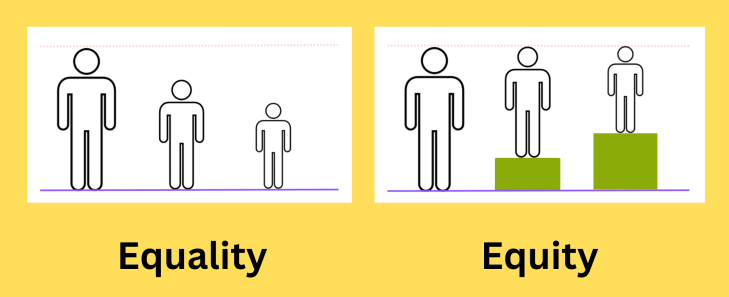
This diagram represents the high point of equity in education because it can be presumed that no matter what adjustments are required or desired, the output is one of total welfare satisfaction (3 people sought degrees; and 3 people received degrees). If the diagram was expanded to 5 or 6 people its basic (ideal) form would (and should) remain unchanged.
The problem is that this graphic presumes an external world (to education) of egalitarian abundance. That is, once the educational process ‘levels’ everyone up (or down) then the desired goals (outputs: such as a ‘degree qualification’ and ‘graduate jobs’) are available for ‘all’ who climb to and over the ‘threshold’. On completion there is no scarcity of qualifications and jobs to be conferred and handed out. Degree certificates can, these days, be laser printed in full colour ‘on demand’. And if it is the college principal’s hand falling off, due to signing degrees en masse, that we are concerned about, then there is always the ”auto pen”.
The issue of scarcity in higher education has been considered to exist at the ‘admissions’ (entry) end, so, how many undergrad ‘places’ are available? And that’s a different question (of diversity in initial demographic ‘make up’) than the one I focus on here, namely, the application of equity policies to those students (and staff) already ‘in’ higher educational institutions or about to ‘transition’ out.
Thus, at the ‘entry’ end there is, hopefully, an increasingly diverse population of new students – a demographic with various, even unique, educational needs or ‘additional requirements’ which the HE equity policy manages to ‘level up’ through an unequal application of resources: equity achieved. This aims to give ‘all’ students truly equal opportunities and chances to achieve a deservedly high ‘degree outcome’, with opulence in certification being the ‘ideal world’ condition for HE equity policy.
At this point I should note that another welcome outcome of equity in admission processes is what I call a ‘diversification in common sense’. This refers to the manner in which the University is a democratic forum, which needs diverse perspectives to function in a truly scientific fashion (on this see my blog on the University of Edinburgh’s Teaching Matters site: McGrail, 2026).
From Ideal to ‘Real’ World: The ‘Graduate’ Job Market
The question of ‘graduate jobs’, however, presents a completely different challenge. Once the graduate leaves the educational establishment, award in hand, they are confronted by a highly competitive jobs market and a system focused not on expanding use values (goods and services required by and useful to people) but on valorising value (Heinrich, 2012, notes that Marx defines ‘capital’ as self-valorising value) through the generation of ‘surplus’ (hence, unrequired and unnecessary) output. As Kohei Saito (2024) points out, jobs are created where they are not needed with the aim of producing and ever growing ‘economy’ on a planet with, ultimately, limited resources. The motivation, of course, is to accumulate more and more private wealth (measured in terms of GDP) which comes at the expense of diminishing public wealth (a condition identified in 1804 by James Maitland, 8th Earl of Lauderdale, known as the Lauderdale Paradox: see Saito, 2024, pp.155-156).
This ‘real’ world system – real because it exists and dominates, but unrealistic by dint of being fantastical (e.g., Elon Musk wanting to mine the Moon and Mars once Earth’s natural resources are saturated) – is the very one graduate qualification and employment structures are intended and designed to supply. Educational ‘equity’ is aimed at ensuring ‘free’ and fair entry to this system based on private (if not personal) domination of others. The more graduates available with a required qualification then the greater the competition for ‘places’. A process which reduces wages and weakens workers ability to control what they do, how they do it, and to whom they do it. From a position of ‘educational equity’ we end up in a state of ‘occupational inequity’.
As a conclusion …
The hierarchy of positions found in business and all kinds of institution (including charities as well as government) is one clear form of the imposition of scarcity since, according to this understanding of ‘leadership’, there can only be a certain number (proportion) of people ‘in control’ (making the decisions). As Saito (2024) also points out, capitalism generates a constant crisis of decision making, where decisions have to be made quickly in response to events beyond the control of managers and owners of ‘investments’ (capital). Such structures are intrinsically anti-democratic, having ‘no time’ for the ‘luxury’ of equitable and fair decision making.
In contrast, real democracy is an open system which can and should easily let new people join. Thus, the corollary of educational equity is the generation of a public space in which the creation of public wealth (non-monetary, focused on the quality of human time) is given priority over the accumulation of private wealth. Without the latter, educationalists who promote diversity, equality and inclusion (DEI) policies and programmes really have to ask themselves ‘why the hell am I doing what I do?’ Whilst there is the critique that educationalists cannot wait until wider society is emancipated or made equal before they tackle inequity in the classroom, its twin argument is also true: trying to create equity within one confined social space (that of the classroom) cannot produce a ‘citadel’ under constant siege. The emancipation of one place implies and is intimately bound up with others.
References:
Arshad, R. (2021) From Inclusion to Transformation to Decolonisation. Teaching Matters blog. https://www.teaching-matters-blog.ed.ac.uk/from-inclusion-to-transformation-to-decolonisation/ [accessed: 28.09.2026].
Heinrich, M. (2012) An Introduction to the Three Volumes of Karl Marx’s Capital. [Translated by Alexander Locascio]. New York: Monthly Review Press.
McGrail, B. A. (2026) Why does classroom diversity make common sense? Teaching Matters blog. Why does classroom diversity make common sense? – Teaching Matters [accessed: 25.10.26].
Saito, K. (2024) Slow Down: How Degrowth Communism Can Save the Earth. London: Weidenfeld & Nicolson.

