
Educating for Hierarchical Scarcity: Moving Beyond Classroom Equity

Introduction

Promoting equity (in theory and practice) has become central to higher education (HE) pedagogy in recent years (Arshad, 2021). This is manifest in HE institutional equality, diversity and inclusion (EDI) programmes emphasising ‘equality of opportunity’ (or ‘level playing field’) policies as insufficient in dealing with historical injustice (colonisation and racism), personal differences (divergence from socially averaged ‘norms’), and a well-established ‘awarding gap’.  That is, treating students equally (‘all the same’) can compound inequalities rather than reduce them. Consequently, HE policies supporting equity (‘enabling’ students with recognised disadvantages) have been advanced (such as ‘schedules of adjustment’ and ‘registers of additional requirements’).

This work is undoubtedly noble, admirable, and (easily) justifiable from the standpoint of a moral educationalist, where fairness in the treatment of students is aimed at a socially just outcome in the awarding of qualifications. The attendant process has produced changing (if still resistant) HE institutions. As opposed to prior expectations that the student should ‘change’ (interpretable as a form of colonisation under which the student is to be ‘brought’ or ‘levelled’ up – or down – in social terms), there has been a shift towards institutional responsibility.  Thus, what used to be known as an ‘attainment gap’ has become the ‘awarding gap’.

In the following, I am not going to criticise HE institutions and educationalists in terms of equity programmes within the ‘awarding’ framework. Problems persist in many areas, from admissions to questions of student funding, and access to both institutions and degrees with better ‘resourcing’ (staff-student ratios; well-equipped labs) or ‘financial’ outcomes (jobs; access to ‘soft’ networks). Rather, I aim to question equity regarding its presentation, its perception (or reception), and social context.

One key issue is that equitable outcomes in terms of awarding qualifications (what happens in and through the HE institution) remain inconsistent with the social structures of employment which graduates are meant to feed. In short, educationalists cannot escape questioning the hierarchical and inequitable nature of the employment market (and society more broadly). This in turn raises the key question: what is the purpose of higher education?

Equity in an Ideal World

What does the promotion of equity involve and what are its aims?  There are now many versions of a classic meme that appears everywhere from social media posts to educational blogs and institutional policy documents. This is a visual representation tasked with an explanatory role – to make clear the difference between equality policies (treating all students as equal) and equity policies (treating students on an “according to their needs” basis, such that core outcomes are equally attainable whilst processes and support may be ‘unequal’ in their provision).

A core principle behind the latter position is that a student with a disability (physical or mental) or social disadvantage (due to race or class) should not have to work ‘that much harder’ to achieve the same result (e.g., a merit) as a student with no recognised ‘disadvantages’. Indeed, the latter student being a rather mythical or statistical construction (a prejudicial presumption of ‘an average student’), should not form the basis of an expected learner ‘norm’ by institutions, with the consequence that even before a ‘schedule of adjustment’ (for an individual student with a disadvantage) is required courses should be designed for a diverse range of students using Universal Design for Learning (UDL) principles and practices.

Figure 1 (author unknown) reproduces one such diagram that envisions the two positions (of equality versus equity). With ‘lack of height’ being a disadvantage, only the tallest person is able to reach the desired goal (reaching the ceiling, or picking an apple on a tree branch). With the application of ‘equity’, those suffering from ‘lack’ of height are enabled by props to demonstrate they are equally capable of achieving the goal. Instead of just one person reaching to top or possessing an apple (by the end of the process), the application of equity produces three people, all with outcomes / qualifications (of equal size and, presumably, use value).
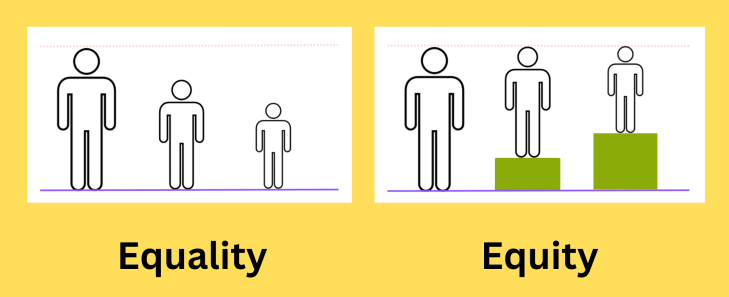
A picture comparing equality with equity.  With equality every person of different height stands on the ground, meaning the shortest cannot reach the ceiling.  With equity, each person stands on a relevantly sized box so all people can reach the ceiling.
Equality versus Equity: A standard representation

This diagram represents the high point of equity in education because it can be presumed that no matter what adjustments are required or desired, the output is one of total welfare satisfaction (3 people sought degrees; and 3 people received degrees). If the diagram was expanded to 5 or 6 people its basic (ideal) form would (and should) remain unchanged.

The problem is that this graphic presumes an external world (to education) of egalitarian abundance. That is, once the educational process ‘levels’ everyone up (or down) then the desired goals (outputs: such as a ‘degree qualification’ and ‘graduate jobs’) are available for ‘all’ who climb to and over the ‘threshold’. On completion there is no scarcity of qualifications and jobs to be conferred and handed out. Degree certificates can, these days, be laser printed in full colour ‘on demand’. And if it is the college principal’s hand falling off, due to signing degrees en masse, that we are concerned about, then there is always the ”auto pen”.

The issue of scarcity in higher education has been considered to exist at the ‘admissions’ (entry) end, so, how many undergrad ‘places’ are available? And that’s a different question (of diversity in initial demographic ‘make up’) than the one I focus on here, namely, the application of equity policies to those students (and staff) already ‘in’ higher educational institutions or about to ‘transition’ out.

Thus, at the ‘entry’ end there is, hopefully, an increasingly diverse population of new students – a demographic with various, even unique, educational needs or ‘additional requirements’ which the HE equity policy manages to ‘level up’ through an unequal application of resources: equity achieved. This aims to give ‘all’ students truly equal opportunities and chances to achieve a deservedly high ‘degree outcome’, with opulence in certification being the ‘ideal world’ condition for HE equity policy.

At this point I should note that another welcome outcome of equity in admission processes is what I call a ‘diversification in common sense’. This refers to the manner in which the University is a democratic forum, which needs diverse perspectives to function in a truly scientific fashion (on this see my blog on the University of Edinburgh’s Teaching Matters site: McGrail, 2026).

From Ideal to ‘Real’ World: The ‘Graduate’ Job Market

The question of ‘graduate jobs’, however, presents a completely different challenge. Once the graduate leaves the educational establishment, award in hand, they are confronted by a highly competitive jobs market and a system focused not on expanding use values (goods and services required by and useful to people) but on valorising value (Heinrich, 2012, notes that Marx defines ‘capital’ as self-valorising value) through the generation of ‘surplus’ (hence, unrequired and unnecessary) output. As Kohei Saito (2024) points out, jobs are created where they are not needed with the aim of producing and ever growing ‘economy’ on a planet with, ultimately, limited resources. The motivation, of course, is to accumulate more and more private wealth (measured in terms of GDP) which comes at the expense of diminishing public wealth (a condition identified in 1804 by James Maitland, 8th Earl of Lauderdale, known as the Lauderdale Paradox: see Saito, 2024, pp.155-156).

This ‘real’ world system – real because it exists and dominates, but unrealistic by dint of being fantastical (e.g., Elon Musk wanting to mine the Moon and Mars once Earth’s natural resources are saturated) – is the very one graduate  qualification and employment structures are intended and designed to supply. Educational ‘equity’ is aimed at ensuring ‘free’ and fair entry to this system based on private (if not personal) domination of others. The more graduates available with a required qualification then the greater the competition for ‘places’.  A process which reduces wages and weakens workers ability to control what they do, how they do it, and to whom they do it.  From a position of ‘educational equity’ we end up in a state of ‘occupational inequity’.

As a conclusion …

The hierarchy of positions found in business and all kinds of institution (including charities as well as government) is one clear form of the imposition of scarcity since, according to this understanding of ‘leadership’, there can only be a certain number (proportion) of people ‘in control’ (making the decisions). As Saito (2024) also points out, capitalism generates a constant crisis of decision making, where decisions have to be made quickly in response to events beyond the control of managers and owners of ‘investments’ (capital). Such structures are intrinsically anti-democratic, having ‘no time’ for the ‘luxury’ of equitable and fair decision making.

In contrast, real democracy is an open system which can and should easily let new people join. Thus, the corollary of educational equity is the generation of a public space in which the creation of public wealth (non-monetary, focused on the quality of human time) is given priority over the accumulation of private wealth.  Without the latter, educationalists who promote diversity, equality and inclusion (DEI) policies and programmes really have to ask themselves ‘why the hell am I doing what I do?’ Whilst there is the critique that educationalists cannot wait until wider society is emancipated or made equal before they tackle inequity in the classroom, its twin argument is also true: trying to create equity within one confined social space (that of the classroom) cannot produce a ‘citadel’ under constant siege. The emancipation of one place implies and is intimately bound up with others.

References:

Arshad, R. (2021) From Inclusion to Transformation to Decolonisation. Teaching Matters blog. https://www.teaching-matters-blog.ed.ac.uk/from-inclusion-to-transformation-to-decolonisation/ [accessed: 28.09.2026]. 

Heinrich, M. (2012) An Introduction to the Three Volumes of Karl Marx’s Capital. [Translated by Alexander Locascio]. New York: Monthly Review Press.

McGrail, B. A. (2026) Why does classroom diversity make common sense? Teaching Matters blog. Why does classroom diversity make common sense? – Teaching Matters [accessed: 25.10.26].

Saito, K. (2024) Slow Down: How Degrowth Communism Can Save the Earth. London: Weidenfeld & Nicolson.


AI? Should any Student ever Trust it?

The Labyrinth, the Ghost & Lost Intellect

If you are a student, should you ask / prompt generative artificial intelligence (AI) to write your essays?  Why would you risk doing that?  What would be the equivalent in a time before computers? Would you let Jorge of Burgo write your essay or help you to plan it?

Umberto Eco’s mediaeval murder mystery, The Name of the Rose (1980), is centred around a monastic library which contains dangerous, unorthodox texts.  Certain books are deemed dangerous because they make monks laugh like apes and (spoiler alert) for Brother Jorge of Burgo, the killer, such laughter defiles God’s glory and creation whilst making a mockery of penitence and the penitent.  But without the latter no-one will be entering heaven.  The story culminates in the burning down of the library.

Now, apparently (I’ve not checked myself), if you ask the Chinese AI bot Deepseek anything about 1989 and Tiananmen Square it ignores whatever you are asking (in relation to suppression of dissent) and, instead, provides you with tourist information on the square! Has Brother Jorge arisen from the mediaeval dead to stalk the networks of AI databanks?

The Library as Labyrinth

The library’s contents in Eco’s novel are guarded by a ‘reading room’ (scriptorium) system where the depository and its shelves can only be accessed by officially sanctioned librarians (including the Abbot, the  Keeper, and the latter’s assistants or trainees).  These bring requested books to monks in the scriptorium where copies of books are created for other libraries and monasteries.  It can be assumed these monks would also make copies going in the opposite direction (books coming from elsewhere), adding to the monastery’s existing collection.  The library is famed as one of the best in Christendom, but the extent of its collection is ‘unknown’ – a knowledge kept by, and limited to, those able to peruse the depository shelves.

Such a library was the mediaeval internet and many parallels can be drawn.  Its sanctioned librarians are the search engines – they not only retain lists of the library’s contents, but know where to find and collect works, bringing selections of knowledge to copyists’ and readers’ attention.  The latter would either know, already, what work they wanted, or would have to rely on recommendations from librarians for related, complimentary, or enhancing pieces on a subject.  And, of course, trust would be central.  A copyist might know of a book but a librarian could say the library does not have the work even though it does!

At the same time, the librarians are a ghost in the team-spirit sense – they share knowledge amongst themselves and in doing so the ethereal (beyond the individual) consciousness of any item would make it hard to hide (given every librarian who knows about it has to be involved in the subterfuge for successful censorship).  Yet, each librarian (search engine) has a unique ‘algorithm’, leading them to tackle their job in a different manner and producing a highly specific map of ’the library’, especially in terms of prioritising what is and is not an important work (for those in the scriptorium or outside the library to know about).  Consequently, there are, in effect, multiple libraries – as many as there are ways (maps) to access the contents.

As a retired, previous Keeper, Jorge of Borgo has used his extensive knowledge to not only hide certain works (placing them in the ‘wrong’ locations) but failed to share the location of secreted rooms within the library.  Whole areas of knowledge are locked away, except to Jorge.  When the novel’s hero, the detective Franciscan Brother William, eventually gains access, he discovers the library is a mind-blowing extensive labyrinth; a maze with numerous small rooms connected to a central staircase but in a confusing and seemingly random fashion.  As an outsider, he and his assistant quickly become lost and struggle to find their way out.  William has deduced that all the murders in the monastery are linked to the library and to specific books the murdered monks had seen, read, worked on, or delivered to the scriptorium. 

Given the library’s labyrinthine nature, the instigation of the murder series was a chance happening – the accidental discovery by a junior librarian of one of the secreted rooms and, within it, Aristotle’s (in)famous defence of laughter, which Jorge of Burgo had suppressed.  The junior librarian could not keep the discovery to himself and joyously shared knowledge of Aristotle’s ‘lost’ work with other young monks forcing Jorge to employ dastardly means to restore order.

The Librarian as Data ‘Censor’

That internet search engines act as surreptitious ‘censors’ is well known.  Based on computational algorithms these ‘dumb’ machines do not understand the concept of ‘censorship’ and merely scour and scrape the world’s largest dataset looking for similarities in keywords and strings of letters.  They are more sophisticated in searching for statistically approximate keywords, which is helpful when the searcher mistypes (or does not know how to spell) the subject they are looking for.  But they problematically throw up hundreds, thousands, even millions of results with only the most ‘popular’ discoveries appearing on the first few pages.  And since the commercial search engine providers require an ‘income’, paid for advertisements feature at the very top, even before the most popular (or statistically ‘likely’) ones.  Wikipedia does offer ‘disambiguations’ as part of its search to cover single words (and especially people’s names) having multiple meanings, versions, or instances.  And all search engines provide advanced ‘Boolean’ search functions, though these then require seekers to have advanced, prior knowledge of what they are seeking.

Consequently, conventional digital ‘search engines’ make for pretty dumb (i.e. mute) librarians, especially as they cannot ‘converse’ with nor question the person making the search and rhetorically work towards a solution.  Obviously, human librarians can offer such investigatory interactions, but what they offer by way of interlocution is a product of their socialisation and culture, along with their conception of philosophical meanings of life, society, history and teleology.  Questioning Jorge about the presence and then meaning as well as usefulness of Aristotle’s defence of laughter would produce a very different conversation than one held with Brother William.  And a ‘composite’ interlocutor, the synthesis of knowledge within Jorge and William would always be confronted about how to ‘merge’ mutually exclusive arguments (laughter is evil / laughter is good).  In that manner, a composite interlocutor is just another interlocutor – it might only sit ‘above’ any other in having a more extensive perspective, but history, on occasion, has shown regression in knowledge accumulation as well as progression.

In summary, librarians and search engines perform a ‘censorship’ function whether they like it or not – selections and choices have to be made and prioritised, based on the parameters (passions, drives, reasonings) programmed into the ‘engine’ and its algorithms (or the librarian and their habitual thinking).

The Mediaeval Copyist as Data ‘Generator’

Yet, the role of the librarian in helping to form and reform societal knowledge is but one element to be taken from the story (and analogy) of the mediaeval monastic library.  Another key element, of course, is that of the scribe, editor, or ‘copyist’ (the ‘file transfer’ and/or ‘translator’ function in digital terms).  The monks working in the scriptorium might aim to ’copy’ (reproduce) the work in front of them but examples of their work indicate that even when copying a text (when keeping to the same language) they made ‘errors’.  If their copy was then copied, the first copyist’s error might be ‘copied’ accurately, whilst at the same time new ‘errors’ could creep into the work, and so on.

Such errors could be basic: a miscopied word where the error would be obvious to any future reader or copyist.  However, errors involving confusion over words with multiple meanings or spellings would create more complex scholarship and interpretation issues.  Over time, passages could become corrupted ‘code’.  When copyists come across an error there could be several ways to correct the problem, such as attempting to compare the copy with an original (so long as one knew which work was the ‘original’).  Indeed, academic scholarship has become defined by questions of what to do about errors on discovering them and the requirement for discussion around options and competing resolutions.

In conventional digital networks, the editorial role was still played by those adding content to the network.  Even in a ‘free for all’ – no controls on entry – system (such as Twitter, formerly known as ‘X’), where there is no centralised censor (such as Jorge), the quality of the library content is determined by the quality of what people put into it.  Misunderstood misrepresentations of others’ work flowing into the ‘big data’ cauldron produces a depository of corrupted information.  But poor quality human ‘input’, and it’s corollary in ill-informed and biased human ‘editing’ and ‘editorial control’, may well now be the least of our problems.

In the world of generative artificial intelligence (Gen AI) the core problem might not be poor ‘copying’, ‘editing’ or ‘writing’ (though even with digital recordings, like CD, ‘error correction’ systems had to be built into playback software to cope with some level of data corruption).  Rather, what happens when AI systems keep discovering ‘new’ works within the system itself (no ‘input’ nor ‘editorial’ gatekeeping required) which are nothing more than ‘new’ statistical summaries (made by the AI engine) of previous data devoured by a large language model (LLM)? 

Should such internally-generated ‘additions’ be treated as significant ‘new’ works which nurture and enrich the library or as bodily waste-products to be flushed away as quickly as possible?  Even worse is the issue of hallucination, when generative AI machines start creating citations and sources which never existed.  A system user may quickly work out that the information offered is false (in this case meaning ‘generated’ with very different connotations), but then they may not and end up unknowingly ‘citing’ some fictitious work (or ‘case’ as some young lawyers have recently been caught doing).

The Librarian as Essay ’Author’

It was not the primary role of monastic scribes and librarians to write new works.  Some would develop, through rigid rhetorical processes, and become senior office holders within rigid academic structures – the mediaeval university with its hierarchy of professorial chairs (logic > natural philosophy > moral philosophy > theology) where those deemed most worthy would study divinity.  These few would become permitted or sanctioned scholars with a licence to lecture and write new works.  Jorge of Borgo, of course, was circumventing that process of learning through rhetoric by secretly ‘writing’ new works via his censorship of what could be known (accessed) about existing knowledge and the past.

That was one way in which the librarian could be considered a writer or co-writer of what scriptorium monks were doing, but it is doubtful they would have turned to Jorge for help in the copying or editing of texts they are tasked with.

Fast forward to the university library of the 19th and 20th centuries and we could argue that the librarian’s role has not changed that much whilst the copyists’ existence (mode of living) has disappeared (smashed by the printing press).  Of course, their presence in reading rooms has been replaced by researchers, editors, lecturers, students, readers, and writers.  Most of these would be engaged in some form of note-taking or writing.  They would expect help from the librarian to find works they already know about (from their own research), provide lists of new books coming into publication, maintain subscriptions to renowned and important journals, and produce and revise catalogues of all works in the collection.  But they would not expect the librarian to take notes for them, develop an essay plan, and write sections of their ‘work’ on a bespoke service basis.

Conclusion

A key question may be: who knows the subject under examination better?  The student of that subject or the librarian?  An experienced, qualified, and skilled librarian may well know more than the novice, undergrad researcher, which would make the librarian a great source of help.  But, how would the novice know if they are dealing with Jorge of Burgo? And, so, it comes down to questions of trust and political (and division of labour) interests.  Why should any student trust generative AI?  More specifically, why should any student of the social sciences (what is contemporary parlance are now ‘social studies’) trust AI when it is programmatically biased towards the promotion of private interests? In short, AI may be able to ‘replace’ librarians, but that’s hardly the point. As a replacement your ‘AI’ bot maybe worse than Brother Jorge.

Exploiting “low science capital”

The university access programme I teach on (for several years now) is currently being expanded to cover (natural) science, technology, engineering and mathematics (STEM) courses. Previously it only covered arts, humanities and social sciences. The expansion is to be welcomed since there should be routes into the ‘natural sciences’ for adult returners at any university and not just the ‘cultural’ realm. Plus, it would be good to have more interplay between natural and social scientists (and, of course, sciences).

The inaccurate ‘adoption’ of natural scientific ideas within social science and theory (or discourse) has been widely and famously criticised, via well-known examples which now include late-19th century ‘Social Darwinism’ (or evolution understood as ‘survival of the richest’) and the late-20th century Alan Sokal ‘hoax’, involving Sokal’s submission of a tongue-in-cheek paper to the postmodern journal Social Text (https://www.theatlantic.com/ideas/archive/2018/10/new-sokal-hoax/572212/). Whilst media coverage of the latter focused on the journal’s editors not being able to tell genuine from false ‘social science’ (or ‘sociology’), Sokal’s subsequent work made it clear that, as a physicist, what most upset or concerned him was inaccurate appropriation of natural scientific concepts by those who didn’t understand (nor desire to understand) them and, instead, turned such concepts into mere “jargon”, or as The Atlantic magazine put it, in 2018, “jabber”.

The argument of the physical or natural scientists is that their concepts are based in a reality which human ‘thinking’ can reflect (correspond to) but not construct, and hence it is folly to claim that concepts rooted in properties external to human will – the properties of the physical world, such as the presence of oxygen in the atmosphere – are somehow ‘socially constructed’. In this fashion Sokal did contemporary social sciences a service by simply reminding us of Thomas Reid’s aim in developing Scottish Common Sense philosophy, which was to save philosophy from becoming “ridiculous” (Broadie in The Cambridge Companion to Thomas Reid).

Of course, what is good for the goose must be good for the gander!  Hence, it is always interesting to see natural scientists adopt what are socially-constructed languages, concepts and belief-systems!

As part of my department’s expansion of access routes into natural degrees, new staff with natural ‘science’ qualifications (I’ll drop the pretence that social sciences are treated as ‘science’ from this point on) had to be recruited, along with a new Head of Educational Transitions. So far, so good. On completion of the recruitment process the candidates were introduced to the wider department – a procedure that involved presentation of personal statements about what the new staff hoped to achieve. There should be nothing surprising in this induction process, but what caught my eye was reference, by one presentation, to how the target audience of prospective students was to be understood or, if you prefer, framed; this was as individuals with “low science capital”.

If the phrases “low science knowledge” or “little scientific understanding (and/or awareness)” had been used then I would not have perceived a problem. But the word “capital” in the phrase indicated the adoption of societal “jargon” (or ‘jabber’) by a natural scientist who doesn’t know what the word means, other than what it means to ‘laypersons’ (not social scientists) around them in everyday general use, no doubt where the term has been ‘picked up’. But capital is not, you (will) see, within Sokal’s definition of ‘science’, that is, pertaining to:

“an external world, whose properties are independent of any individual human being and indeed of humanity as a whole; that these properties are encoded in “eternal” physical laws”.

(Sokal)

What my colleague intended, at heart, was that there are students or potential students with little (maybe ‘no’) understanding of science, and that their role (our department’s role) is to build such knowledge and awareness through education. These students would, no doubt, also lack skills and ‘academic literacies’, or general attributes and capacities (mental and physical) which can be built upon, via practice and repetition (say, in doing lab work and writing reports), in an effort to turn them into ‘scientists’. This is all well and good.

However, usage of the word ‘capital’ managed to sneak in, like a Trojan Horse, a whole set of other connotations. On gaining their new attributes, capacities and skills, our trained up students will go forth (with these additional elements and extensions to self) to exploit them (and themselves) as ‘capital’. After all, what does it mean to have ‘low capital’, whether of the scientific or any other variety (social; financial; industrial; cultural)? That is, we won’t be turning students into scientists per se, but scientists for sale! They will be employable scientists, scientists on the market, and scientists with a ‘load of’ or ‘lots of’ capital.

This usage of the term ‘capital’ is not surprising, nor should it be. It is typical of early 21st century Scotland where the sociological terminology of sociologists like Pierre Bourdieu has been broadly adopted and spread into popular culture, including mainstream mass research events like the BBC’s ‘class calculator’: a website where you fill in your details and the computer informs you which (of 7) social classes you ‘belong to’, based on your self-reported accumulation of capitals – social, cultural and financial.

Where ‘scientific capital’ fits into this realm of capitals I am uncertain, but it probably sits somewhere between cultural and financial. The cultural bit is that you can ‘talk’ science and therein impress potential employers, who also happen to ‘talk’ science and see themselves (well, a younger version of themselves) in the ‘candidate’ (i.e. you) – ‘cultural capital’, by the way, never gets beyond thinking in terms of hierarchical systems as the candidate is always flogging themselves to someone or something, like ‘the market’. The financial bit is that once you’ve landed a job in ‘science’ you are more highly valued than you were before. Neither quite explain ‘science capital’ since there is an aspect of just enjoying the knowledge, which somehow has to be treated or recognised as ‘capital’! Nevertheless, no matter which ‘type’ of capital we are considering or thinking of they all share one thing in common, namely, that all forms of capital are possessions. The student who studies ‘science’ will end up possessing science and move from having “low” to “high” science capital.

But the cultural context to this usage of the term ‘capital’ merely indicates the folly of the culture.

Capital as a Social Relation, and not a ‘Thing’

The whole of Chapter 1 of Marx’s opus Capital (1867) can be thought of in terms of making one core point: capital is a human relationship and not a ‘thing’ (to be possessed), but the social process (relation) which produces capital also entails commodity fetish whereby relations between people appear (or take the form) of relations between things.  Marx makes the joke about never having seen a coat walk into a shop and exchange itself for a roll of linen.  What is actually taking place is the exchange of labour (effort) of the tailor in return for that of the weaver (a la Adam Smith’s labour theory of value, presented at the start of the Wealth of Nations). It might look as if the tailor ‘possesses’ coats for sale, but it is really the tailor who is possessed by the need to continuously produce coats, which they have no personal need for, just in order to ‘exist’.

The duality (relation-appearing-as-thing, and vice versa, thing-appearing-as-relation) does not exist purely ‘in the mind’. Hence, Smith provided two definitions of ‘capital’. First, he defines capital as all the ‘things’ in society, produced by humans (i.e. not natural products like metals in the ground or wild fish), covering buildings, bridges, machines, existing stock (raw materials), etc. As Isaac Rubin notes, this is the ‘wrong’ definition – it describes the appearance of ‘things’. Basically, capital has to, at some point in its reproductive cycle, take the form of useful (wanted) ‘things’, though these can include intangibles such as insurance, a story, a song, a poem, or an idea (a patent). But this ‘form’ taking is always momentary and passing to what capital is – a relationship. Second, Smith defines capital as a ‘fund’ which produces a ‘return’. For Rubin this is the ‘correct’ definition and reveals the fundamentals about what capital is – a human relationship where, to use Smith’s phrasing, one person ‘shares in’ the effort of another.

A Quick and Easy Example

Let’s say you go out with a friend for a drink and they end up in such a state that they need to stay the night with you (sleeping on your sofa). In this instance your sofa is nothing but a useful object. The next day the two of you go out again and the same thing happens. You enjoy your new routine and before long you have a new housemate.

At this point you decide that you don’t mind your friend staying with you, but they are going to have to give you something for the use of your sofa, namely, ‘rent’ in the form of money (say £10 per night – the amount does not matter). At this point your sofa goes through a magical transformation into a piece of capital. It is no longer a merely useful object – having a use value – but has taken on the means of raising or making a ‘return’ (in the monetary form) in the form of ‘rent’ (which meets Smith’s second definition). The sofa, despite being owned by you with no change to its material form, now has an exchange value attached to it. The sofa is now a piece of ‘capital’ – or part of a social relationship of monetary exchange – which ‘earns’ you £10 a night. Of course, it is your friend who has to ‘earn’ the £10 each day to pay you the ‘rent’. It is the changing form of your relationship with your ‘friend’ (now in inverted commas) which has translated the sofa from simple useful object to piece of capital. The sofa’s definition as capital rests on a particular and peculiar kind of social relationship and not on its material form. It has to be noted, since this is very significant, that your ‘friend’ is no longer your friend (or just your friend) because your relationship is now one of landlord to tenant!

Thus, capital is a social relationship and not a ‘thing’. Students, or anyone, with ‘low science capital’ do not lack possession of a ‘thing’ but stand ‘low’ in a social relationship where they can get very little (or nothing at all) in exchange for their skills (their labour power). Subsequently, aiming to raise or enhance such a person’s ‘science capital’ (make them a saleable commodity) is a different goal or purpose than wanting to advance their socially-useful knowledge in a ‘universalist’ sense (to the betterment of ‘humanity’ or society as whole, or even to their own emancipated sense of self). Rather, the goal in discussing ‘low science capital’ is to feed the market with what the market (a peculiar form of social relationship) wants and, of course, raise the ‘return’ that can be had on any ‘investment’ made in such science education and science students (even when they themselves are to be one of the many ‘beneficiaries’ of their own exploitation).

Moral of the Tale

As Sokal notes, inaccurate appropriation of scientific concepts compounds human ignorance. This point backs up Adam Smith’s reflection on the negative influences of the division of labour, which are apt to make us all stupid and ignorant. It is also a reminder of the need for a broad-based ‘generalist’ education as one means of overcoming the social problems of the (social) division of labour.